


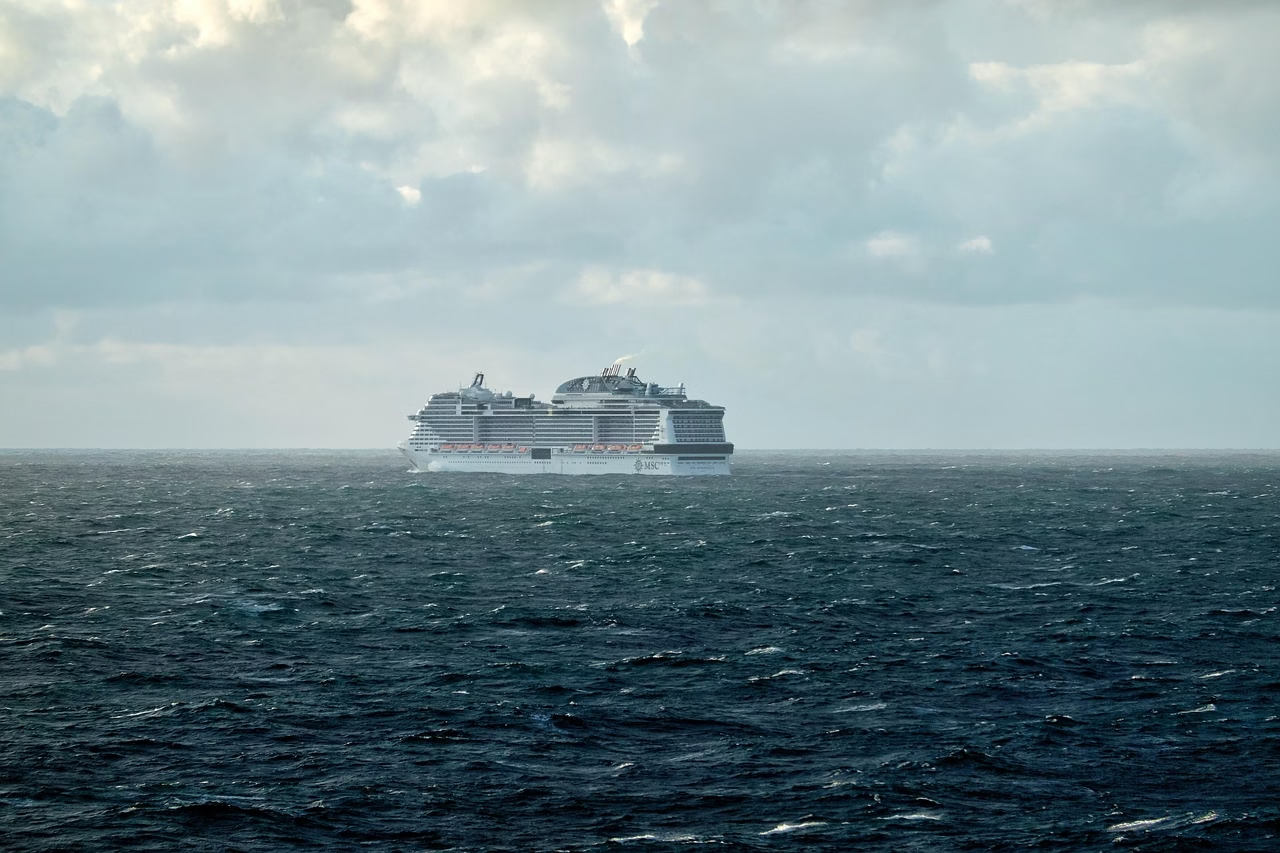
A crew member aboard the Regal Princess cruise ship has died after going overboard, vessel operator Princess Cruises confirmed in an official statement. The tragic incident triggered immediate emergency search and rescue protocols at sea, though the cruise line has withheld the individual’s identity and the ship’s precise coordinates out of respect for the family’s privacy.
Emergency response teams deployed rescue vessels and notified local maritime authorities immediately after the crew member went missing. Despite the rapid response of the ship’s crew and regional search units, the cruise line later confirmed the fatality, casting a somber shadow over the ongoing voyage.
Immediate Response and Search Protocols
When an individual goes overboard, cruise ships must execute highly standardized, time-critical maneuvers to maximize the chances of recovery. Upon receiving a man-overboard report, the bridge crew immediately plots the vessel’s exact coordinates, deploys lifebuoys with tracking beacons, and initiates a turn to bring the ship back along its original path.
Simultaneously, the vessel’s command team coordinates with regional maritime rescue centers, such as the Coast Guard, to deploy aerial and surface search units. In this instance, the crew of the 141,000-ton Regal Princess worked rapidly to locate their colleague, but the inherent challenges of open-ocean rescue often complicate recovery efforts.
The height of modern cruise ship balconies and public decks—often exceeding 100 feet above the waterline—means that falling overboard carries an exceptionally high risk of severe impact trauma or immediate drowning. Water temperature, sea state, and visibility also play critical roles in determining the window of survival for any individual in the water.
The Regulatory Framework of Overboard Incidents
Overboard events remain one of the most scrutinized aspects of cruise ship safety, governed by international maritime laws and national regulations. In the United States, the Cruise Vessel Security and Safety Act (CVSSA) of 2010 mandates that cruise ships operating in U.S. waters integrate technology to detect passengers or crew members who go overboard.
These physical barriers, including railings that must stand at least 42 inches above the deck, serve as the primary line of defense against accidental falls. Despite these heights, determined actions or extreme environmental conditions can still bypass physical restrictions, emphasizing the necessity of secondary electronic safety nets.
This technology typically includes thermal imaging cameras, motion sensors, and radar systems designed to alert the bridge instantly when an object breaks a designated perimeter. However, safety advocates point out that the implementation of these automatic detection systems across the global cruise fleet remains inconsistent, as some older vessels rely primarily on physical barriers and manual surveillance.
Industry Statistics and Expert Perspectives
Statistically, going overboard is an extremely rare occurrence given the millions of passengers and crew members who travel by cruise ship annually. According to data compiled by the Cruise Lines International Association (CLIA), the industry’s primary trade group, the vast majority of overboard incidents are determined to be the result of intentional acts or reckless behavior rather than accidental slips.
Maritime safety experts note that crew members face unique occupational stressors that differ significantly from those of passengers. Extended contracts, long working hours, isolation from family, and intense physical labor can take a heavy toll on the mental well-being of international shipboard staff.
International maritime labor standards, such as those outlined in the Maritime Labour Convention (MLC) 2006, establish basic rights for seafarers, including health protection and medical care. However, the enforcement of mental health provisions remains an ongoing battle for advocacy groups representing the estimated 250,000 cruise ship crew members worldwide.
Implications for the Cruise Industry and Crew Welfare
For Princess Cruises, a subsidiary of Carnival Corporation, this tragedy underscores the ongoing challenge of managing crew welfare across a massive global fleet. The company stated that it is providing support and counseling services to the ship’s crew as they process the loss of their colleague while continuing to operate the vessel.
The incident is likely to prompt internal reviews of safety barriers, deck patrol schedules, and the availability of mental health resources for shipboard employees. Industry analysts suggest that cruise lines may face increased pressure from labor unions and maritime safety advocates to standardize psychological support systems, making them as robust as physical safety protocols.
Furthermore, the financial and operational impact of an overboard search can be substantial, requiring ships to divert from planned itineraries, burn additional fuel, and delay subsequent voyages. However, cruise lines consistently emphasize that saving lives remains the absolute priority, regardless of the operational costs incurred during search and rescue maneuvers.
What to Watch Next
In the coming weeks, maritime authorities and the flag state of the Regal Princess are expected to launch a formal investigation to determine the precise circumstances surrounding the crew member’s fall. Investigators will review closed-circuit television (CCTV) footage, interview eyewitnesses, and examine shipboard logbooks to piece together the timeline of events.
Safety advocates will watch closely to see if this incident accelerates the adoption of advanced, AI-driven man-overboard detection systems across all major cruise brands. As technology matures, the integration of real-time computer vision and machine learning could soon make manual monitoring obsolete, potentially saving lives through instant, automated alerts.
























Leave a Reply