


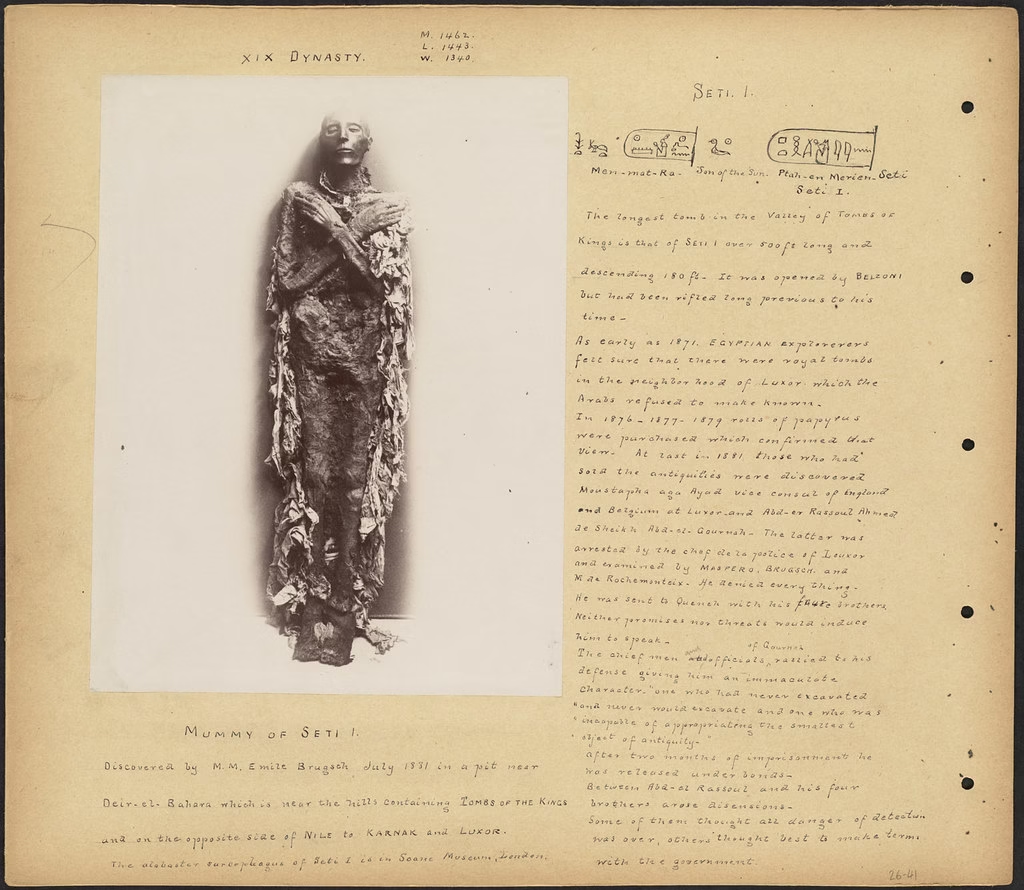
An Egyptian archaeological mission has discovered a 3,000-year-old tomb belonging to a prominent official named Paser near the historic city of Luxor, Egypt’s Ministry of Tourism and Antiquities announced this week. The rock-cut tomb, located in the celebrated Theban Necropolis on the West Bank of the Nile, offers fresh insights into the administrative and social elite of the New Kingdom period. Researchers successfully identified the tomb’s owner through detailed hieroglyphic inscriptions carved into the chamber walls, marking a significant milestone in Egypt’s ongoing efforts to map its ancient heritage.
Historical Context of the Theban Necropolis
Luxor, known in antiquity as Thebes, served as the religious and political heart of Egypt during its golden age. The West Bank of the Nile is world-renowned for housing the Valley of the Kings and the Valley of the Queens, where pharaohs and their consorts were laid to rest. However, the surrounding hillsides also contain hundreds of tombs belonging to nobles, priests, and high-ranking state officials who formed the backbone of the empire’s administration.
The New Kingdom, spanning from the 16th century BCE to the 11th century BCE, represented the peak of Egyptian imperial power and wealth. During this era, royal scribes and administrators held immense influence, managing the vast wealth flowing into the empire from foreign conquests and trade. The discovery of Paser’s tomb provides a rare, detailed look at the life, career, and afterlife expectations of these powerful non-royal figures.
Unlocking the Secrets of Paser’s Tomb
Archaeologists working at the site revealed that the tomb features a courtyard leading to a main T-shaped hall and an inner burial chamber. Despite the passage of three millennia and ancient tomb raiding, several key architectural elements and decorative features remain remarkably intact. Brightly colored wall paintings depict scenes of the deceased worshipping various deities, including Osiris, the god of the underworld, and Anubis, the patron of mummification.
The inscriptions identify Paser as a high-ranking royal scribe, a title that carried significant prestige and authority in ancient Egyptian society. Scribes were among the few literate individuals in the empire, responsible for tax collection, legal documentation, and recording royal decrees. Experts believe Paser likely managed state-run agricultural estates or oversaw temple treasuries in the fertile Theban region.
Excavators also recovered a variety of funerary objects from the tomb shafts. Among the artifacts are painted wooden ushabti figurines—designed to act as manual laborers for the deceased in the afterlife—as well as clay vessels, ornamental amulets, and fragments of a painted wooden sarcophagus. These items are currently undergoing cleaning and preservation by conservation specialists in Luxor.
Expert Analysis and Archaeological Significance
Dr. Mostafa Waziri, Secretary-General of the Supreme Council of Antiquities, emphasized the scientific value of the find. “Every tomb we uncover in Luxor adds a new page to our understanding of the daily administration of the New Kingdom,” Waziri stated. “The inscriptions in Paser’s tomb are particularly valuable as they detail his lineage and the specific duties he performed for the crown, allowing us to reconstruct the social networks of ancient Thebes.”
Independent Egyptologists note that the artistic style of the wall paintings suggests the tomb dates back to the Ramesside period, specifically the 19th Dynasty (c. 1292–1189 BCE). This era, which included the reign of Ramesses II, was characterized by bold artistic choices and an increased emphasis on personal piety in funerary art. The vibrant pigments used in Paser’s tomb, derived from natural minerals, have survived remarkably well due to the protective, dry desert climate.
Economic Impact and Future Research
The discovery comes at a crucial time for Egypt’s tourism sector, which serves as a vital pillar of the national economy. The Egyptian government has heavily promoted recent archaeological discoveries to revitalize international tourism, which has faced fluctuations in recent years. Officials hope that the addition of newly excavated tombs to the Luxor visitor circuit will attract history enthusiasts and bolster local economies.
Looking ahead, the archaeological team plans to conduct a comprehensive 3D digital scan of the tomb’s interior to preserve the inscriptions and paintings virtually. This data will be shared with international research institutions to facilitate collaborative studies on Ramesside administrative titles. Restoration work will continue over the coming months, with the ultimate goal of opening the tomb of Paser to the public once conservation efforts are complete.

























Leave a Reply