


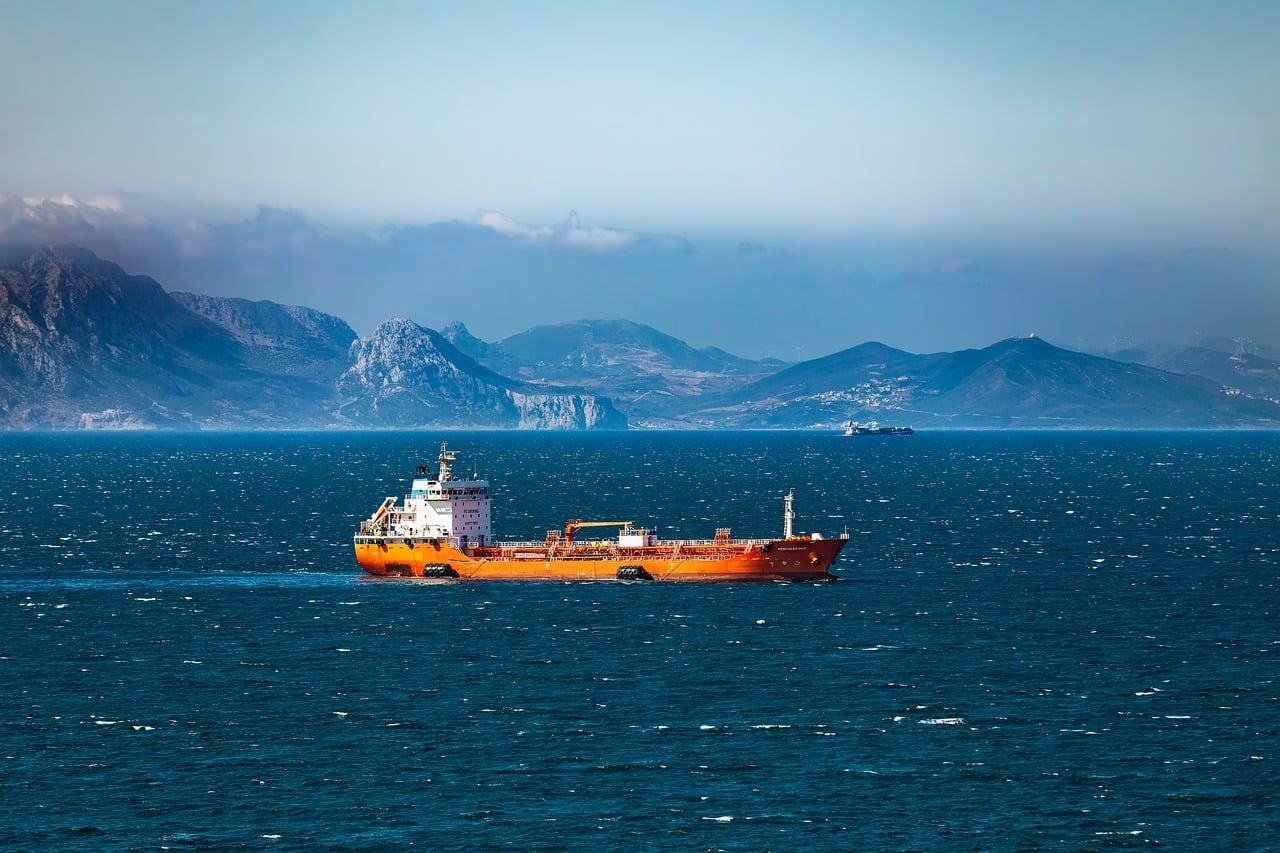
On Tuesday, U.S. President Donald Trump officially withdrew his highly controversial proposal to levy a 20 percent fee on all commercial cargo transiting the Strait of Hormuz. The decision, announced from the White House, follows intense pushback from international trade organizations, maritime industry leaders, and key foreign allies who warned the tariff would trigger severe disruptions in global supply chains. The administration had initially floated the fee as a mechanism to offset the high costs incurred by the U.S. military in securing international shipping lanes in the Middle East.
The Strategic Importance of the Strait of Hormuz
The Strait of Hormuz, a narrow waterway situated between Iran and Oman, is widely considered the world’s most critical maritime chokepoint. According to data from the U.S. Energy Information Administration (EIA), approximately 21 million barrels of oil per day—representing roughly 20 percent of global petroleum consumption—pass through the passage. Additionally, a significant portion of the world’s liquefied natural gas (LNG) transits the strait, making its stability vital to global energy security.
The geopolitical sensitivity of the Strait of Hormuz has historically made it a flashpoint for international tension. In recent years, regional conflicts have seen commercial tankers targeted by naval mines, drone strikes, and direct seizures. These security threats prompted the United States and its partners to establish Operation Sentinel, a multinational maritime effort designed to deter attacks and reassure commercial shipping. However, the financial burden of these operations has fallen disproportionately on the United States, a point of contention that the administration sought to address with the proposed fee.
Industry Pushback and Legal Hurdles
Global shipping associations reacted with immediate relief to the policy reversal. The International Chamber of Shipping (ICS), which represents more than 80 percent of the world’s merchant fleet, had previously warned that a 20 percent fee would paralyze maritime trade. Industry analysts argued that shipping companies would have been forced to reroute vessels around the Cape of Good Hope, adding weeks to transit times and inflating freight costs exponentially.
For decades, the United States Navy’s Fifth Fleet, based in Bahrain, has maintained a robust presence in the Persian Gulf to guarantee the free flow of commerce. However, maritime legal experts quickly pointed out that imposing a unilateral transit fee would violate international law, specifically the United Nations Convention on the Law of the Sea (UNCLOS), which guarantees the right of transit passage through international straits.
“A unilateral tariff on a global commons like the Strait of Hormuz was always an operational and legal impossibility,” said Marcus Vance, a senior maritime analyst at the London-based global trade consultancy Vanguard Marine. “Had the administration proceeded, it would have created a dangerous precedent, encouraging other nations to charge toll fees on critical international waterways like the Malacca Strait or the English Channel.”
Economic Fallout and Market Reactions
Energy markets also showed immediate sensitivity to the announcement. Crude oil futures, which had experienced heightened volatility when the fee was first proposed, stabilized on Tuesday afternoon. Brent crude settled down 1.4 percent, reflecting eased anxieties over potential supply bottlenecks. Economists had warned that a 20 percent fee on crude shipments would have translated directly to higher pump prices for consumers worldwide, particularly in import-dependent regions like Europe and Asia.
The proposed collection mechanism for the 20 percent fee had also raised numerous operational questions. Shipping registries and port authorities expressed confusion over how the U.S. government intended to enforce and collect fees from foreign-flagged vessels operating in international waters. Experts argued that enforcing such a measure would require a naval blockade or aggressive boarding actions, which could be interpreted as acts of aggression under international law.
“The logistics of enforcing a tariff in international waters without the consent of the flag states would have been a nightmare,” noted Sarah Jenkins, a professor of international maritime law at Georgetown University. “It would have required the U.S. Coast Guard or Navy to intercept non-compliant vessels, risking military escalation over commercial billing disputes.”
Furthermore, the domestic political implications of the proposed fee were becoming increasingly problematic for the administration. Domestic oil refiners in the United States, particularly those on the Gulf Coast that rely on heavy crude imports from the Middle East, lobbied heavily against the measure. They argued that the tariff would increase production costs, ultimately leading to higher gasoline prices for American consumers ahead of an election year.
What to Watch Next
Looking ahead, the focus shifts to how the United States will negotiate security contributions with its strategic partners. Analysts predict that Washington will intensify diplomatic pressure on major energy-importing nations, particularly China and Japan, to deploy their own naval assets to escort commercial vessels. This shift could lead to a more fragmented security landscape in the Persian Gulf, with multiple national navies operating independently to protect their respective commercial interests.
Additionally, the shipping industry is expected to accelerate its investments in risk-mitigation strategies. Marine insurance underwriters, who had spiked war-risk premiums in response to the tariff threat, are likely to recalibrate their rates. However, the episode has served as a stark reminder to global logistics planners of the inherent political risks associated with major maritime chokepoints, potentially driving further interest in overland pipeline projects and alternative trade routes that bypass the Middle East altogether.




















Leave a Reply