


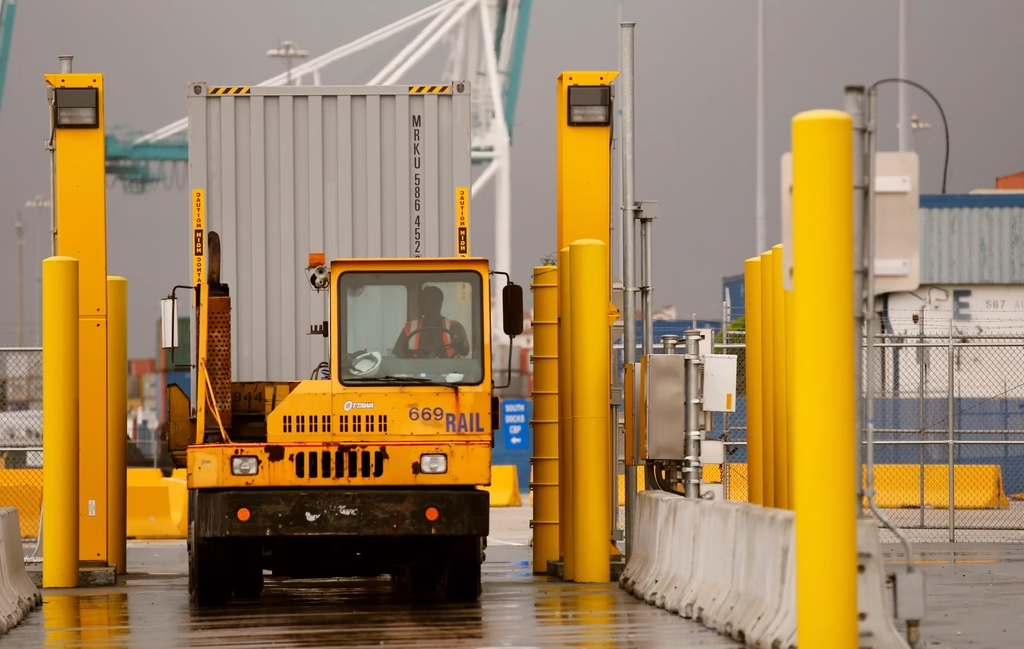
The Office of the U.S. Trade Representative (USTR) announced this week that the Trump administration is preparing to impose additional tariffs of 10% or more on a wide range of trading partners. This move follows an extensive government investigation into systemic forced labor practices within international supply chains, marking a significant escalation in U.S. trade enforcement policy.
The Scope of the Investigation
The proposed tariffs stem from a formal probe initiated to identify nations failing to meet international labor standards. Federal investigators examined manufacturing hubs across several continents, focusing on regions where allegations of state-sponsored forced labor have persisted for years.
By targeting dozens of major trading partners, the administration aims to leverage economic pressure to force compliance with human rights benchmarks. Officials state that these measures are intended to level the playing field for American workers who compete against companies utilizing exploited labor.
Economic Context and Global Trade
International trade policy has shifted dramatically over the past decade as the U.S. moves away from broad multilateral agreements toward more targeted, punitive enforcement actions. The use of Section 301 of the Trade Act of 1974 has become a primary tool for the current administration to address perceived unfair trade practices.
Historically, such tariff hikes have triggered immediate retaliatory measures from affected nations, complicating global logistics. Economists warn that broad-based tariffs often result in higher costs for domestic consumers as importers pass on the added expenses.
Industry Perspectives and Expert Analysis
Trade experts remain divided on the efficacy of these measures. While proponents argue that the tariffs provide a necessary moral and economic deterrent against human rights abuses, skeptics suggest that they may disrupt fragile supply chains still recovering from recent global instability.
“The complexity of modern manufacturing means that a tariff on a finished good often impacts dozens of sub-suppliers across multiple borders,” noted an analyst from the Peterson Institute for International Economics. “Targeted sanctions are effective, but broad tariffs risk creating unintended inflationary pressure on the U.S. domestic market.”
Long-term Implications and Supply Chain Shifts
For multinational corporations, the announcement signals an urgent need to audit global operations. Companies are increasingly looking to “near-shoring” or “friend-shoring” strategies to avoid the potential costs associated with these new trade barriers.
Industry leaders are now bracing for a period of heightened volatility as the USTR finalizes the list of impacted goods and countries. The administration is expected to open a public comment period, allowing stakeholders to express concerns regarding the potential economic fallout of the proposed duties.
As the administration moves toward implementation, market participants should watch for potential exemptions or sector-specific waivers. The success of this policy will likely be measured by whether it forces tangible changes in foreign labor practices or simply accelerates the decoupling of global supply chains.




















Leave a Reply