


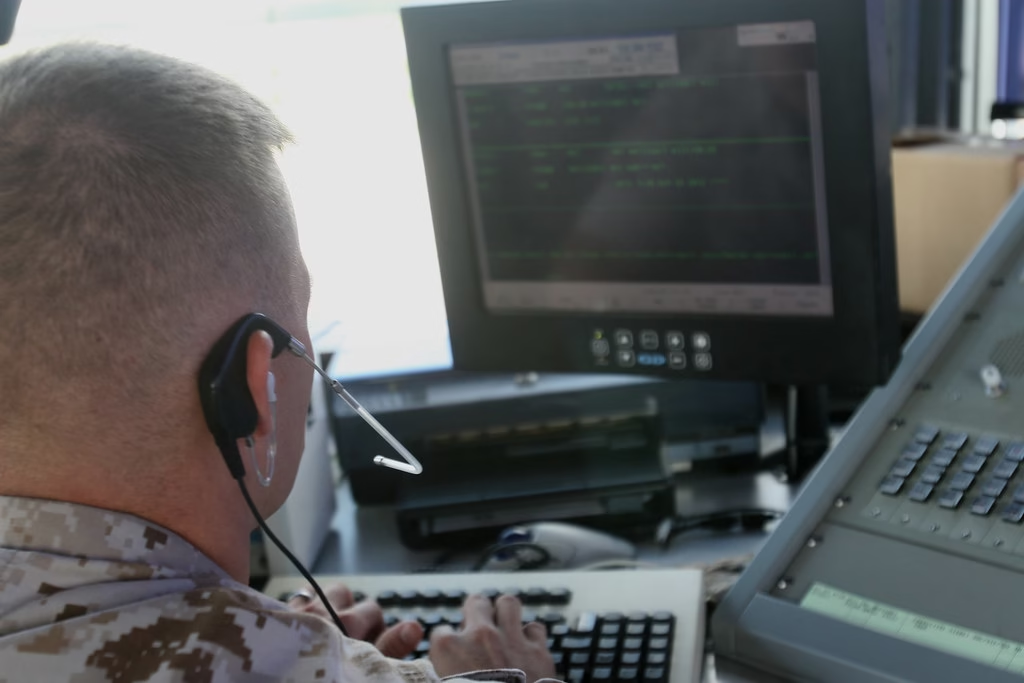
Former President Donald Trump issued a stern warning to Iran on Wednesday, declaring that the nation will “pay the price” for its role in recent regional tensions while asserting that Tehran has “taken too long” to negotiate a formal agreement. This statement follows a series of U.S. military strikes launched Tuesday evening against Iranian-linked targets, marking a sharp escalation in the ongoing geopolitical standoff between Washington and Tehran.
The Context of Rising Tensions
The latest military engagement arrives after months of fluctuating diplomatic efforts to revive or replace the 2015 nuclear deal, which the Trump administration withdrew from in 2018. Since that time, the policy of “maximum pressure” has defined the U.S. approach, characterized by heavy economic sanctions and periodic military posturing.
Regional experts note that the recent strikes are part of a broader cycle of retaliation between U.S. forces and militias backed by the Islamic Revolutionary Guard Corps. The conflict has centered on influence in Iraq and Syria, where both nations maintain significant strategic interests.
Military and Diplomatic Dimensions
Pentagon officials confirmed the Tuesday strikes were precision operations designed to degrade the capabilities of Iranian-aligned groups. The administration maintains that these actions are necessary to protect U.S. personnel stationed in the Middle East from continued threats.
Simultaneously, the diplomatic track remains largely gridlocked. Trump’s criticism regarding the time taken to reach a deal underscores a frustration with the current pace of international mediation. Analysts suggest that Tehran’s reluctance to return to the negotiating table on U.S. terms has fundamentally altered the calculus for regional stability.
Expert Analysis and Data Points
According to data from the Armed Conflict Location & Event Data Project (ACLED), incidents involving Iranian-backed militias in Iraq saw a 15% increase in the last quarter compared to the previous year. This rise in activity has placed significant pressure on the U.S. Department of Defense to demonstrate a credible deterrent.
Dr. Sarah Jenkins, a senior fellow at the Center for Strategic and International Studies, suggests that the rhetoric from the former president reflects a broader bipartisan consensus that traditional diplomacy has reached a point of diminishing returns. “The current strategy is shifting from containment toward active disruption,” Jenkins stated.
Industry and Global Implications
For global markets, the escalation poses a direct threat to oil supply chains, particularly through the Strait of Hormuz. Energy analysts at Goldman Sachs have warned that sustained military conflict in the region could drive crude prices up by as much as $10 per barrel in the short term, impacting global inflation rates.
Furthermore, the increased military presence is forcing regional allies to reassess their own security architectures. Nations like Saudi Arabia and the United Arab Emirates are closely monitoring the frequency of these strikes to determine how they might affect their own bilateral defense agreements with the United States.
Looking ahead, observers should watch for the reaction of the Iranian leadership in the coming 48 hours. The potential for a reciprocal escalation remains high, and international observers are waiting to see if either side will offer a de-escalation signal or if the cycle of retaliatory strikes will continue to intensify through the end of the month.


















Leave a Reply