


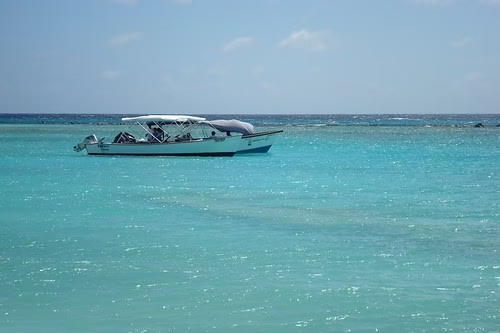
As the summer boating season approaches in the United States, recreational boaters are recalibrating their travel plans in response to persistent volatility in fuel prices. While attention is often focused on the impact of energy costs on motorists and airline passengers, the recreational marine sector faces unique economic challenges that are forcing boat owners to reconsider their itineraries, maintenance schedules, and overall time spent on the water.
The Economic Landscape of Recreational Boating
The marine industry relies heavily on marine-grade gasoline and diesel, which frequently carry a price premium over automotive fuels due to taxes, distribution logistics, and demand fluctuations at waterfront marinas. With summer fuel expenditures representing one of the largest variable costs for boat owners, even minor price surges significantly alter the feasibility of long-distance cruising or frequent day trips.
Data from the U.S. Energy Information Administration (EIA) indicates that energy markets remain sensitive to global geopolitical tensions and supply chain constraints, contributing to the current pricing environment. For the average powerboat owner, these macro-economic shifts directly translate into a higher cost-per-mile, prompting a shift in consumer behavior.
Shifting Trends in On-Water Behavior
Industry analysts report a noticeable transition toward more localized boating activities as owners look to mitigate fuel consumption. Rather than planning multi-day voyages to distant coastal destinations, many families are choosing to anchor at local sandbars or frequent nearby marinas, effectively reducing their engine run-time.
According to the National Marine Manufacturers Association (NMMA), while demand for boating remains high following the post-pandemic surge in interest, fuel efficiency has become a primary consideration for new boat buyers. Dealers report an uptick in inquiries regarding more efficient engine packages and hull designs that prioritize fuel economy over raw speed.
Expert Insights and Operational Adjustments
Marine industry experts suggest that boat owners are increasingly adopting “fuel-conscious” habits to maintain their summer routines. This includes performing routine engine maintenance, such as checking propeller pitch and ensuring proper hull cleanliness, which can drastically improve fuel efficiency.
“When fuel prices rise, we see a shift in how owners utilize their vessels,” says a spokesperson for a leading marine consultancy. “It is not necessarily a decrease in boating, but a change in the ‘how’ and ‘where.’ Owners are becoming more deliberate with their fuel consumption, often opting for trolling speeds or shorter excursions to extend their time on the water without breaking their seasonal budget.”
Long-term Industry Implications
The current fuel climate is acting as a catalyst for innovation within the marine propulsion sector. Manufacturers are accelerating research and development into hybrid-electric and fully electric propulsion systems, aiming to reduce dependence on fossil fuels for recreational vessels.
For the average consumer, the next few months will serve as a test of resilience for the recreational boating lifestyle. Industry watchers will continue to monitor whether the trend toward localized, fuel-efficient boating becomes a permanent fixture or a temporary reaction to current price spikes. As the season progresses, the focus will remain on how marinas manage demand and whether fuel price stabilization can encourage a return to longer-distance travel before the summer ends.
























Leave a Reply