


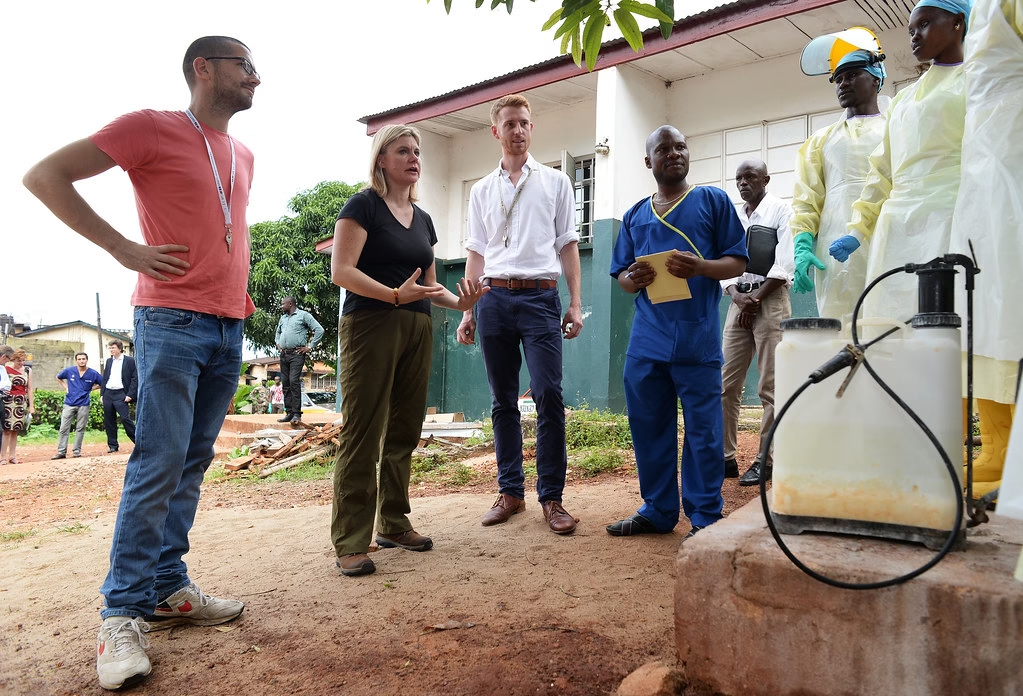
A rapidly escalating Ebola outbreak has claimed the lives of more than 40 individuals across the Democratic Republic of the Congo and Uganda, triggering an urgent mobilization of international health agencies. Government officials and humanitarian organizations are currently struggling to contain the transmission of the deadly viral hemorrhagic fever as it spreads across porous border regions.
Context and Historical Precedent
Ebola remains one of the world’s most lethal infectious diseases, characterized by high mortality rates and the potential for rapid transmission through direct contact with infected bodily fluids. The current emergence follows a series of sporadic outbreaks in the Great Lakes region, where dense populations and significant cross-border movement complicate traditional containment strategies.
Healthcare infrastructure in these regions faces immense pressure, often hampered by limited access to personal protective equipment and specialized isolation facilities. The World Health Organization (WHO) has historically classified these outbreaks as public health emergencies of international concern, citing the risk of regional destabilization.
The Scope of the Crisis
The current epidemiological data indicates that the outbreak is primarily concentrated in remote territories where community trust in medical interventions remains fragile. Health workers are navigating complex terrain and local resistance to contact tracing, which is essential for identifying potential chains of transmission.
International aid groups, including Médecins Sans Frontières (MSF), have reported critical shortages in medical supplies and trained personnel. These organizations are working alongside local health ministries to establish triage centers and community education programs intended to curb the spread of misinformation regarding the virus.
Expert Insights and Epidemiological Data
Public health experts emphasize that early detection and rapid isolation are the only proven methods to effectively break the cycle of infection. According to recent WHO reports, the incubation period for the virus can last up to 21 days, making asymptomatic spread a significant concern for health authorities.
Data from the field suggests that the mortality rate remains alarmingly high, consistent with previous strains of the virus observed in Central Africa. Epidemiologists warn that without a significant increase in surveillance and vaccination efforts in high-risk zones, the death toll could rise significantly over the coming weeks.
Implications for Regional Stability
The persistence of the outbreak poses a profound challenge to regional economic and social stability. Trade routes connecting the DR Congo and Uganda are vital for local commerce, and travel restrictions necessitated by the outbreak threaten to disrupt essential supply chains.
For the residents of the affected regions, the immediate future remains uncertain as healthcare systems attempt to scale their response. Observers are now looking toward the speed of international vaccine distribution and the efficacy of cross-border coordination efforts as the primary indicators of success in suppressing the virus. Monitoring the containment of these specific clusters will be critical to preventing a larger-scale epidemic that could cross international borders into more densely populated urban centers.

























Leave a Reply