


Ukrainian President Volodymyr Zelenskyy dismissed his military Commander-in-Chief, General Oleksandr Syrskyi, on Thursday in Kyiv, following weeks of public protests and a deepening strategic rift over the conduct of the war against Russia. The high-stakes decision marks the most significant shake-up in Ukraine’s military leadership since the dismissal of Syrskyi’s predecessor, Valeriy Zaluzhnyi, and comes at a critical juncture as frontlines face intense pressure.
Context of a Growing Military Rift
The relationship between President Zelenskyy and General Syrskyi had reportedly deteriorated over several months. Syrskyi, who assumed the top military post in February 2024, faced mounting scrutiny over high-casualty defensive operations and the controversial incursion into Russia’s Kursk region.
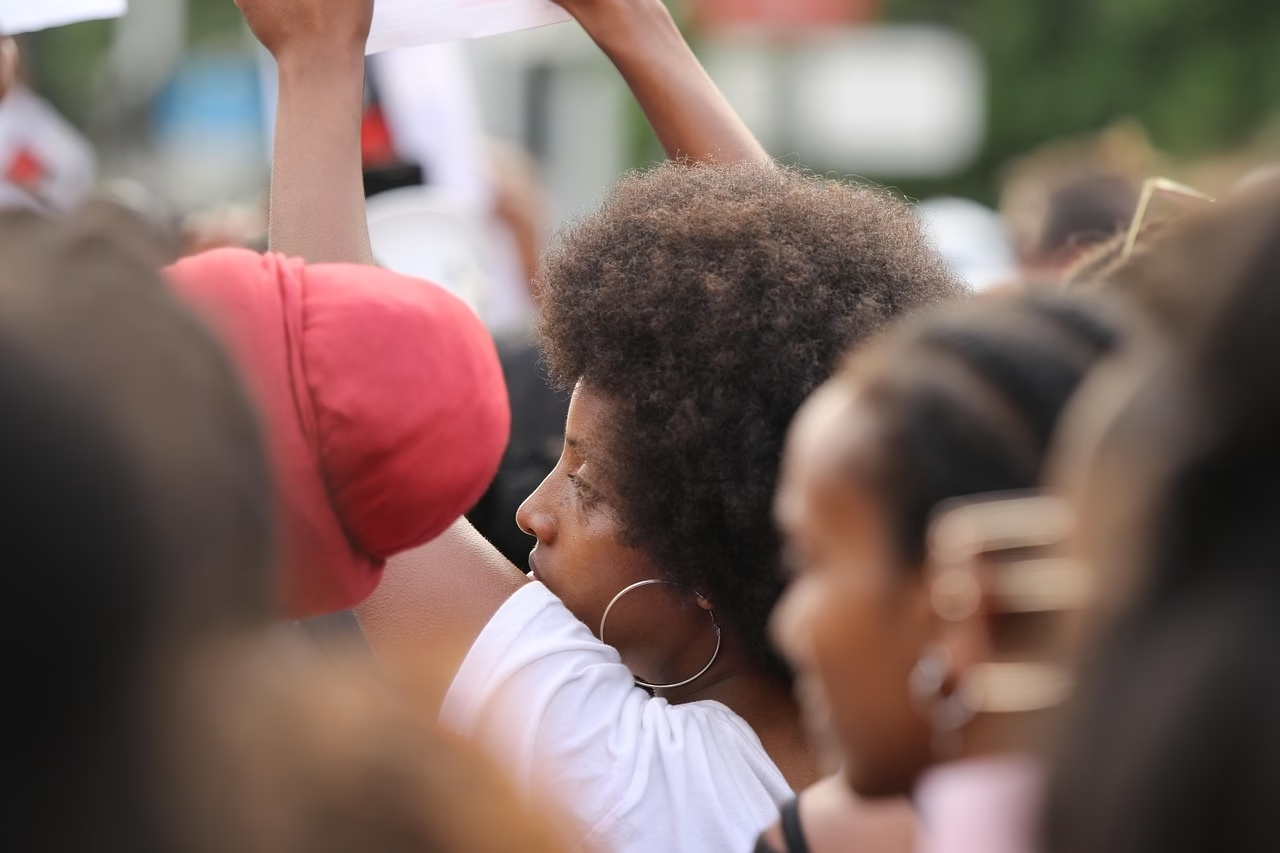
Public discontent peaked in recent weeks, culminating in street protests in Kyiv where citizens and families of service members demanded accountability for battlefield losses and exhaustion among frontline troops. Demonstrators gathered in Independence Square, holding signs criticizing the military command’s tactical decisions.
This leadership crisis unfolds as Ukraine grapples with severe ammunition shortages, delayed Western aid, and relentless Russian advances in the eastern Donbas region. The political risk of maintaining a commander who had lost public trust became too high for the Zelenskyy administration to ignore.
A High-Stakes Decision Amid Public Unrest
The dismissal caps a turbulent period characterized by rare public demonstrations in wartime Ukraine. Protesters called for Syrskyi’s resignation due to what they described as rigid, Soviet-style tactical decisions that resulted in unnecessary casualties among experienced brigades.
Military analysts suggest the rift between the presidential administration and the military command had become untenable. “A commander-in-chief must possess not only tactical competence but also the trust of both the political leadership and the public,” said military analyst Michael Kofman of the Carnegie Endowment for International Peace. Without this dual mandate, executing complex defensive strategies becomes nearly impossible.
The administration had also grown increasingly frustrated with the slow progress of mobilization efforts. While Zelenskyy sought a more politically sensitive approach to conscription, military planners under Syrskyi pushed for aggressive mobilization targets to reinforce depleted units along the 1,000-kilometer front line.
Strategic Divergence and the Kursk Offensive
Underlying the political tension was a fundamental disagreement over strategic priorities. Syrskyi championed the bold Kursk offensive, which initially boosted Ukrainian morale but ultimately drew criticism for diverting elite troops from the critical defense of Pokrovsk.
Data from open-source intelligence groups, including DeepState, indicated that while Ukrainian forces held territory inside Russia, the defense of key logistical hubs in eastern Ukraine rapidly deteriorated during the same period. The trade-off proved highly controversial among both frontline soldiers and strategic planners.
The Kursk operation was a high-risk gamble that did not yield the strategic relief in the Donbas that the leadership had hoped for, noted retired British Army officer Richard Barrons. This strategic misalignment eroded Zelenskyy’s confidence in Syrskyi’s long-term vision for the war, making a leadership change inevitable.
The Mobilization Dilemma and Tactical Overhaul
The incoming military leadership inherits a deeply complex mobilization dilemma. Ukraine’s parliament passed a controversial mobilization law earlier this year, but enforcement has been met with societal resistance and bureaucratic bottlenecks.
The new command must balance the urgent need for fresh troops with the economic necessity of keeping skilled workers in the domestic economy. Furthermore, training timelines must be accelerated without compromising the readiness of new recruits, a challenge that Syrskyi’s administration was heavily criticized for failing to resolve.
Tactically, the new leadership is expected to pivot back to a “strategic defense” posture. This approach emphasizes fortifying existing lines, maximizing drone warfare capabilities, and conserving manpower while waiting for more robust Western military assistance to arrive.
Implications for the Frontline and Western Allies
The removal of Syrskyi introduces profound uncertainty for Ukraine’s defense posture at a time when Russian forces are advancing at their fastest pace since 2022. The immediate challenge for the incoming command will be stabilizing the collapsing frontlines in Donetsk and managing the transition of leadership without disrupting active operations.
For international allies, particularly the United States and NATO members, this leadership change demands reassurance that Ukraine’s military strategy remains coherent and viable. Western defense officials will closely monitor whether the new leadership shifts focus back to active defense or attempts further counter-offensives.
Looking ahead, observers will watch how the Ukrainian public responds to the appointment of a successor. The new commander-in-chief must quickly bridge the gap between political objectives and military realities, while navigating the delicate task of troop mobilization and maintaining domestic morale in a prolonged war of attrition.

















Leave a Reply