


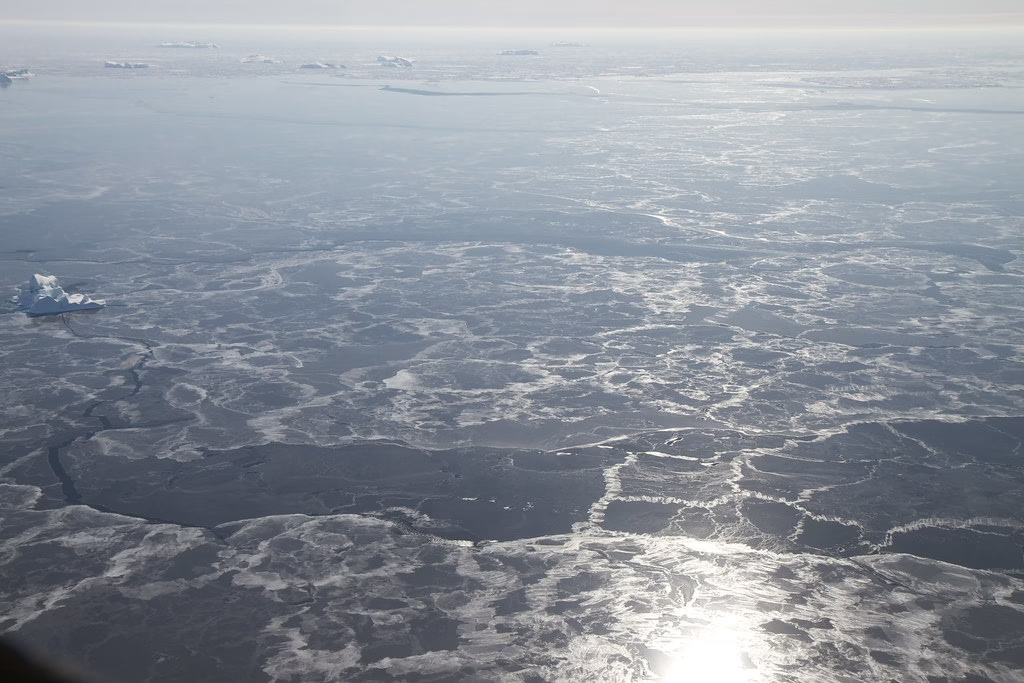
U.S. President Donald Trump reaffirmed his administration’s interest in securing control over Greenland on Wednesday, asserting that the autonomous Danish territory is vital for the protection of the world. The statement marks a renewed diplomatic focus on the Arctic, a region increasingly viewed as a critical theater for international security and resource competition.
The Strategic Context of the Arctic
Greenland, the world’s largest island, occupies a strategically significant position in the North Atlantic. It serves as a gateway between North America and Europe, housing the Thule Air Base, the U.S. military’s northernmost installation, which provides essential missile early-warning capabilities and space surveillance.
Denmark has maintained sovereignty over the island for centuries, though Greenland operates with significant home rule. The territory’s vast, largely untapped mineral reserves and its proximity to emerging trans-Arctic shipping routes have recently drawn the attention of global powers, including Russia and China.
Geopolitical Motivations and Tensions
Analysts suggest the push for greater influence in Greenland is driven by the desire to counter the growing footprint of rival nations in the High North. As climate change melts sea ice, the Arctic is becoming more accessible for commercial transit and resource extraction.
Critics of the administration’s approach point to the complexities of international law and the right to self-determination for the Greenlandic people. Danish officials have historically emphasized that Greenland is not for sale, viewing the island as a sovereign part of the Kingdom of Denmark rather than a commodity for geopolitical acquisition.
Expert Perspectives on Arctic Security
Security experts note that the U.S. military presence in Greenland is already robust. According to the Center for Strategic and International Studies, the Arctic remains a priority for the Pentagon, which has increased funding for ice-breaking capabilities and northern infrastructure in recent years.
However, diplomatic experts warn that aggressive rhetoric regarding territorial control could strain relations with Nordic allies. The North Atlantic Treaty Organization (NATO) relies on close cooperation among member states to maintain security in the region, making unilateral moves by Washington a point of contention within the alliance.
Implications for Future Relations
The hardening stance on Greenland underscores a broader shift in U.S. foreign policy toward prioritizing resource security and regional dominance. For the industry, this signals a potential increase in investment opportunities related to rare earth metals, which are abundant in Greenland’s interior.
Looking ahead, observers should monitor whether these assertions lead to formal diplomatic negotiations or remain a rhetorical strategy. Future developments will likely hinge on the upcoming parliamentary discussions in Copenhagen and the evolving energy policies of the Greenlandic government, both of which will determine the level of foreign participation in the island’s economic development.





















Leave a Reply