


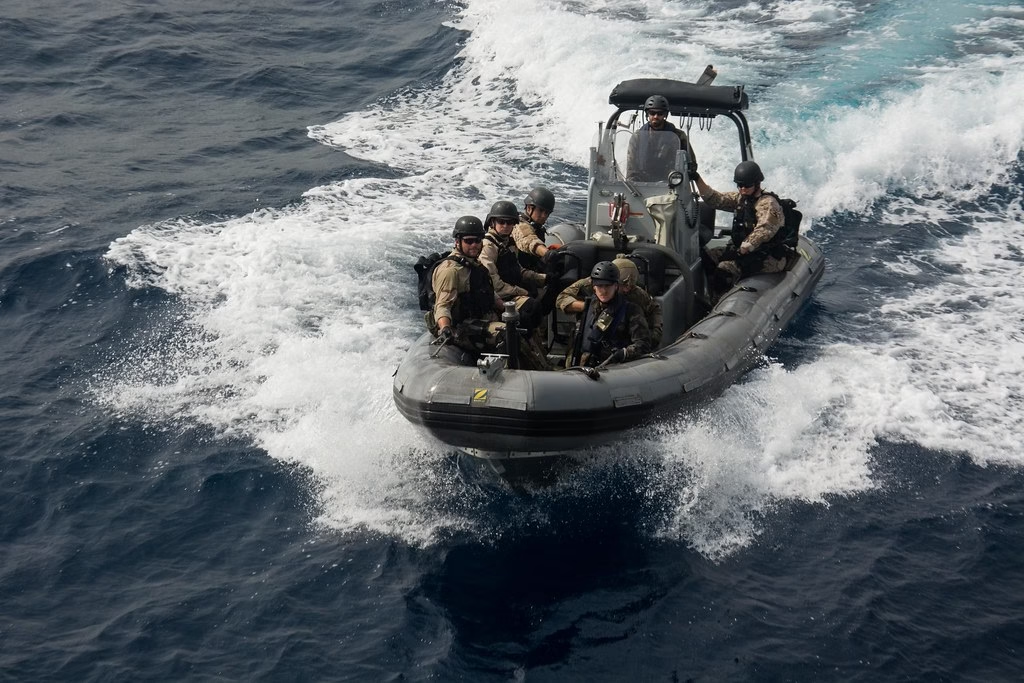
Military Operations Amid Heightened Tensions
The United States military conducted a series of targeted airstrikes in southern Iran early this week, focusing primarily on key missile storage facilities and launch infrastructure. Pentagon officials confirmed the operation, citing an immediate need to neutralize imminent threats to U.S. personnel and regional allies, though specific details regarding the origin of those threats remain classified.
This escalation marks a significant shift in the U.S. posture toward Iranian military assets. While the administration has long utilized sanctions and diplomatic pressure, the direct engagement with infrastructure inside Iranian territory represents a tactical departure from previous containment strategies.
The Context of Regional Instability
Tensions between Washington and Tehran have simmered for decades, but the current volatility is rooted in a complex web of proxy conflicts and stalled nuclear negotiations. Over the past year, U.S. intelligence agencies have reported an uptick in Iranian-backed militia activity across the Middle East, including drone attacks on commercial vessels and rocket fire directed at regional bases.
The current strikes follow a series of failed back-channel communications aimed at curbing missile proliferation. International observers have tracked a steady modernization of Iran’s ballistic missile program, which analysts at the International Institute for Strategic Studies (IISS) describe as the largest and most diverse in the region.
Analysis of Strategic Objectives
Military analysts suggest the strike was designed to achieve a limited, specific deterrent effect rather than a broader regional conflict. By targeting missile sites directly, the U.S. aims to degrade Iran’s immediate offensive capabilities while signaling the threshold of acceptable provocations.
“This is a calibrated message of deterrence,” said Dr. Elena Vance, a senior fellow specializing in Middle Eastern security. “The choice of targets indicates that Washington is prioritizing the destruction of high-value, long-range systems that pose a direct threat to the power projection of the U.S. Navy in the Persian Gulf.”
However, the operation carries inherent risks of retaliation. Iranian state media has condemned the act as a violation of sovereignty, vowing a decisive response that could further destabilize the Strait of Hormuz, a critical chokepoint for global oil shipments. Global energy markets reacted with immediate volatility, as traders weighed the potential for prolonged supply chain disruptions.
Implications for Global Diplomacy
The strikes leave the future of ongoing negotiations in total uncertainty. Diplomatic channels, which had been fragile at best, face the prospect of a complete freeze as both nations recalibrate their domestic and international policies.
For the average reader, the primary concern remains the potential for localized conflict to evolve into a broader regional war. The administration faces mounting pressure to provide transparency regarding the specific intelligence that necessitated such a direct military intervention. Without clear evidence of an imminent, existential threat, political analysts anticipate significant pushback from both domestic critics and international partners who fear an uncontrolled escalation.
Looking ahead, the international community will watch for signs of a coordinated Iranian response. Observers are monitoring potential cyber-attacks, increased maritime harassment, or further proxy mobilization in neighboring countries. The coming weeks will determine whether this strike successfully reset the rules of engagement or if it has inadvertently ignited a new, more dangerous phase of the long-standing standoff.
























Leave a Reply