


A Testament to Patience and Precision
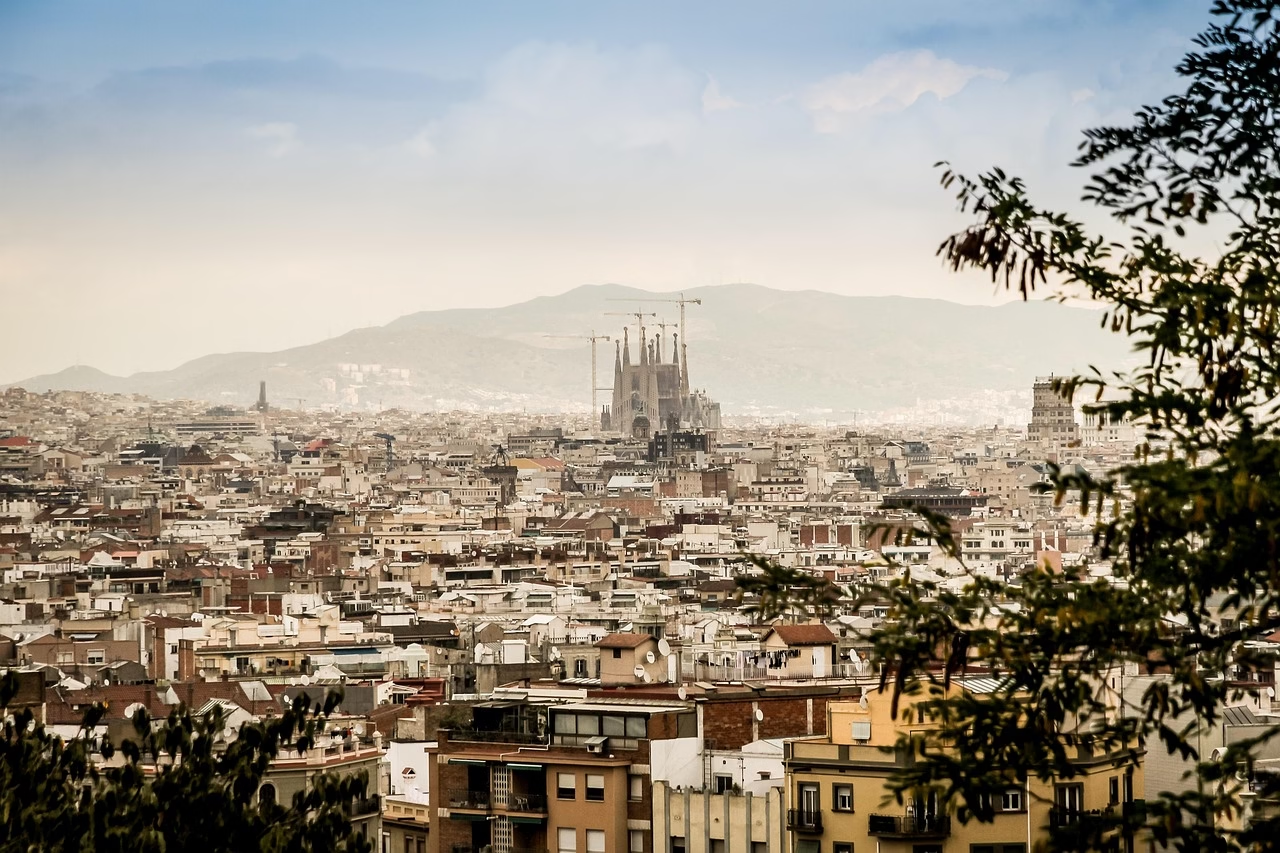
In Barcelona, Spain, a team of dedicated ceramicists led by Toni and Guillem has officially concluded a 14-year endeavor to complete the crowning feature of the Sagrada Familia: a massive, 24-ton reflective cross. The installation marks a significant milestone in the century-long construction of Antoni Gaudí’s masterpiece, bringing the basilica closer to its long-awaited completion.
The Legacy of Gaudí’s Vision
The Sagrada Familia, a UNESCO World Heritage site, has been under construction since 1882. Gaudí, the architect who took over the project in 1883, envisioned a structure that blended Gothic and Art Nouveau styles to create a spiritual forest of stone and light. For over a century, the project has relied on private donations and a steady stream of skilled artisans to interpret the architect’s original, often abstract, designs.
Engineering the Celestial Glow
The cross is not merely a structural element but a feat of modern engineering and traditional ceramic craftsmanship. Weighing 24 tons, the structure was designed to reflect light across the Barcelona skyline, serving as a beacon that changes appearance depending on the time of day and the angle of the sun. The ceramicists spent over a decade perfecting the reflective coating and the structural integrity required to withstand the high-altitude winds at the basilica’s peak.
Expertise Meets Tradition
According to interviews conducted by NBC News, the process required a unique synthesis of historical techniques and contemporary technology. The team utilized computer-aided modeling to ensure the dimensions aligned with Gaudí’s complex geometric plans, while the application of the ceramic finish was performed by hand to ensure a legacy-grade quality. This combination of digital precision and artisanal labor highlights the evolving nature of the Sagrada Familia construction site, which has become a hub for architectural innovation.
Impact on the Architectural World
The completion of the cross signals a turning point for the basilica, which is currently aiming for completion by the 100th anniversary of Gaudí’s death in 2026. For the construction industry, this project serves as a case study in long-term preservation and the successful integration of modern materials into historic architectural frameworks. It demonstrates that large-scale, multi-generational projects can maintain consistency in quality even as the tools used to build them shift from analog to digital.
Looking Ahead
As the scaffolding begins to come down, attention now shifts to the remaining towers and the intricate façade work required to finalize the exterior. Observers and architectural historians will be watching closely to see if the final phases of construction can maintain the high standards set by the artisans who spent over a decade on the cross. The coming years will determine if the basilica can meet its ambitious 2026 deadline without compromising the artistic integrity that has defined the site for nearly 150 years.





















Leave a Reply