


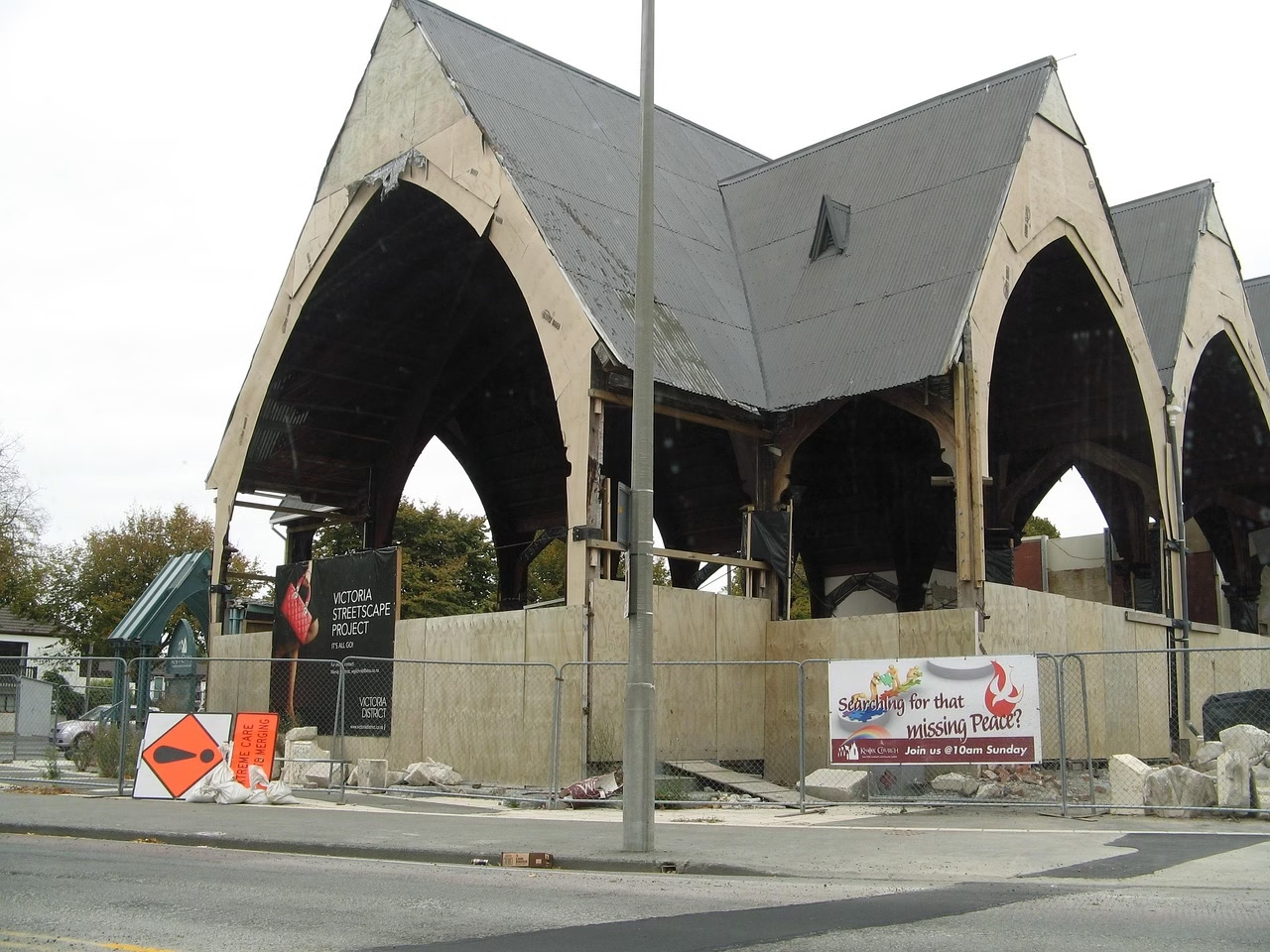
On May 22, 2011, an unprecedented EF5 tornado devastated Joplin, Missouri, destroying nearly one-third of the city and claiming 161 lives, triggering a decade-long recovery effort that offers critical lessons in community resilience for climate-vulnerable towns today.
The Impact of the 2011 Supercell
The tornado struck Joplin in the late afternoon on a Sunday, carving a six-mile-wide path of destruction through the heart of the city. With winds exceeding 200 miles per hour, the storm flattened nearly 7,000 homes, damaged critical medical facilities including St. John’s Regional Medical Center, and compromised essential municipal services.
Economic damage totaled an estimated $2.8 billion, making it the costliest single tornado in United States history. Beyond the financial impact, the loss of landmarks, neighborhood schools, and historic structures threatened the fundamental social identity of the community.
In the immediate aftermath, state and federal emergency response agencies arrived to manage search-and-rescue operations and establish temporary infrastructure. However, city leaders quickly realized that long-term stabilization would require a sustained, locally driven recovery strategy.
Mobilizing Social Capital and Volunteer Networks
Rather than relying solely on federal assistance, Joplin’s recovery accelerated through an unprecedented mobilization of civic organizations, faith-based groups, and national volunteers. Within months of the disaster, more than 180,000 registered volunteers traveled to the city, contributing over one million hours of labor.
Local authorities established a unified recovery framework, the Citizens Advisory Recovery Team, to ensure residents had a direct voice in urban planning decisions. This public engagement structure allowed citizens to prioritize projects such as rebuilding public schools, expanding park networks, and redesigning commercial corridors.
By empowering neighborhood associations and grassroots organizations, the municipality maintained social cohesion even as thousands of residents were displaced into temporary housing. This high level of social capital prevented the population flight that frequently plagues cities following catastrophic natural disasters.
Measurable Outcomes and Economic Recovery
Economic indicators demonstrate that Joplin’s public-private recovery model yielded results faster than regional projections anticipated. According to data from disaster management agencies, nearly 90 percent of destroyed retail businesses reopened within three years of the event.
School district officials successfully reopened classes for all affected students by August 2011 using temporary modular facilities, ensuring that families remained anchored in the community. Over the subsequent decade, voters approved municipal bond issues to construct state-of-the-art schools equipped with reinforced safe rooms.
Property tax revenues and sales tax receipts rebounded to pre-storm levels by 2015, supported by targeted municipal incentives that encouraged homeowners and commercial developers to rebuild using updated building codes.
Expert Perspectives on Modern Disaster Mitigation
Disaster mitigation experts frequently cite Joplin as a baseline study for how social infrastructure functions alongside physical infrastructure during long-term disaster management. Urban policy researchers note that civic trust and social cohesion are as critical to emergency response as structural engineering.
Public policy analysts observe that physical reconstruction is only half the challenge in post-disaster scenarios, pointing out that communities with strong pre-existing civic networks experience faster economic recovery and higher population retention rates.
Engineers also point to the city’s updated building codes, implemented post-2011, which required enhanced roof tie-downs and storm-resistant construction techniques. These standards have since been adopted by several other Midwestern municipalities facing similar severe weather risks.
Implications for Future Urban Resilience
As climate models predict an increase in the frequency and intensity of severe weather events across the continent, the lessons learned from Joplin’s recovery are shaping policy frameworks for municipal emergency planners nationwide.
Federal disaster policy increasingly mirrors Joplin’s grassroots approach, prioritizing local community input and pre-disaster planning over top-down administrative mandates. Urban planners are studying the city’s integrated land-use strategies, which combine green spaces as natural buffers with resilient public construction.
Observers should watch how emerging climate adaptation grants incentivize towns to build social infrastructure alongside structural defenses. The long-term trajectory of Joplin highlights that while extreme weather can erase physical structures, embedded civic bonds remain the primary foundation for urban survival and renewal.




















Leave a Reply