


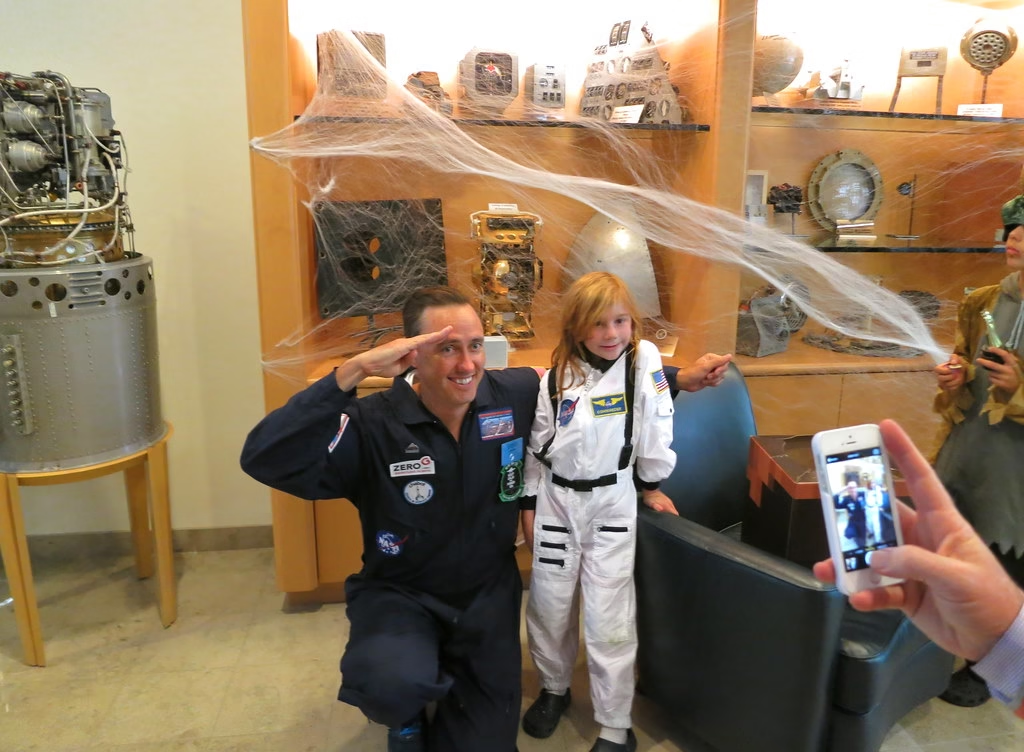
Canadian Space Agency (CSA) astronaut Jeremy Hansen, the first non-American selected for a lunar mission, is stepping down from his full-time active flight status at NASA. The announcement, confirmed this week, marks a significant transition for the veteran pilot who served as a mission specialist on the Artemis II flight crew, the first crewed mission to orbit the Moon since 1972.
Context of the Artemis II Mission
Hansen was selected in April 2023 to join NASA astronauts Reid Wiseman, Victor Glover, and Christina Koch for the Artemis II mission. His selection underscored the deepening partnership between the United States and Canada, formalized through the Gateway Treaty, which granted Canada a seat on the lunar flyby in exchange for providing the Canadarm3 robotic system.
The Artemis program represents NASA’s renewed commitment to lunar exploration, aiming to establish a long-term presence on the Moon. Hansen’s role was pivotal in representing international cooperation, serving as a bridge between the Canadian Space Agency and NASA’s operational flight teams.
A Transition in Career Path
While Hansen remains an astronaut with the CSA, his transition from full-time active flight status reflects the conclusion of the intensive training cycle for the Artemis II mission. NASA officials noted that such transitions are standard for astronauts who have completed their primary flight assignments and are looking toward long-term institutional goals.
Hansen’s career prior to his selection was marked by extensive leadership roles within the astronaut office, including training and evaluation of new candidates. His expertise in mission management has made him a key figure in the integration of international partners into the Artemis architecture.
Expert Perspectives on International Collaboration
Aerospace analysts point out that Hansen’s tenure has solidified Canada’s position as a primary partner in deep-space exploration. According to industry data, the collaboration on Canadarm3 is expected to generate significant economic benefits for the Canadian aerospace sector over the next two decades.
Dr. Sarah Jenkins, an aerospace policy researcher, suggests that Hansen’s influence extends beyond his flight assignment. “Hansen demonstrated that international partners are not just passengers, but essential contributors to the success of complex orbital missions,” Jenkins stated.
Implications for Future Missions
For the space industry, this move raises questions about the long-term staffing of upcoming lunar missions. As NASA pivots toward the Artemis III landing mission, the agency must balance the need for experienced veterans with the requirement to train a new generation of lunar explorers.
Industry observers should watch for how the Canadian Space Agency utilizes Hansen’s experience in his new capacity. His focus is expected to shift toward mission operations and the development of the lunar Gateway, ensuring that Canada’s technological contributions remain on schedule for the upcoming launch windows.
The shift in personnel also highlights the evolving nature of the astronaut corps, where experience is increasingly shared across borders. Future mission announcements will likely mirror the collaborative spirit established by the Artemis II crew, setting a precedent for how global space agencies share the burden of deep-space exploration.
























Leave a Reply