


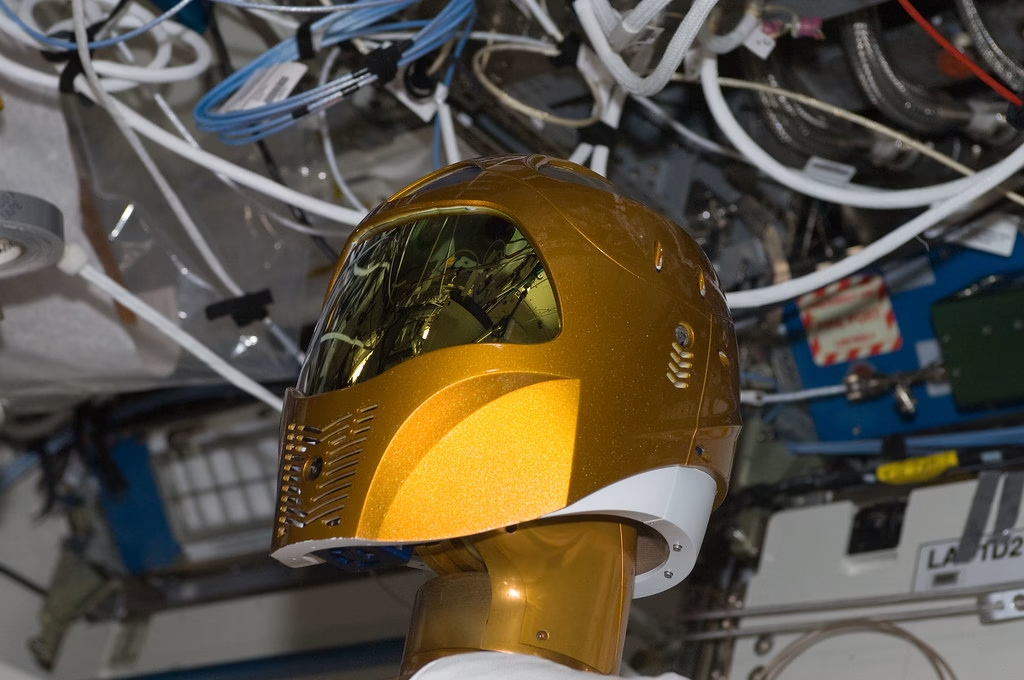
A consortium of industry titans, including Nvidia and Amazon, has injected up to $1.4 billion into the burgeoning humanoid robotics sector this week, signaling a massive shift in capital toward physical artificial intelligence. The funding round, which includes participation from venture arms of major technology firms, aims to accelerate the development and deployment of general-purpose robots capable of performing complex tasks in human-centric environments.
The Rise of Physical AI
The investment marks a significant pivot from software-based AI models to embodied systems that interact with the physical world. While generative AI has dominated headlines for the past two years, industry analysts suggest that the next frontier is physical automation, where robots move beyond stationary assembly lines to navigate dynamic workplaces.
The convergence of advanced neural networks and mechanical engineering has reached a tipping point. Improved sensor fusion, high-torque actuators, and transformer models allow these machines to learn tasks through observation rather than rigid programming.
Strategic Motivations for Tech Giants
For investors like Amazon, the interest is rooted in logistical efficiency and the need to augment labor in massive fulfillment centers. By backing humanoid platforms, these companies are looking to solve long-term scalability issues in supply chains where high-dexterity tasks remain difficult to automate.
Nvidia, conversely, provides the essential hardware and simulation infrastructure required to train these robots. Through its Omniverse platform, the company enables developers to create virtual digital twins, allowing robots to log millions of hours of training in simulated environments before entering the real world.
Economic and Industry Implications
Industry data from the International Federation of Robotics indicates that the demand for service robots is climbing, with a projected compound annual growth rate of over 20% through 2030. The influx of $1.4 billion serves as a validation for startups that have struggled to balance the high costs of hardware development with the slow pace of commercialization.
However, the rapid entry of humanoid robots into the workforce raises complex questions regarding labor displacement and safety standards. Independent researchers emphasize that while these machines promise productivity gains, integrating them into human-occupied spaces requires rigorous testing and new regulatory frameworks to ensure operational safety.
Future Outlook and Market Trajectory
The coming eighteen months will serve as a litmus test for these companies as they transition from laboratory prototypes to pilot programs in controlled industrial settings. Observers should watch for announcements regarding standardized safety protocols and the establishment of specific industrial benchmarks, which will be critical for widespread adoption.
As these robots begin to move from R&D facilities to warehouse floors, the focus will shift toward battery efficiency and the cost-to-performance ratio of the units. If these startups can demonstrate a clear return on investment through increased uptime and reduced error rates, the humanoid robotics industry could fundamentally reshape the global labor market within the decade.






















Leave a Reply