


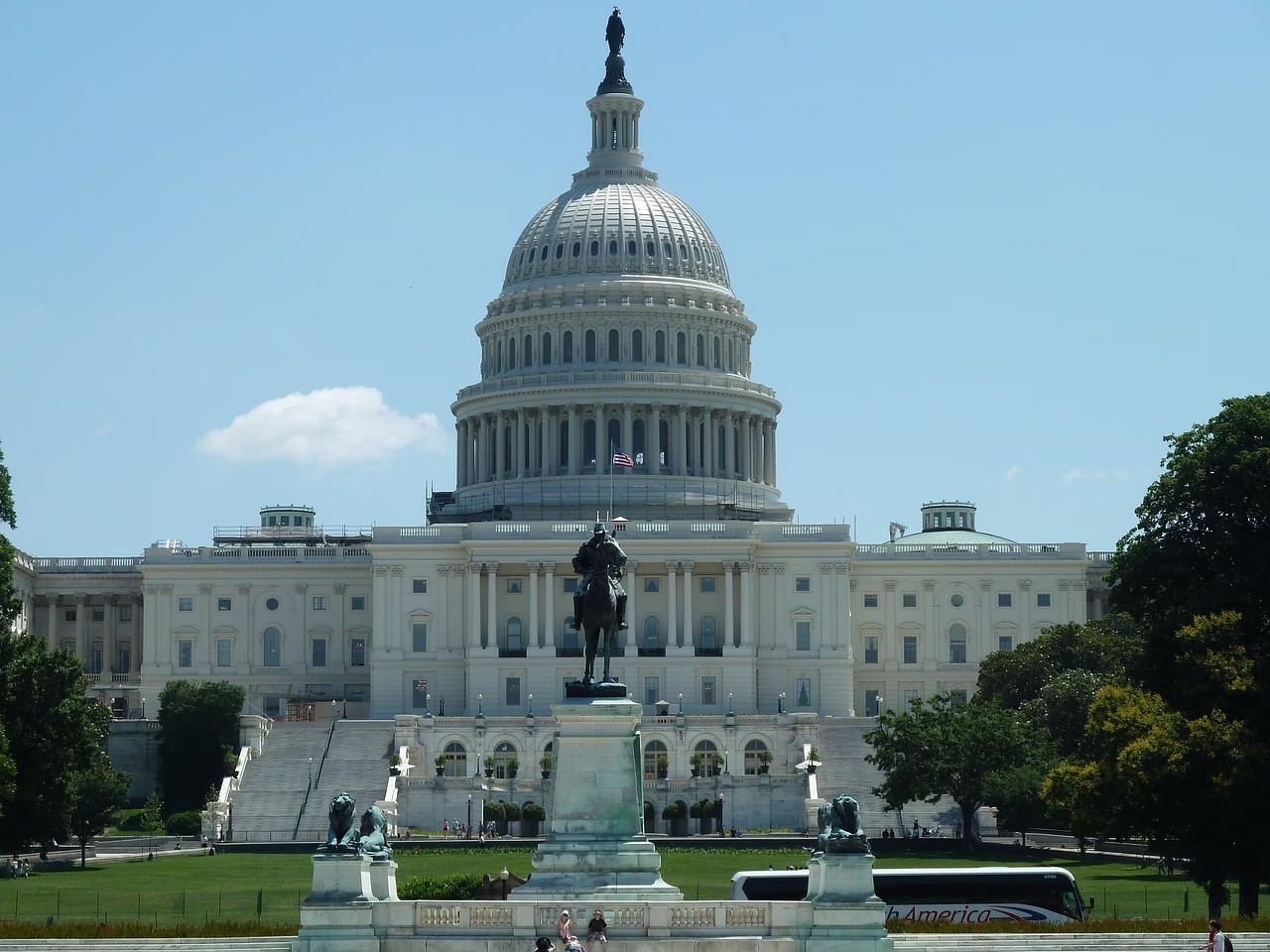
Rep. Jamie Raskin (D-Md.) and Sen. Sheldon Whitehouse (D-R.I.) introduced bicameral legislation on Capitol Hill this week aimed at preventing foreign-influenced domestic corporations from pouring money into American political campaigns. The Get Foreign Money Out of U.S. Elections Act seeks to establish explicit foreign ownership thresholds for corporations engaging in political spending, closing a legal loophole stemming from the Supreme Court’s landmark 2010 Citizens United decision.
The Shadow of Citizens United
Under federal law, foreign nationals, foreign governments, and foreign entities are explicitly banned from donating directly to U.S. political candidates or spending in American elections. However, the Supreme Court’s 2010 ruling in Citizens United v. Federal Election Commission fundamentally altered this landscape by declaring that corporations possess First Amendment political speech rights, allowing them to spend unlimited funds to influence elections.
Because the ruling made no distinction between purely domestic corporations and domestic corporations owned or controlled by foreign shareholders, foreign money has been able to flow into the American political ecosystem through corporate intermediaries. Today, foreign investors hold unprecedented stakes in American enterprise, creating a conduit for overseas influence in U.S. policy decisions.
Data from the Tax Policy Center highlights the scale of this shift: foreign ownership of U.S. corporate equity surged from approximately 5 percent in 1986 to over 40 percent by 2020. This massive infusion of international capital means that many prominent domestic corporations are now heavily owned by entities abroad, despite operating within the United States.
Setting Clear Ownership Thresholds
The proposed legislation establishes concrete legal definitions for what constitutes a foreign-influenced corporation. Under the bill, a business entity would be prohibited from making political expenditures if a single foreign owner controls 1 percent or more of its voting shares, or if multiple foreign owners collectively hold 5 percent or more of voting equity.
Additionally, the bill targets foreign national involvement in corporate decision-making regarding political activities. If a foreign national participates directly or indirectly in a corporation’s election-related decision-making process, that firm would be immediately disqualified from spending in U.S. political races.
Lawmakers behind the effort argue these metrics align with standard financial thresholds used in corporate governance. In public markets, acquiring a 1 percent stake in a major publicly traded corporation often grants a shareholder significant access to board members and executive management, providing ample leverage to shape corporate priorities.
National Security Concerns vs. Free Speech Debates
Advocates for campaign finance reform argue that foreign-influenced corporate spending poses an urgent threat to national security and democratic integrity. Nonpartisan watchdog organizations, such as the Brennan Center for Justice, have repeatedly emphasized that foreign state-backed funds and multinational entities can use corporate vehicles to discreetly shape local, state, and federal elections.
Supporters of the legislation note that state-level measures have already successfully implemented similar safeguards. States including Minnesota, Maine, and Washington have passed laws restricting campaign contributions from foreign-influenced corporations, providing a operational framework for federal enforcement.
Conversely, opponents of corporate spending restrictions contend that lower ownership thresholds could inadvertently disenfranchise legitimate American businesses. Business advocacy groups historically maintain that global investment is standard practice in modern commerce, arguing that broad restrictions risk penalizing domestic companies simply because their stock is publicly traded on international exchanges.
Industry Impact and Electoral Trends to Watch
If enacted, the bill would force major corporations and political action committees (PACs) to conduct rigorous internal compliance audits to verify their shareholder structures before funding political advertising or donating to independent expenditure committees. Super PACs, which rely heavily on massive corporate contributions, would face stringent compliance requirements to ensure accepting funds does not violate federal foreign influence laws.
The bill’s trajectory now depends on congressional appetite amid a divided legislative environment where campaign finance reform remains deeply polarized. Political analysts expect the measure to serve as a key benchmark for upcoming legislative debates surrounding foreign election interference and transparency.
Observers are monitoring whether more states will adopt localized foreign-influence restrictions ahead of the next national election cycle, as well as whether federal courts will eventually be called upon to decide if foreign ownership caps conflict with corporate First Amendment protections.























Leave a Reply