


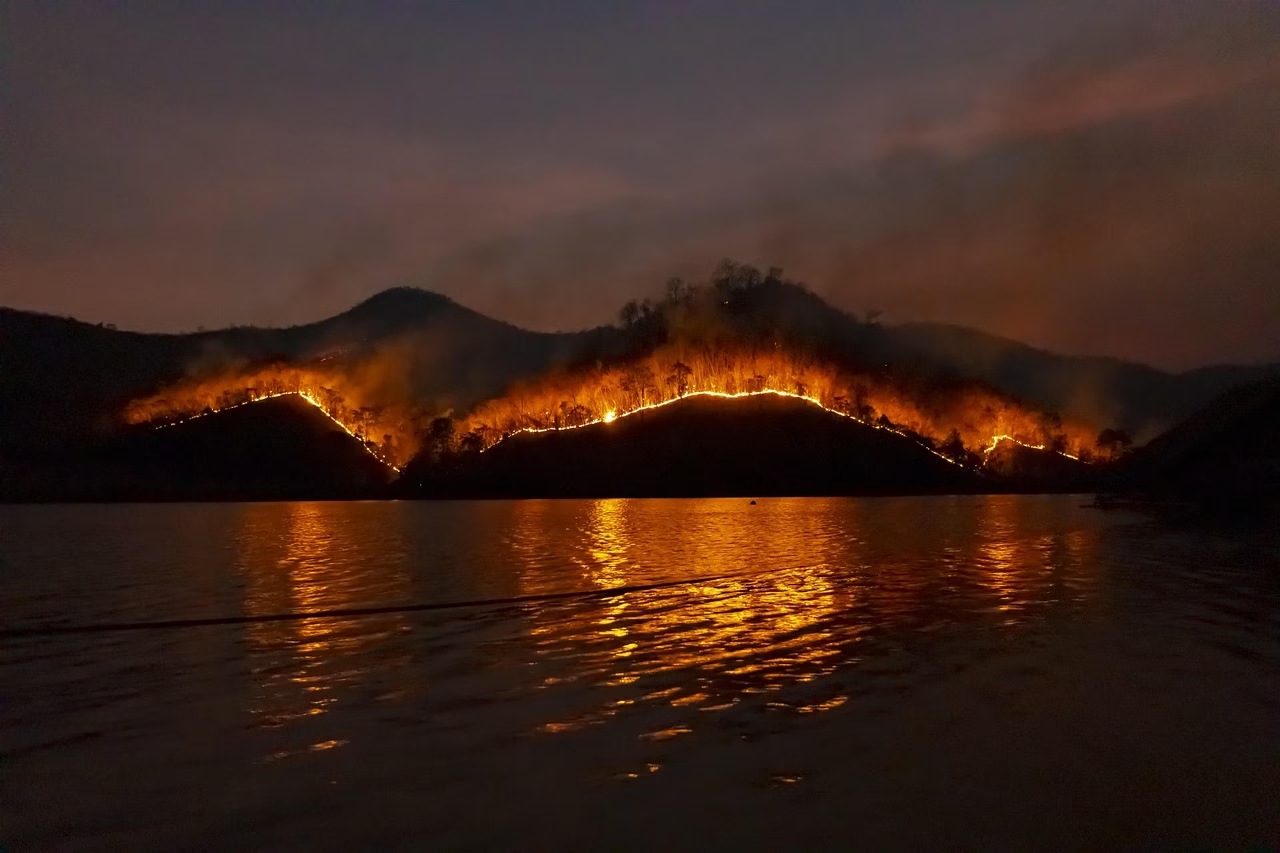
WASHINGTON — President Donald Trump threatened on Tuesday to impose sweeping new tariffs on Canadian imports in response to heavy wildfire smoke that has drifted south, blanketing major metropolitan areas across the U.S. Midwest and East Coast. The warning, delivered via social media and subsequent press statements, marks an unprecedented attempt to use trade policy as leverage over transboundary environmental issues.
A Hazy Summer Across the Border
Over the past week, massive wildfires raging across Ontario and Quebec have sent thick plumes of fine particulate matter across the U.S. border. Air quality indexes (AQI) in cities such as Chicago, Detroit, and New York spiked into the “unhealthy” and “very unhealthy” ranges, prompting local health departments to issue stay-at-home advisories. The seasonal recurrence of these fires has increasingly strained bilateral relations between the two North American neighbors.
While wildfire smoke has historically been treated as a natural disaster, the Trump administration is reframing the issue as a failure of Canadian forest management. Trump argued that the environmental and economic toll on American businesses and public health warrants economic retaliation if Canada does not take more aggressive measures to suppress the blazes. The Canadian government has defended its practices, pointing to record-breaking temperatures and drought conditions driven by global climate patterns.
Tariffs as an Environmental Lever
The proposed tariffs would target key Canadian exports, potentially including softwood lumber, crude oil, and electricity. Analysts note that using trade penalties to address natural disasters represents a significant departure from traditional diplomatic protocols. The United States and Canada currently operate under the United States-Mexico-Canada Agreement (USMCA), which governs free trade across the continent and contains strict rules regarding unilateral tariff hikes.
“If Canada cannot control their own forests and prevent this toxic smoke from choking our cities, then they must pay the price at the border,” Trump stated during a press briefing. The administration has not yet released a specific timeline or tariff rate, but officials confirmed that executive agencies are drafting options for implementation. The move has sparked intense debate among trade lawyers regarding the legality of such measures under international law.
Canadian officials quickly responded to the threat, defending their forest management practices and pointing to climate change as the primary driver of the intensifying fire seasons. Canadian Minister of Natural Resources Jonathan Wilkinson emphasized that firefighting crews are working at maximum capacity, aided by international teams, including American firefighters. Canadian officials warned that retaliatory measures would be considered if the U.S. moves forward with unilateral trade penalties.
Economic and Scientific Skepticism
Trade experts warn that imposing tariffs over environmental conditions could face immediate legal challenges under international trade law. The USMCA contains specific dispute settlement mechanisms, and unilateral tariffs on these grounds could violate the treaty’s core provisions. Furthermore, economists warn that American consumers would likely bear the brunt of any new import taxes, particularly in the housing and energy sectors.
“Tariffs on Canadian lumber or energy products would immediately drive up construction and utility costs for American families,” said Sarah Jenkins, a senior trade analyst at the Peterson Institute for International Economics. “Using trade policy to penalize a neighbor for a natural disaster is legally dubious and economically self-defeating.” Jenkins noted that the U.S. relies heavily on Canadian natural resources to sustain its domestic manufacturing and housing industries.
Environmental scientists also question the efficacy of the threat. Data from the Canadian Interagency Forest Fire Centre indicates that a significant portion of the fires burn in remote, inaccessible boreal forests where active suppression is ecologically impractical and physically dangerous. Scientists argue that no amount of funding or management can completely eliminate wildfire smoke in an era of rising global temperatures, which dry out forest fuels and increase lightning strikes.
What to Watch Next
The immediate focus turns to Capitol Hill and Ottawa, where lawmakers are assessing the viability of the President’s proposal. Congressional Democrats and some border-state Republicans have expressed skepticism, urging the administration to focus on joint firefighting initiatives rather than trade wars. Observers will monitor whether the White House moves forward with an executive order under Section 232 of the Trade Expansion Act, which allows the president to impose tariffs on national security grounds.
If enacted, Canada is expected to retaliate swiftly with counter-tariffs on U.S. agricultural and manufactured goods, potentially triggering a broader trade dispute. In the coming weeks, bilateral discussions between U.S. and Canadian environmental agencies will be crucial. Whether the two nations can negotiate a cooperative framework to address transboundary smoke mitigation without disrupting the world’s largest bilateral trading relationship remains the central question for policymakers on both sides of the border.




















Leave a Reply