


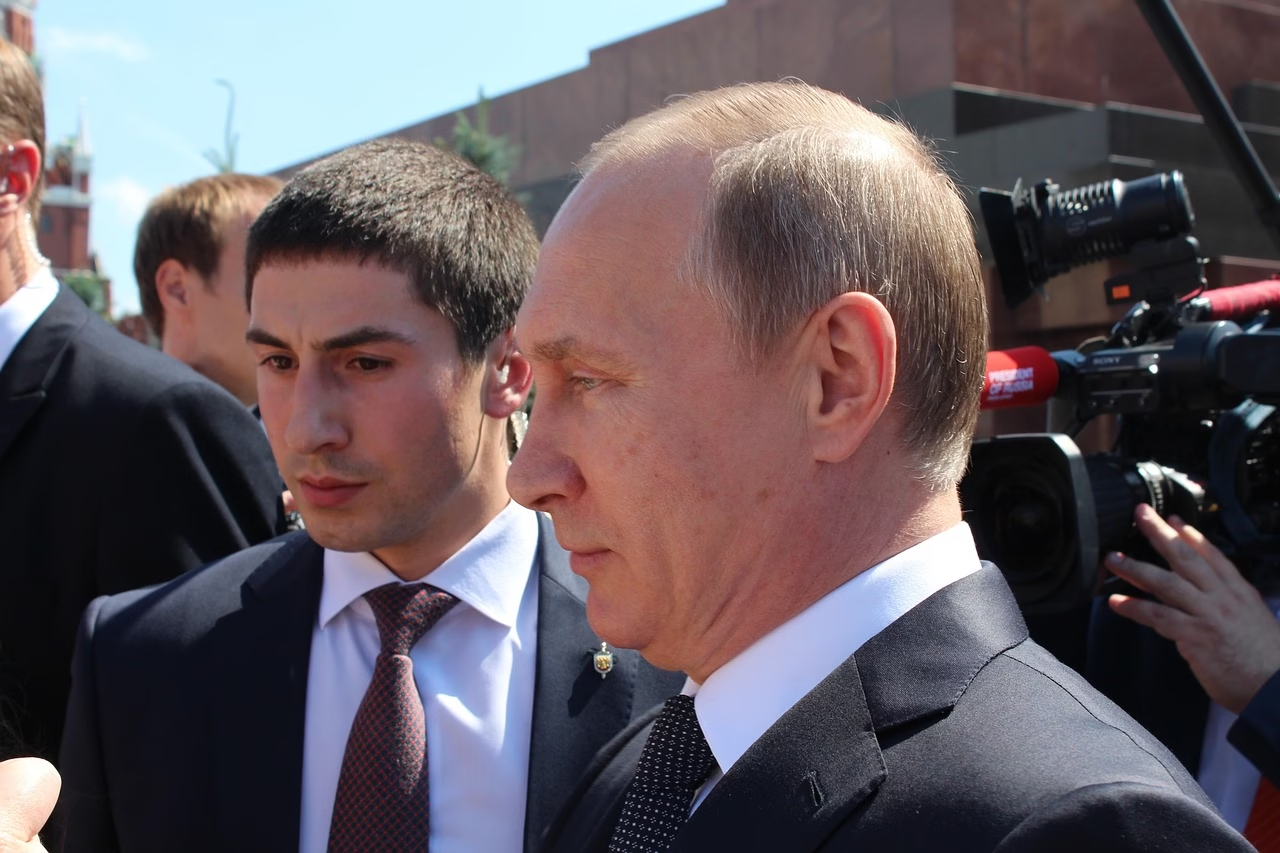
President Vladimir Putin signaled a potential shift in Moscow’s diplomatic posture toward the United States during a high-profile appearance in St. Petersburg this Friday, suggesting a willingness to explore a new relationship as the protracted conflict in Ukraine faces a significant battlefield deadlock.
Speaking before an international audience, the Russian leader framed the current geopolitical climate as one of transition, hinting that the Kremlin may be open to recalibrating its adversarial stance toward Washington. This overture comes at a time when military analysts observe a grinding war of attrition in Ukraine that has strained Russia’s domestic economy and tested the limits of its international isolation.
Contextualizing the Shift
The relationship between the Kremlin and the White House has remained at its lowest point since the height of the Cold War following Russia’s full-scale invasion of Ukraine in February 2022. Successive rounds of Western sanctions, combined with extensive military aid provided by the U.S. to Kyiv, have effectively severed most diplomatic and economic ties between the two global powers.
However, recent months have seen a noticeable shift in the tactical realities on the ground. With neither side achieving a decisive breakthrough, the financial and human costs of the conflict have climbed, prompting observers to question whether Moscow is seeking a strategic exit ramp or a tactical pause to consolidate its gains.
The Stagnation Factor
The war in Ukraine has evolved into a grueling war of artillery and trenches, with frontline positions remaining largely static for months. According to data from the Institute for the Study of War, the cost of sustained offensive operations has placed immense pressure on the Russian industrial base, which is increasingly focused on wartime production.
Energy exports, once the bedrock of the Russian economy, have been diverted to Asian markets, yet the loss of European and American financial systems continues to create long-term structural vulnerabilities. Putin’s rhetoric suggests that the Kremlin is cognizant of these constraints, potentially viewing a dialogue with the U.S. as a mechanism to alleviate international pressures.
Expert Perspectives
Geopolitical analysts suggest that Putin’s comments may be intended for multiple audiences, including domestic stakeholders who are wary of a long-term economic drain. “This is not necessarily an immediate pivot to peace, but rather a recognition that the current paradigm of total confrontation is becoming increasingly difficult to sustain,” noted one foreign policy expert.
Other observers caution that such statements are often designed to create fractures within the Western coalition. By dangling the prospect of a ‘new relationship,’ Moscow aims to appeal to isolationist factions in the West, potentially complicating the ongoing consensus regarding military support for Ukraine.
Implications for the Global Order
For the international community, the prospect of a thaw in U.S.-Russia relations carries significant weight. A change in tone could lead to renewed talks on nuclear arms control, a domain where communication has been virtually non-existent since the suspension of the New START treaty.
However, the skepticism remains high in Washington and among NATO allies, who maintain that any genuine diplomatic progress must be preceded by a cessation of hostilities in Ukraine. The industry and global markets will be watching for any tangible de-escalation steps, such as prisoner exchanges or direct high-level summits, which would serve as concrete indicators of a policy shift rather than mere rhetoric.
Moving forward, analysts will closely monitor Russia’s military procurement activities and diplomatic messaging to see if the rhetoric of a ‘new relationship’ translates into actual policy changes. The primary indicator to watch will be whether Moscow alters its demands for the recognition of annexed territories, as any formal negotiation remains contingent on the status of the occupied regions.


















Leave a Reply