


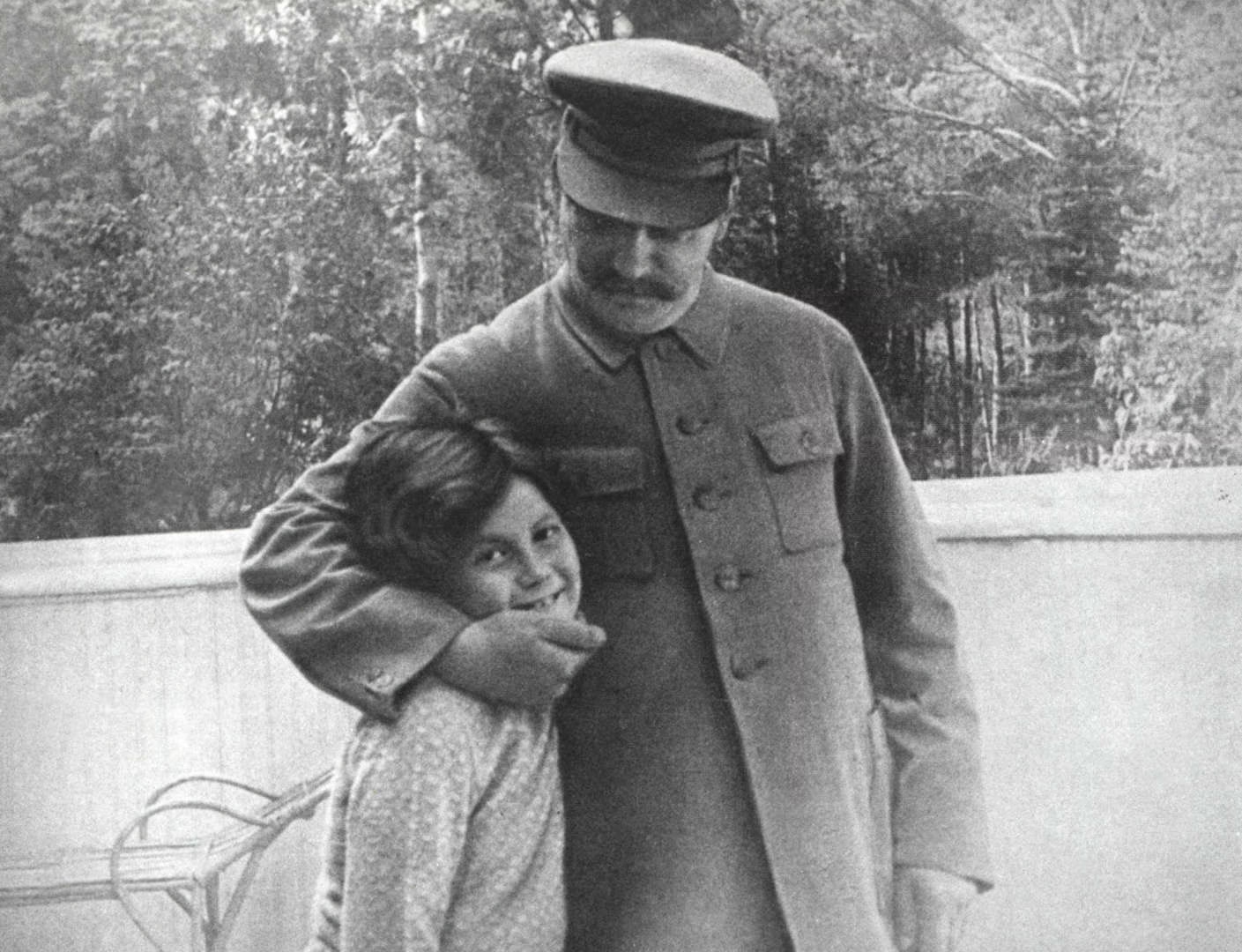
Introduction: The Burden of a Political Legacy
Svetlana Alliluyeva, born in 1926, was the only daughter of Joseph Stalin, one of the most controversial and influential leaders of the 20th century. Growing up in the Kremlin, Svetlana was not only a witness to the complexities of her father’s totalitarian regime but also an unwilling participant in the political narratives that unfolded around her. As the daughter of a dictator, she navigated a childhood steeped in privilege yet marred by the oppressive weight of her father’s legacy. This dichotomy profoundly shaped her identity and choices, creating a clash between personal desires and the expectations imposed by her lineage.
From a young age, Svetlana was acutely aware of her father’s powerful position and the political climate that surrounded her. The Stalinist era was marked by widespread purges, repression, and a personality cult that lionized her father while obliterating dissent. This atmosphere of fear and adoration complicated her emotional landscape, as she was torn between familial loyalty and the haunting consequences of Stalin’s policies. Though she enjoyed certain privileges, such as access to the best education and exclusive cultural experiences, she also grappled with the moral implications of her father’s actions and their impact on countless lives.
As the daughter of one of history’s most ruthless dictators, Svetlana’s personal relationships were often colored by the shadows of her father’s legacy. Her marriages, friendships, and affiliations raised questions about her identity and autonomy, often reflecting the larger political drama at play. In this context, Svetlana’s self-perception was deeply intertwined with the public perception of Stalin’s rule, leading her to seek ways to assert her individuality. Ultimately, her struggle against the weight of her political legacy would culminate in her dramatic escape from the Soviet Union, a decision that would define her life in the years to come.
Childhood Under Stalin: Tragedy and Turmoil
Svetlana Alliluyeva, born into the tumultuous world shaped by her father, Joseph Stalin, faced profound emotional challenges from her earliest days. As the only daughter of the Soviet leader, her childhood was marked by a stark contrast between privilege and personal anguish. The oppressive environment of Stalin’s rule extended into her family’s domestic life, creating a sense of neglect that would haunt her throughout her youth.
Stalin’s totalitarian regime left a deep impact on all aspects of Soviet life, including the family dynamics within the Alliluyeva household. While Svetlana was automatically afforded certain luxuries due to her birthright, she often felt isolated, overshadowed by her father’s formidable presence. The emotional turbulence associated with being Stalin’s child manifested in a myriad of ways, reflecting the broader societal unrest of the time.
One notable aspect of her early years was the chilling absence of her mother, who died in 1932 under circumstances that remain a subject of speculation. This loss, compounded by her father’s notorious policies and the resulting fear within society, amplified her feelings of abandonment and instability. Svetlana frequently encountered the emotional fallout of her father’s political decisions, as they directly affected her family life, ultimately leading to strained relationships with her siblings and her father himself.
As she grew older, the weight of her father’s ambition and the relentless political machine further alienated her from a sense of normalcy. The constant shadows of surveillance, propaganda, and terror loomed large, firmly establishing a volatile backdrop to her childhood—a childhood intertwined with tragedy and uncertainty. It is within this turbulent setting that Svetlana began to understand the complexities of loyalty, love, and the costs of Stalin’s unyielding power.
The Stalin Era: Growing Up in a Totalitarian State
The period of Joseph Stalin’s rule, from the late 1920s until his death in 1953, marked one of the most tumultuous eras in Soviet history, characterized by oppressive totalitarian control. It was a time when the government instilled fear among its citizens through widespread surveillance and harsh repressive measures against perceived dissent. Growing up in this climate profoundly influenced Svetlana Alliluyeva, Stalin’s only daughter, shaping her views on authority, personal freedom, and her eventual departure from the USSR.
Under Stalin’s regime, families lived in constant apprehension, often torn between loyalty to the state and the need to protect their loved ones. The Great Purge of the late 1930s serves as a grim illustration of this turbulent time, during which millions were executed or imprisoned for alleged political crimes. Such events created a pervasive culture of fear and mistrust, where even familial bonds were tested by the looming threat of denunciation. Svetlana witnessed the devastating effects of political oppression first-hand, which inherently molded her understanding of loyalty and the nature of authority.
This totalitarian landscape also propagated a distorted version of freedom. Citizens were bombarded with state propaganda, portraying the Communist Party as their only path to societal and personal development. However, beneath this surface lay stark realities of restricted freedom, where individual expression was quashed, and one’s fate often hinged on the whims of those in power. For Svetlana, this created an underlying conflict; her lineage afforded her certain privileges, yet it also trapped her in a web of public expectations and ideological conformity.
Ultimately, growing up in a totalitarian state fostered in Svetlana a complex relationship with authority. It was this very environment that would later propel her towards a daring escape from the USSR, as she sought to forge her identity away from the shadow of her father’s oppressive legacy.
Defiance and Independence: Svetlana’s Personal Journey
Svetlana Alliluyeva, the only daughter of Joseph Stalin, embarked on her personal journey marked by profound defiance against the shadows cast by her father’s infamous legacy. Born into unparalleled privilege, she faced expectations from both her family and the Soviet regime that sought to define her identity. Rather than conforming, Svetlana’s life became a testament to her quest for autonomy, showcasing her resistance to the constricting norms of her upbringing.
Throughout her life, Svetlana engaged in various relationships that mirrored her courageous pursuit of independence. Her marriages were emblematic of her desire to break free from her father’s dominance and the state’s oppressive influence. Each union represented a step towards establishing her own identity, separate from the father who loomed large over her existence. Despite the tumultuous nature of these relationships, they played a crucial role in shaping her understanding of personal freedom and self-determination.
As Svetlana navigated her adult life, she gradually moved away from the ideology instilled in her by the Soviet regime. She struggled to reconcile her upbringing with her emerging sense of self. This conflict was not merely personal; it mirrored the larger struggle of many Soviet citizens who sought a national identity beyond the constraints of state-imposed narratives. Svetlana’s journey was emblematic of a growing sense of individualism, demonstrating her resilience as she sought to carve out her path in a society steeped in conformity.
Ultimately, Svetlana Alliluyeva’s life encapsulates the essence of defiance and the pursuit of independence. Her quest was not just about dismantling the expectations placed upon her as Stalin’s daughter but also about asserting her own identity in a world that often sought to suppress it. Through her choices, she challenged the very foundations of her father’s legacy while striving for autonomy in her personal and national identity.
The Turning Point: The Decision to Defect
Svetlana Alliluyeva’s decision to defect from the Soviet Union in 1967 was marked by significant personal and political turmoil that ultimately influenced her path. Growing up in the shadows of her father, Joseph Stalin, she experienced a life filled with both privilege and deep-seated fear. The oppressive atmosphere of Stalinist rule shaped her early years and reflected the broader socio-political landscape of the USSR, which weighed heavily on her psyche and desires.
As she matured, Svetlana found herself increasingly disillusioned with the regime that had dictated her life. Her motivations to seek a different life stemmed from a longing for individual freedom and personal fulfillment, a yearning that stood in stark contrast to the repressive environment of Soviet society. Throughout her life, she grappled with the expectations placed upon her, both as a daughter of the dictator and as a woman navigating a male-dominated world. The political climate of the 1960s, witnessing a thaw in relations between the West and the USSR, created a unique window of opportunity for defectors like her.
In 1966, during a visit to India, she became captivated by the possibilities that awaited her outside the confines of the Soviet Union. The contrasting freedoms she observed ignited a flame of hope within her, ultimately pushing her to contemplate a life unburdened by the legacy of her father’s reign. The culmination of events—a personal crisis, a growing sense of isolation, and a profound desire for autonomy—drove Svetlana to make the life-altering decision to seek asylum in the United States. Her defection not only symbolized her quest for personal liberation but also challenged the narrative of loyalty to the regime she had inherited, forever changing her trajectory and the perceptions of her legacy.
The Escape: A Daring Journey to Freedom
Svetlana Alliluyeva’s escape from the clutches of the Soviet Union was marked by meticulous planning and sheer determination. As the daughter of Joseph Stalin, she faced formidable challenges that few could truly comprehend. With a strong desire for freedom and a notable sense of urgency, her journey began with the decision to abandon her life in her homeland, where she felt overshadowed by the legacy of her father.
In preparation for her daring escape, Svetlana gradually sought to gather resources discreetly. She managed to procure a false passport under the alias “Svetlana Zhdanova,” which was crucial for her plan. Utilizing her connections and the assistance of trusted friends, she analyzed various routes to ensure her departure would go unnoticed by the government authorities. This careful orchestration of her escape was not merely a flight; it was a calculated risk she was willing to take to free herself from a life overshadowed by her father’s oppressive regime.
The day before her escape marked a turning point in Svetlana’s life. With her children reluctantly in tow and the lingering thoughts of potential repercussions on her family, she navigated through the streets of Moscow, her heart pounding with anticipation and fear. The challenges she faced were multifaceted; not only did she have to evade detection from the KGB, but she also had to confront the emotional turmoil of leaving her life and loved ones behind.
Once she finally crossed the border into Italy, the euphoric taste of freedom filled the air. Svetlana Alliluyeva’s arrival in the United States was met with both intrigue and skepticism, yet it signified the culmination of her brave journey. This moment was not just an escape; it represented a profound assertion of autonomy, allowing her to step out of the shadows of her father’s legacy into a life defined by her own choices.
Life in America: A New Chapter
Svetlana Alliluyeva’s move to America marked a significant shift in her life, as she ventured into a new world that was starkly different from the one she had known in the Soviet Union. After her defection in 1967, she settled in the United States, where she faced the dual challenges of acclimatizing to a new culture and reconciling her past with her hopeful future. Although she found herself in a society that championed individual freedom, the shadow of her father, Joseph Stalin, loomed large over her identity.
Initially, Svetlana experienced a wave of public interest. The media portrayal of Stalin’s daughter was both sensational and sympathetic, a spectacle that thrust her into the global spotlight. Headlines celebrated her escape from a repressive regime, but the scrutiny of her past can be seen as relentless. Consequently, this overwhelming attention played a crucial role in shaping her initial experiences in America. While some viewed her as a brave defector, others saw her as a controversial figure, creating a complex dynamic between her desire for anonymity and the public’s curiosity.
As she navigated her new life, Svetlana also grappled with significant cultural adjustments. The freedoms enjoyed in the United States contrasted sharply with her upbringing, which had been steeped in Soviet ideology and expectations. She found herself wrestling with the implications of her family history whilst seeking to forge a new identity far removed from the legacy of Stalin. Despite her newfound agency, the emotional ties to her roots remained potent.
Throughout her years in America, Svetlana’s reflections on her past were bittersweet. She often expressed a sense of guilt over her familial connections and a longing for the familiar, complicated by the stark realities of her father’s regime. In many ways, her journey in America represented both an escape from tyranny and a quest for personal reconciliation, as she sought to discover what freedom truly meant beyond the political dimensions.
Legacy and Impact: How Svetlana’s Story Resonates Today
Svetlana Alliluyeva’s remarkable life, characterized by her emergence from a shadowed past as Joseph Stalin’s daughter, has etched a lasting imprint on historical discussions regarding identity, freedom, and defiance against oppressive regimes. Her decision to defect from the Soviet Union in 1967 is not merely a personal choice but carries profound implications that resonate in contemporary society. Svetlana’s story serves as a poignant symbol of the struggle for individual liberty amidst authoritarian control, particularly relevant in today’s geopolitical landscape where issues of oppression and human rights continue to manifest.
Furthermore, her journey exemplifies the complexities of family loyalty and national identity. By rejecting the political ideologies that surrounded her upbringing, Svetlana challenged the entrenched narratives of her father’s legacy. This act of defiance has prompted ongoing discussions about the reconciliation of personal identity with historical legacy. Today’s discourse on individuality and self-determination reflects the critical nature of Svetlana’s decisions, showcasing how one person’s actions can inspire countless others to seek autonomy and reject conformity.
The emotional and psychological ramifications of her experiences are equally significant. Svetlana’s writings have opened a dialogue about the often-overlooked personal toll of living under a totalitarian regime. This aspect of her life engages with modern themes of mental health and resilience, inviting individuals to reflect on their struggles against external and internal barriers. Furthermore, her defiance has emboldened discussions surrounding the peering into one’s past as a path toward understanding and healing.
In conclusion, Svetlana Alliluyeva’s legacy transcends her connection to Stalin; it represents an enduring narrative of courage in the face of adversity. Her life story remains a vital part of discussions about freedom, identity, and the historical legacies that shape our modern understanding of autonomy, resilience, and the human spirit.
Conclusion: A Complex Figure in History
Svetlana Alliluyeva, known as the daughter of Joseph Stalin, stands as an intricate figure in the annals of history. Her life story is marked not only by her lineage but also by her relentless quest for personal freedom and identity, which reflects the broader themes of resilience and rebellion against oppressive regimes. Born into the oppressive reality of a totalitarian state, Svetlana grappled with the burdens of her father’s legacy throughout her life.
As she grew older, Alliluyeva sought to distance herself from her father’s shadow, striving to forge her own path amidst the heavy expectations created by her lineage. Her defection to the West in 1967 was a bold statement, symbolizing her desire for autonomy and an escape from the suffocating grip of her past. This act was not only a personal rebellion but also a significant political statement during the Cold War, challenging the ideological battles of the era.
Throughout her life, Svetlana embodied contradictions. She was a devoted daughter caught in the tumult of her father’s tyrannical rule and a woman eager for independence in a male-dominated society. Her endeavors oscillated between embracing her father’s heritage and rejecting the tyrannical legacy of Stalinism. The publications of her memoirs and her public appearances brought her both admiration and disdain, reflecting the complexities of her character and the perception of her within various political and social contexts.
In considering her life, it becomes clear that Svetlana Alliluyeva is more than simply Stalin’s daughter; she is a representation of the struggle for personal identity amidst the weight of historical legacies. Her journey serves as a poignant reminder of the nuanced intersections between personal and political realms, ultimately leaving us with a deeper understanding of the complexities faced by individuals in the shadows of significant historical figures.























Leave a Reply