



President Donald Trump announced on Tuesday that the United States will lift its blockade on the Strait of Hormuz, citing a newly reached proposed agreement with Iran. The decision marks a significant de-escalation in a region that serves as the world’s most critical maritime chokepoint for global oil transit. White House officials confirmed that the move follows weeks of high-stakes diplomatic negotiations aimed at stabilizing energy markets and reducing military tensions in the Persian Gulf.
Context of the Maritime Standoff
The Strait of Hormuz, a narrow waterway connecting the Persian Gulf to the Gulf of Oman, has historically been a flashpoint for international conflict. Approximately 20% of the world’s total petroleum consumption passes through this corridor daily, making it vital to global economic stability.
Tensions reached a breaking point earlier this year when the U.S. implemented a blockade strategy to counter Iranian naval maneuvers. The policy was designed to restrict the movement of vessels associated with Iran’s Islamic Revolutionary Guard Corps while securing international shipping lanes. The resulting military buildup led to increased insurance premiums for commercial tankers and concerns over potential supply chain disruptions.
Details of the Proposed Agreement
While specific terms of the deal remain classified, sources close to the administration suggest the agreement involves a reciprocal commitment to maritime transparency. Iran has reportedly agreed to limit its naval patrols near the center of the shipping lanes in exchange for the removal of the U.S. naval presence currently enforcing the blockade.
Economic analysts note that the announcement has already impacted international crude oil prices. Futures fell by nearly 3% within hours of the President’s statement, reflecting investor relief over the prospect of unhindered oil flow. The agreement is viewed as a pragmatic solution to a standoff that had threatened to draw regional powers into a broader military confrontation.
Expert Perspectives on Regional Stability
Geopolitical analysts remain cautiously optimistic about the long-term viability of the arrangement. Dr. Aris Thorne, a senior fellow at the Institute for Global Security, stated that while the lifting of the blockade is a positive step, the underlying friction between Washington and Tehran remains unresolved.
“The immediate removal of the naval blockade prevents an accidental skirmish from escalating into a full-scale war,” Dr. Thorne explained. “However, the durability of this peace depends entirely on the enforcement mechanisms embedded within the agreement and how both parties interpret the new maritime boundaries.”
Economic and Strategic Implications
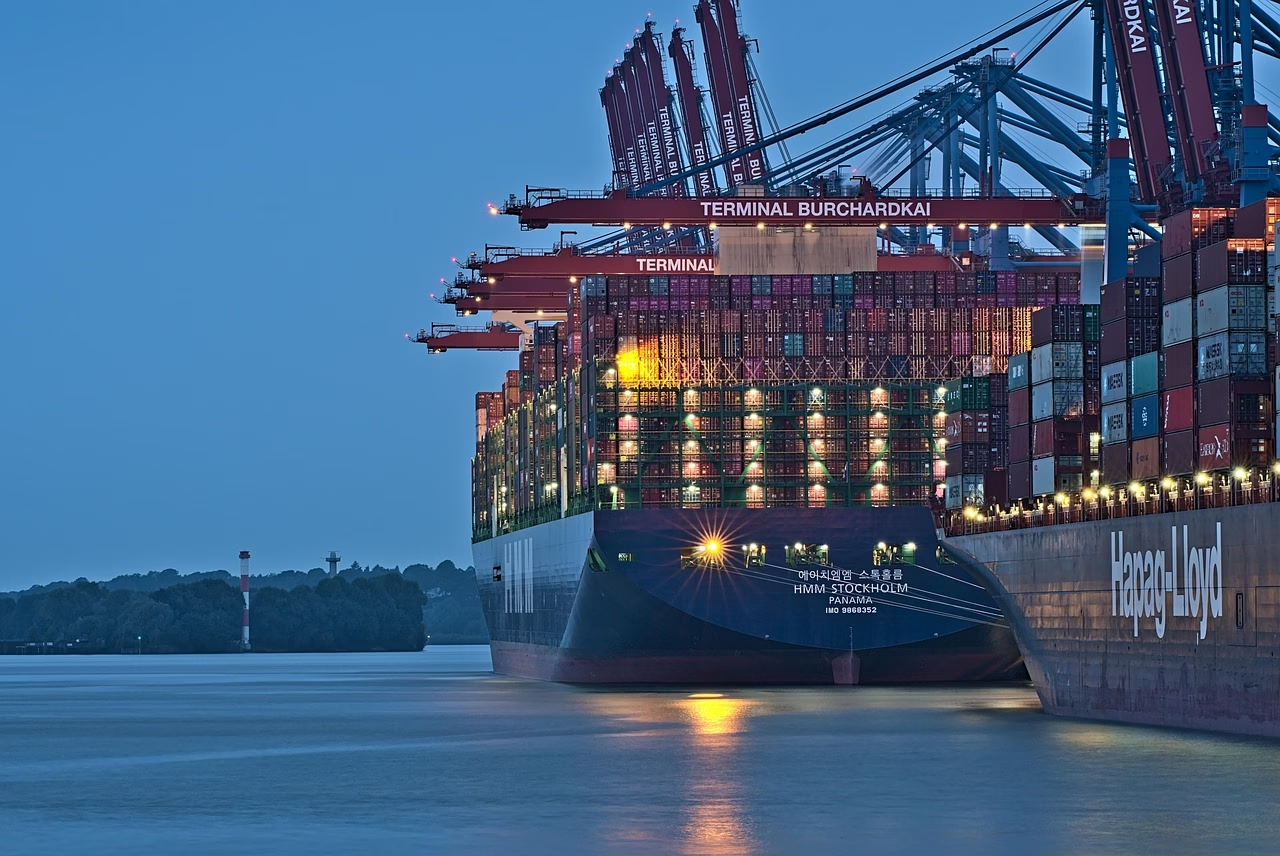
The stabilization of the Strait is expected to provide much-needed relief to global energy markets. Shipping companies have already begun rerouting vessels to take advantage of the reopened lanes, which are shorter and more cost-effective than alternative paths. For the broader industry, this means a reduction in operational overhead and a return to predictable shipping schedules.
Beyond the economic impact, the decision signals a shift in the U.S. strategy toward containment through diplomacy rather than direct naval intervention. Observers are now looking toward the next phase of the agreement, which is expected to include a formal monitoring process overseen by neutral international maritime observers.
The international community will be watching for signs of compliance in the coming weeks, specifically regarding the movement of tankers through the narrowest points of the strait. Future developments will likely focus on whether this agreement serves as a template for further de-escalation efforts or if it remains a temporary reprieve in a volatile geopolitical landscape.























Leave a Reply