


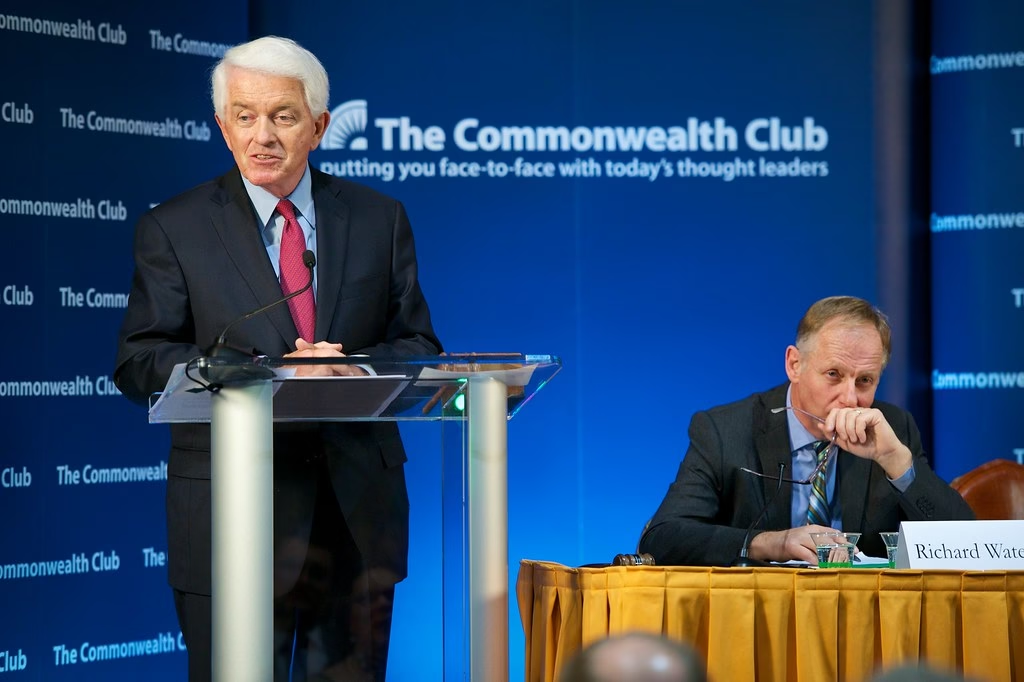
Vice President JD Vance officially stated in Washington on Tuesday that the United States government will not provide Iran with any financial resources unless the nation fully complies with the stringent terms of a proposed peace agreement. This declaration serves as a definitive defense of the Trump administration‘s broader foreign policy strategy, which prioritizes strict conditionality over unconditional diplomatic engagement.
The Context of U.S.-Iran Relations
The history of U.S.-Iran relations has been characterized by decades of economic sanctions and diplomatic volatility. Since the 2018 withdrawal from the Joint Comprehensive Plan of Action (JCPOA), the United States has employed a ‘maximum pressure’ campaign aimed at curbing Iran’s nuclear ambitions and regional influence.
Current policy discussions center on whether to leverage frozen assets as a bargaining tool. The administration maintains that these funds remain essential leverage to ensure adherence to non-proliferation protocols and regional security guarantees.
Strategic Conditionality and Enforcement
Vice President Vance emphasized that the administration’s approach is rooted in verifiable compliance. He clarified that the release of any financial assets is strictly contingent upon Iran meeting specific, measurable benchmarks set forth in the proposed deal.
This framework is designed to prevent the misappropriation of funds for military expansion or regional proxy support. By maintaining control over these resources, the administration aims to hold Tehran accountable for its actions in the Middle East.
Expert Perspectives on Diplomatic Leverage
International relations analysts are divided on the efficacy of this approach. Proponents argue that withholding financial liquidity is the only mechanism capable of forcing a change in Iranian state behavior.
Conversely, some geopolitical experts suggest that such rigid conditions could stall progress toward a broader nuclear accord. According to data from the Atlantic Council, previous periods of total economic isolation have occasionally resulted in increased regional aggression rather than diplomatic concessions.
Economic and Geopolitical Implications
For global markets, the uncertainty surrounding these negotiations contributes to volatility in energy prices. As long as the status of Iranian oil exports remains tied to these diplomatic conditions, oil-dependent economies may experience fluctuating supply projections.
The industry is closely monitoring the potential for a breakthrough. If the administration successfully leverages these assets to secure a lasting agreement, it would represent a significant shift in the regional security architecture.
Future Developments to Watch
Observers should monitor upcoming diplomatic summits for signs of movement on the verification protocols. The central question remains whether Tehran will accept the administration’s terms or seek alternative economic partnerships to bypass the current sanctions regime. Analysts suggest that the next ninety days of back-channel communications will be critical in determining whether the proposed peace deal moves toward implementation or remains at a standstill.


















Leave a Reply