


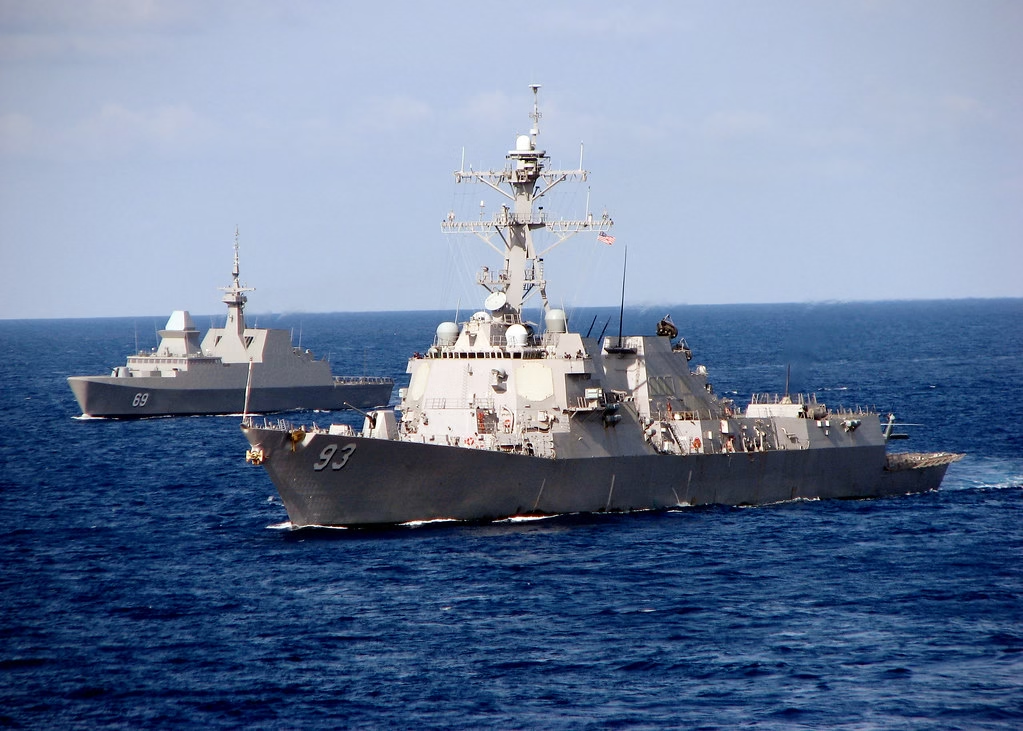
WASHINGTON/MANILA — The United States issued a stern condemnation against Beijing on Tuesday following a violent maritime confrontation in the disputed South China Sea that left a Philippine sailor severely injured, dramatically elevating regional security risks just days before top American and Chinese diplomats gather in Manila for high-stakes diplomatic talks. U.S. Secretary of State Marco Rubio blasted the Chinese Coast Guard for engaging in “dangerous and aggressive” tactics against routine Philippine resupply operations near a strategic shoal, setting a volatile backdrop for upcoming meetings with Chinese Foreign Minister Wang Yi and Southeast Asian foreign ministers.
Escalating Friction in a Strategic Waterway
The clash marks the latest in a series of increasingly hostile encounters at Second Thomas Shoal, a submerged reef located well within the Philippines’ 200-nautical-mile Exclusive Economic Zone (EEZ). Manila maintains a rusty, grounded World War II-era navy vessel, the BRP Sierra Madre, at the shoal to assert its territorial sovereignty, requiring frequent resupply missions for troops stationed aboard.
China claims historic sovereignty over nearly the entire South China Sea under its expansive claims, an assertion that was unanimously invalidated by the Permanent Court of Arbitration in The Hague in 2016. Despite the international tribunal ruling, Beijing has fortified artificial islands with military infrastructure while deploying hundreds of coast guard and maritime militia vessels to enforce its authority across disputed waters.
Previous standoffs involved high-powered water cannons and acoustic devices, but recent encounters have escalated to physical collisions, vessel ramming, and the boarding of ships by armed Chinese personnel. The recent injury of a Philippine navy service member underscores the rising human toll and operational risks along one of the world’s most vital shipping corridors, through which an estimated $3.3 trillion in trade passes annually.
Diplomatic Fallout Ahead of Manila Summit
The escalation comes at an exceedingly delicate moment for Indo-Pacific diplomacy. Foreign ministers from the Association of Southeast Asian Nations (ASEAN) are convening in Manila this week alongside international partners, bringing rival global powers into direct proximity following months of worsening rhetoric.
State Department officials confirmed that Secretary Rubio will address the maritime incident directly during bilateral sessions in Manila, reiterating the unyielding nature of Washington’s commitments under the 1951 U.S.-Philippines Mutual Defense Treaty. Under Article IV of the treaty, an armed attack on Philippine public vessels, aircraft, or armed forces anywhere in the Pacific—including the South China Sea—would trigger mutual defense obligations for the United States.
Beijing has rejected Washington’s criticism, asserting that its coast guard acted legally to defend Chinese territorial sovereignty against unauthorized intrusion. Chinese Foreign Ministry spokespersons reaffirmed that Beijing remains open to dialogue, but insisted that external powers—specifically the United States—are fueling regional instability to advance geopolitical agendas.
Expert Analysis and Strategic Risks
Maritime security analysts warn that the frequency and intensity of these gray-zone tactics have brought the region dangerously close to an unintended military confrontation. According to tracking data from the Asia Maritime Transparency Initiative (AMTI), Chinese vessel deployments inside disputed Philippine zones have surged significantly over the past year, creating persistent operational friction.
“Beijing is testing the operational thresholds of the U.S.-Philippine alliance without crossing the line into an outright armed conflict,” said Dr. Elena Rostova, a senior fellow in Indo-Pacific security studies. “However, when physical injuries occur and military assets are damaged, the margin for error narrows dramatically. A single operational miscalculation on the water could trigger an automatic military escalation framework.”
Philippine officials have signaled a refusal to back down, insisting that routine resupply missions to the BRP Sierra Madre will continue unimpeded. Defense leaders in Manila are simultaneously expanding joint naval patrols with key democratic partners, including Australia, Japan, and the United States, to bolster collective deterrence across disputed maritime zones.
Implications for Regional Stability
For regional trade networks and defense planners, the escalating crisis signals a structural shift toward heightened naval deterrence in Southeast Asia. Defense expenditures across ASEAN member states continue to trend upward as regional nations scramble to modernize their maritime domain awareness capabilities amidst ongoing security volatility.
The immediate focus turns to the diplomatic corridors in Manila, where observers will closely monitor whether Secretary Rubio and Foreign Minister Wang Yi engage in direct side discussions to establish military-to-military crisis communication protocols. Whether ASEAN leaders can forge a cohesive, unified position on a binding South China Sea Code of Conduct will serve as a critical test for regional conflict management in the months ahead.
















Leave a Reply