


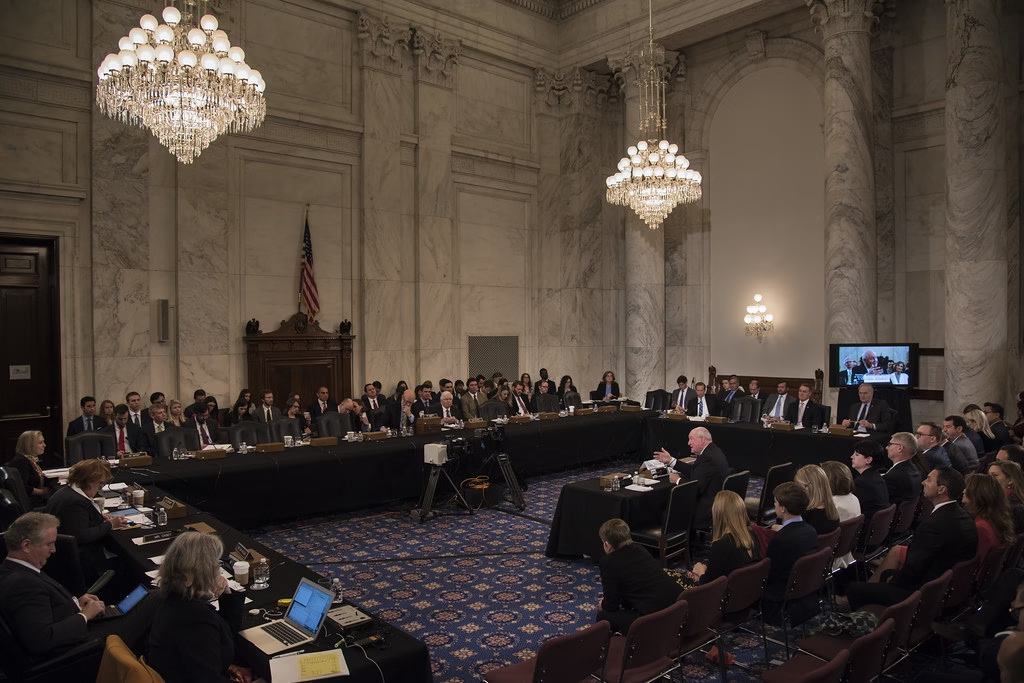
President Donald Trump’s nominee for U.S. Attorney General, Todd Blanche, saw his confirmation prospects grow uncertain on Capitol Hill this week following a marathon hearing before the Senate Judiciary Committee. Both Republican and Democratic lawmakers subjected the nominee to sharp questioning regarding his judicial independence, past criminal defense work, and vision for the Department of Justice.
Contextualizing the High-Stakes Nomination
Blanche, a veteran trial attorney and former federal prosecutor, gained national prominence after serving as a key defense lawyer for Trump during multiple complex legal proceedings. His nomination to lead the country’s chief law enforcement agency represents a pivotal appointment for the incoming administration’s legal and domestic policy agenda.
The Department of Justice oversees vast federal law enforcement apparatuses, including the Federal Bureau of Investigation, federal prosecutions, and civil rights enforcement. Historically, nominees for Attorney General undergo rigorous Senate vetting to evaluate their commitment to constitutional boundaries and institutional independence from executive interference.
Political dynamics in the Senate leave a narrow margin for error. With a tightly divided chamber, any bipartisan pushback during committee hearings significantly increases the political risk for a Cabinet nominee.
Bipartisan Scrutiny on Capitol Hill
During the five-hour hearing, Democratic senators questioned Blanche extensively on whether he could objectively manage federal investigations that might involve the White House or former associates. Lawmakers pressed him for concrete assurances that DOJ prosecutorial decisions would remain free from political pressure.
Unexpectedly, several Republican committee members also raised pointed concerns during the session. GOP senators focused their inquiry on Blanche’s transition from defense attorney to top federal prosecutor, questioning his stance on federal law enforcement priorities and regulatory enforcement.
The line of questioning revealed underlying tensions within the Senate Republican caucus. Several key swing-vote senators declined to explicitly endorse Blanche immediately following the hearing, indicating that their final votes remain contingent on further written responses.
Expert Analysis and Historic Benchmarks
Legal experts note that cross-party pushback during confirmation hearings often serves as an early indicator of wider floor challenges. Historical data highlights that cabinet nominees facing public reservations from members of their own party face heightened legislative hurdles.
Data from the Congressional Research Service indicates that over the past four decades, Attorney General nominees who faced bipartisan opposition during committee hearings experienced significantly longer confirmation timelines, averaging 45 additional days of Senate deliberation.
“The Attorney General occupies a unique position in the Cabinet because the role demands absolute fidelity to the rule of law above political considerations,” said Dr. Ellen Vance, a constitutional law scholar at the Governance Institute. “When senators from both sides of the aisle raise questions about independence, it signals deep institutional concern rather than standard party politics.”
Former Justice Department officials emphasized that public confidence in the agency’s political neutrality remains a central benchmark for any incoming leader. The questioning highlighted how difficult it can be for former personal legal counsel to transition directly into leading the nation’s prosecutors.
Legislative Strategy and Next Steps
The immediate focus now shifts to the Senate Judiciary Committee, which must hold a formal vote to report Blanche’s nomination to the full Senate floor. Committee leadership is expected to schedule the vote after Blanche submits written responses to dozens of follow-up questions submitted by senators.
If the committee deadlocks along party lines, Senate leadership will need to execute additional procedural steps to discharge the nomination to the floor. Such maneuvers consume valuable floor time and further complicate the administration’s early legislative momentum.
Political analysts will closely monitor several moderate senators who have not yet committed their votes. The outcome will signal not only the fate of Blanche’s nomination, but also the extent of Senate resistance to executive control over federal law enforcement institutions in the coming term.























Leave a Reply