


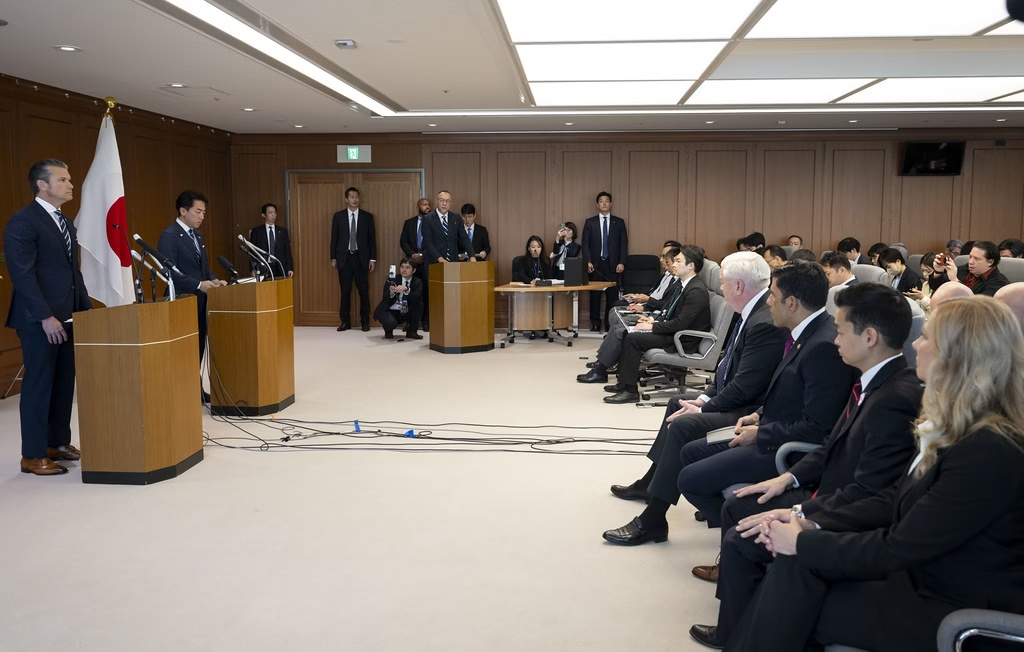
Japanese Defense Minister Minoru Kihara, speaking in Tokyo this week, formally rejected international allegations that Japan is embracing a policy of “neo-militarism.” The statement comes as the nation continues to modernize its Self-Defense Forces in response to evolving security threats in the Indo-Pacific region.
The Context of Regional Security
Japan has historically maintained a strictly defensive military posture since the end of World War II, governed by Article 9 of its pacifist constitution. However, shifting geopolitical dynamics, including increased naval activity in the East China Sea and ongoing tensions regarding regional sovereignty, have prompted Tokyo to increase its defense spending.
In late 2022, the Japanese government unveiled a major national security strategy that aims to double defense spending to 2% of GDP by 2027. This move, while popular domestically as a deterrent, has drawn scrutiny from neighboring states who fear a departure from Japan’s post-war pacifist identity.
Dispelling Allegations of Neo-Militarism
Defense Minister Kihara emphasized that Japan’s defense reforms are strictly intended to bolster deterrence and maintain a rules-based international order. He stated that the narrative of “neo-militarism” is a mischaracterization that ignores the transparent and defensive nature of Japan’s current military upgrades.
“To suggest that we are returning to a militaristic past is nothing further from the truth,” Kihara noted during the briefing. He underscored that all defense acquisitions remain subject to rigorous parliamentary oversight and remain aligned with Japan’s long-standing alliance with the United States.
Expert Perspectives on Strategic Posture
Defense analysts suggest that Japan is navigating a difficult balancing act. According to the Stockholm International Peace Research Institute (SIPRI), Japan’s military expenditure has seen consistent growth, reflecting a broader global trend of increased defense investment among democratic nations.
Dr. Elena Rossi, a senior fellow in Asian Security Studies, notes that Tokyo’s actions are a reaction to external pressures rather than an internal ideological shift. “Japan is not pursuing an expansionist agenda; it is responding to a reality where traditional deterrence is failing and regional volatility is at a multi-decade high,” Rossi stated.
Implications for the Indo-Pacific
For the broader international community, Japan’s evolving stance signifies a more active role in regional security architecture. This shift implies that Tokyo will likely seek deeper interoperability with partners like Australia, India, and the United States through expanded joint training exercises and technological cooperation.
Industry observers should watch for the upcoming defense budget deliberations, which will clarify the specific procurement priorities for the Japanese Maritime Self-Defense Force. As Tokyo integrates long-range strike capabilities into its arsenal, the focus will remain on whether these assets are viewed as purely defensive or as a shift in power projection that could necessitate new diplomatic dialogues with regional counterparts.






















Leave a Reply