


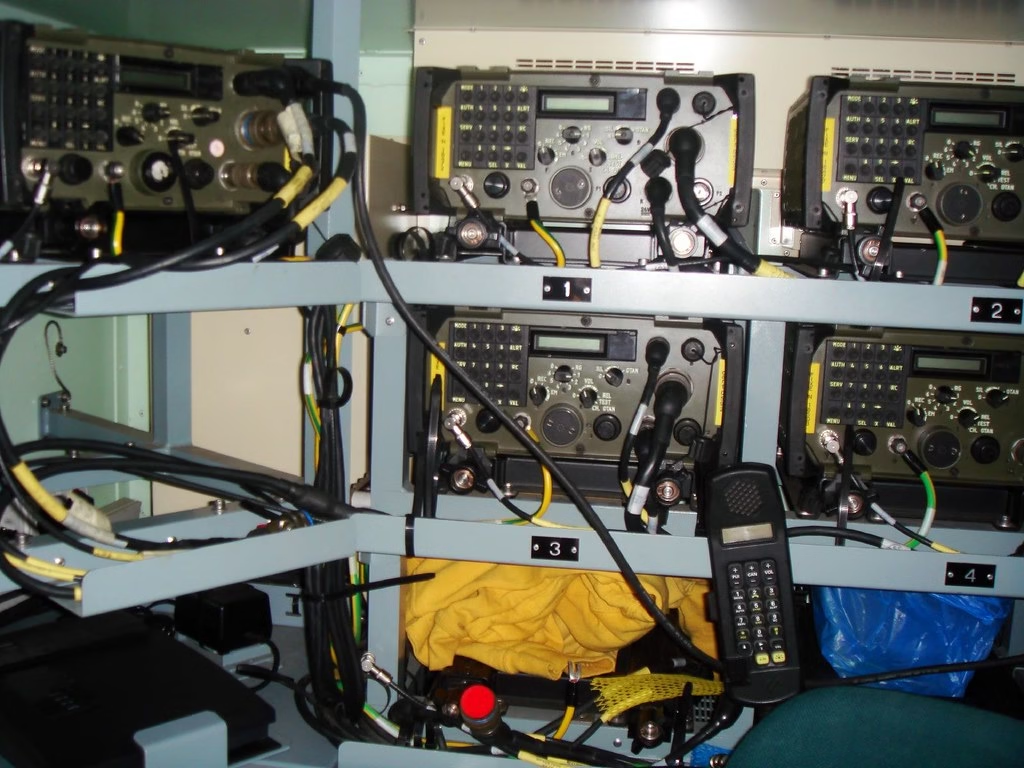
Israeli Defense Minister Israel Katz officially unveiled the recipients of the prestigious 2026 Israel Security Award this week in Jerusalem, honoring the engineers and operational teams behind a new generation of unique weaponry and advanced electronic warfare systems. The annual ceremony recognized breakthrough technological achievements that military officials claim are critical to maintaining the nation’s qualitative edge in an increasingly complex and digitized regional theater.
The Evolution of Modern Deterrence
The Israel Security Award, established in the state’s infancy, serves as the highest institutional recognition for individuals and units contributing to national security. While the specific details of the awarded projects remain classified due to operational security, the committee highlighted a shift toward autonomous systems and sophisticated cyber-defense mechanisms.
Recent years have seen a massive pivot in global military spending toward electronic warfare (EW) capabilities. As drones and precision-guided munitions become more accessible to non-state actors, the ability to jam communications, disrupt GPS signals, and neutralize incoming threats through electromagnetic interference has become a top priority for the Israel Defense Forces (IDF).
Technological Breakthroughs and Strategic Depth
The 2026 winners represent a diverse cross-section of the defense establishment, including collaborations between elite intelligence units and private-sector aerospace giants. Industry analysts suggest that the projects honored this year focus heavily on the integration of artificial intelligence into real-time battlefield decision-making.
According to data from the Ministry of Defense, investment in research and development has increased by 15% over the last fiscal year. This surge is largely attributed to the urgent need for defensive systems capable of intercepting low-altitude threats that traditional radar systems often struggle to track.
One of the recurring themes among the winning projects is the concept of ‘modular lethality.’ This approach allows military hardware to be rapidly adapted for different mission profiles, reducing the logistical burden on ground troops while increasing the effectiveness of existing platforms.
Expert Perspectives on Defense Modernization
Defense analysts note that the recognition of electronic warfare systems signals a permanent shift in how Israel approaches its border security. Dr. Elena Rossi, a fellow at the Institute for National Security Studies, suggests that these awards reflect a move toward a ‘smarter, not just stronger’ military posture.
‘The focus is no longer solely on kinetic impact, such as traditional bombs or missiles,’ Rossi explained. ‘The real power now lies in the ability to blind an adversary’s sensors while simultaneously hardening one’s own network against digital intrusion.’
Government officials emphasize that these advancements are not merely for offensive operations but are essential for protecting critical infrastructure. As cyber-attacks on civilian power grids and water systems become more frequent globally, the technology developed for the battlefield is being increasingly dual-purposed for civil defense.
Implications for the Future Battlefield
For the broader defense industry, the 2026 awards set a clear benchmark for upcoming procurement cycles. Companies that can bridge the gap between rapid software development and ruggedized hardware are expected to dominate the market in the coming decade.
Looking ahead, observers should watch for the integration of these new electronic warfare suites into the IDF’s existing aerial and naval fleets. Analysts expect the next phase of development to focus on long-range autonomous drone swarms, which will likely be the primary subject of future security evaluations as the landscape of regional conflicts continues to evolve.






















Leave a Reply