


A bystander remains in serious condition at a Washington, D.C. hospital after being caught in the crossfire of a fatal shooting near a security checkpoint outside the White House on Friday afternoon. U.S. Secret Service officers shot and killed an armed male suspect after he approached a security post and opened fire, triggering an immediate armed response and a temporary lockdown of the executive mansion.
Security Breach at the Perimeter
The incident occurred at an outer security checkpoint, a critical buffer zone where tourists, government employees, and journalists frequently gather. These checkpoints serve as the first line of defense for the White House complex, manned 24 hours a day by the Secret Service Uniformed Division. According to law enforcement officials, the suspect approached the checkpoint on foot before drawing a firearm, prompting officers to take decisive action to neutralize the threat.
Emergency medical personnel arrived on the scene within minutes to treat both the suspect and the injured bystander. While the suspect was pronounced dead at the scene, paramedics rushed the bystander to a local trauma center with life-threatening injuries. Authorities have not yet released the identities of either the suspect or the victim, citing the ongoing investigation and the need to notify next of kin.
Investigation and Emergency Response
The Metropolitan Police Department of the District of Columbia has taken the lead on the homicide investigation, a standard protocol when a shooting involving law enforcement occurs on public streets. Investigators are currently reviewing surveillance footage from multiple security cameras positioned around the White House perimeter. They are also interviewing dozens of eyewitnesses who were in the area when the shots broke out.
Federal law enforcement agencies, including the Federal Bureau of Investigation (FBI), are assisting in the probe to determine if the suspect acted alone or had broader motives. Preliminary reports suggest the suspect had no known ties to international terrorist organizations, though authorities are thoroughly examining his digital footprint and past activities. The motive behind the attempted breach remains unclear as investigators search his last known residence and vehicle.
The incident caused immediate disruptions throughout the nation’s capital, forcing the closure of Pennsylvania Avenue and Lafayette Park to pedestrian traffic. The White House press briefing room was briefly locked down, with journalists instructed to shelter in place until the area was declared secure. Normal operations resumed several hours later, though a heightened security presence remained visible throughout the weekend.
Forensic teams spent hours cataloging evidence at the intersection near the checkpoint, recovering multiple shell casings and the suspect’s weapon. The Bureau of Alcohol, Tobacco, Firearms and Explosives (ATF) is conducting an urgent trace on the firearm to determine its origin and ownership history. This collaborative effort aims to construct a complete timeline of the suspect’s movements leading up to the confrontation.
Evaluating High-Profile Security Protocols
Security experts point out that securing the perimeter of the White House presents a unique challenge due to its dual nature as an active government office and a major tourist attraction. “You have to balance public access with absolute security,” said Thomas Langer, a former federal security consultant. “These checkpoints are designed specifically to stop threats before they reach the inner sanctum, but the outer perimeter will always carry risks for the public.”
Data from the Government Accountability Office (GAO) indicates that security incidents near the White House have prompted several reviews of perimeter security over the last decade. Past recommendations have led to the installation of taller, spike-topped fences and restricted vehicle access on adjacent streets. However, managing pedestrian crowds near active checkpoints remains one of the most volatile aspects of executive protection.
The physical security upgrades, including the 13-foot fence completed in 2022, were designed to prevent intruders from scaling the barriers. However, these physical barriers do not entirely eliminate the threat of armed individuals approaching the outer gates where the public interacts with security personnel. Analysts suggest this vulnerability highlights the ongoing difficulty of protecting open urban spaces against sudden acts of violence.
Broader Implications for Urban Security
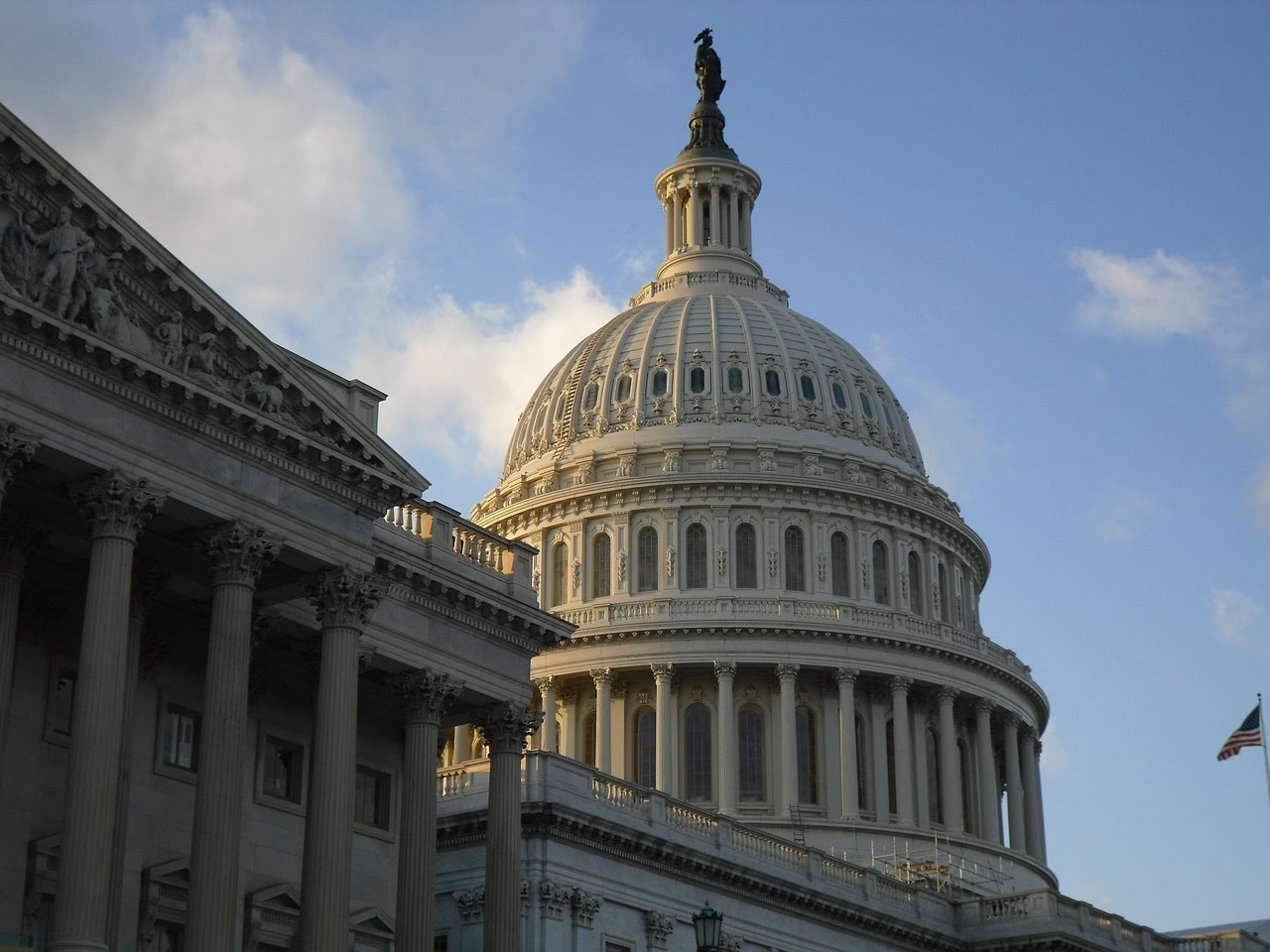
The shooting raises urgent questions about the safety of bystanders in highly secured government zones. Lawmakers on Capitol Hill are already calling for briefings on the incident to assess whether current defensive tactics sufficiently protect innocent civilians during active shooter scenarios. Some advocates suggest implementing more advanced non-lethal deterrents at outer checkpoints, though tactical experts argue that lethal force remains necessary when a suspect brandishes a firearm.
In the coming weeks, the Secret Service is expected to conduct an internal review of the shooting to evaluate officer response times and tactical positioning. This review could lead to further modifications of the pedestrian corridors surrounding Lafayette Park and the Ellipse. Visitors to the nation’s capital should expect tighter security measures, potential delays at public access points, and an increased presence of armed patrols as authorities work to prevent similar incidents in the future.
















Leave a Reply