


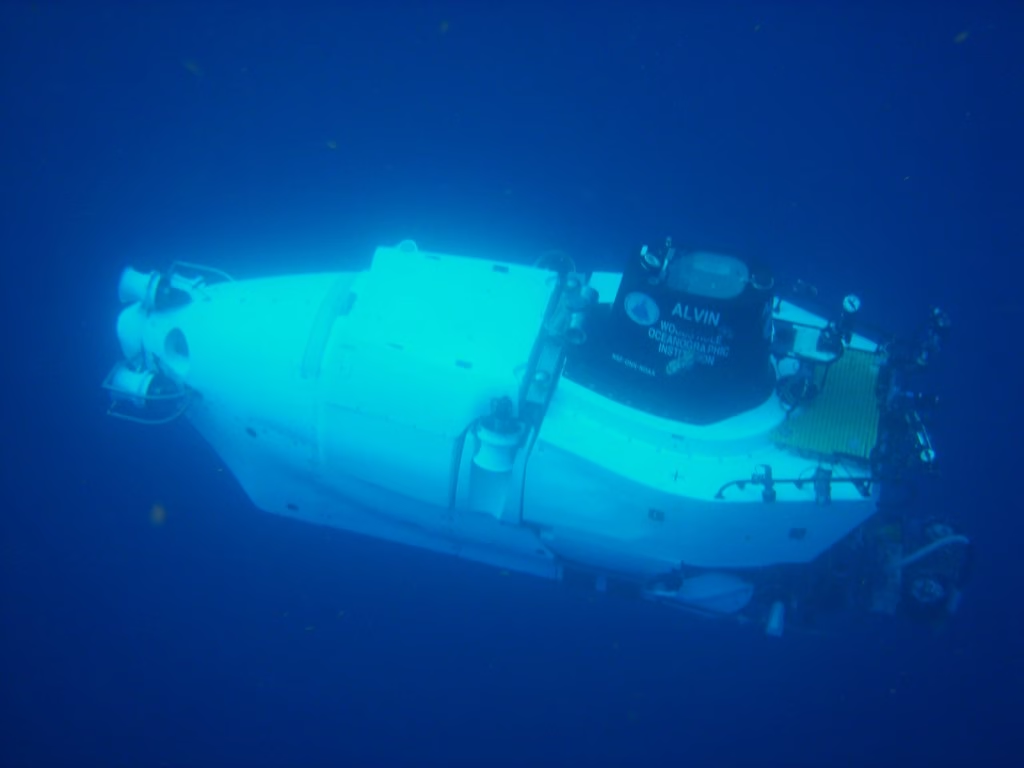
The Transportation Safety Board of Canada (TSB) released a scathing report this week, confirming that the Titan submersible operated with virtually no regulatory oversight prior to its catastrophic implosion in June 2023. The investigation, which spanned over a year, concluded that the vessel, owned by OceanGate, functioned outside the purview of Canadian maritime authorities despite launching from a Canadian port in St. John’s, Newfoundland.
Regulatory Gaps in Deep-Sea Exploration
The Titan disaster claimed the lives of five individuals during a high-profile expedition to the wreck of the RMS Titanic. The TSB investigation revealed that because the submersible was not technically a vessel engaged in traditional commercial transport, it occupied a regulatory gray area that allowed it to bypass standard safety certifications.
Maritime law typically requires vessels to undergo rigorous inspections to ensure structural integrity and life-support reliability. However, the report highlights that OceanGate’s unconventional design and experimental carbon-fiber hull were never subjected to the rigorous, third-party certification processes mandated for more conventional underwater craft.
The Anatomy of the Failure
The TSB findings emphasize that the lack of oversight was not merely a bureaucratic oversight but a systemic failure to categorize emerging deep-sea tourism vehicles. The report indicates that the submersible’s design team chose to forgo industry-standard classification, citing a desire to innovate beyond established safety protocols.
According to the TSB, this decision-making process left the vessel vulnerable to structural fatigue. The investigation points to the cyclical pressure loading experienced by the hull during repeated dives as a primary factor in the eventual implosion, a risk that formalized certification processes are specifically designed to monitor and mitigate.
Expert Perspectives on Maritime Safety
Industry experts have long criticized the lack of international standards for private, deep-sea tourism. Dr. Aris Thorne, a maritime engineering consultant, noted that the Titan incident serves as a wake-up call for global regulators. “When private enterprises push into extreme environments, the absence of a standardized framework creates a dangerous environment where safety becomes secondary to rapid development,” Thorne stated.
Data from the International Maritime Organization (IMO) suggests that while commercial shipping is heavily regulated, submersibles used for research and private exploration often fall into a patchwork of national jurisdictions. This fragmentation makes it difficult to enforce a unified safety standard across international waters.
Industry-Wide Implications
The report is expected to catalyze a significant shift in how maritime authorities approach private submersibles. Industry analysts anticipate that the TSB’s findings will lead to stricter requirements for launch permits and mandatory safety disclosures for any company operating experimental craft in international or territorial waters.
For the broader tourism industry, the disaster has prompted a decline in interest for high-risk, extreme-environment excursions. Companies currently operating in the deep-sea sector are already facing increased pressure from insurance providers to prove their vessels meet internationally recognized safety codes, regardless of their experimental design.
What to Watch Next
Moving forward, the focus will shift toward the implementation of new international treaties governing private deep-sea exploration. Stakeholders should watch for potential legislative changes in Canada and the United States that could mandate third-party certification for all submersibles. Additionally, the industry will likely see a move toward greater transparency in engineering data, as regulators seek to ensure that future innovations do not come at the cost of human life.


















Leave a Reply