


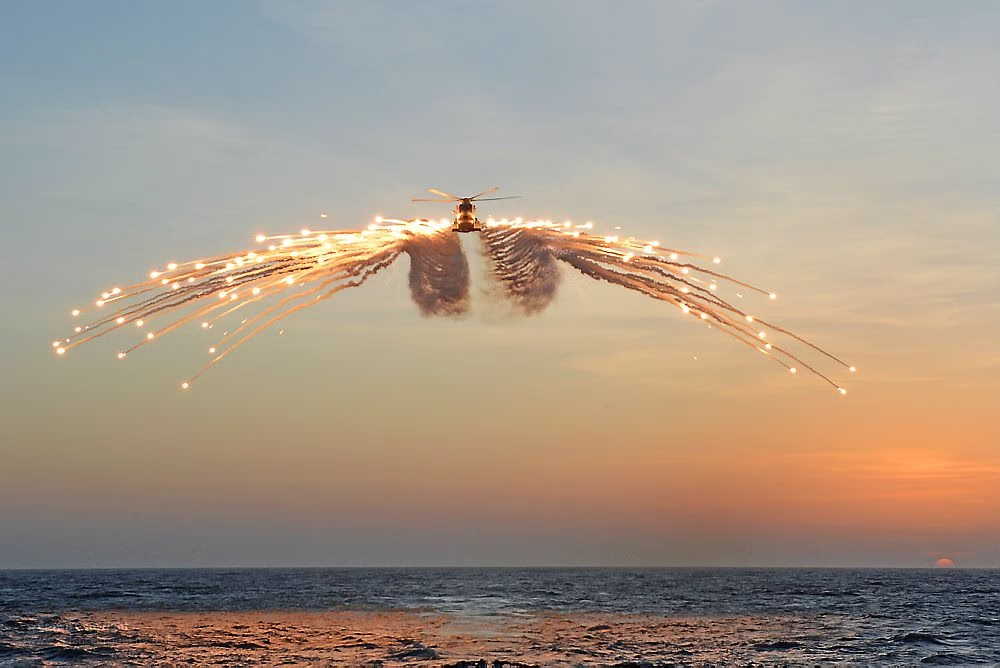
Former President Donald Trump asserted on social media that Iranian forces shot down an American military helicopter near the Strait of Hormuz, prompting calls for a swift U.S. response. The incident involved an Apache attack helicopter that crashed in the volatile maritime corridor, with the crew successfully rescued by a drone boat operating in the vicinity.
Contextualizing Tensions in the Strait of Hormuz
The Strait of Hormuz remains one of the world’s most critical maritime chokepoints, through which approximately 20% of the world’s oil consumption passes. Historically, the region has served as a flashpoint for military posturing between the United States and Iran, often involving naval harassment and drone activity.
U.S. military presence in the area has been consistent since the mid-20th century, but regional friction has escalated significantly over the last decade. Both nations have previously accused one another of provocative maneuvers that threaten the safety of international shipping lanes.
The Incident and Military Response
Initial reports indicate that the Apache helicopter experienced a catastrophic failure while conducting routine patrols over the strait. While the military has yet to release an official casualty report, the confirmation that a drone boat successfully recovered the crew highlights the increasing role of autonomous technology in U.S. naval operations.
Military analysts suggest that if a hostile act did occur, it represents a significant escalation in regional rules of engagement. Defense officials are currently analyzing radar telemetry and flight data to determine the exact cause of the crash, as distinguishing between mechanical failure and anti-aircraft fire requires extensive forensic investigation.
Expert Perspectives on Regional Escalation
Security experts note that the rhetoric surrounding the incident could destabilize ongoing diplomatic efforts. Dr. Elena Rodriguez, a senior analyst at the Center for Maritime Security, stated that any unverified claim of an attack creates an immediate pressure cooker for military commanders on the ground.
“The risk of miscalculation in the Strait of Hormuz is at an all-time high,” Rodriguez explained. “When political leaders characterize accidents as acts of war, it narrows the window for de-escalation and increases the likelihood of a kinetic response from either side.”
Implications for Global Security and Energy Markets
The immediate consequence of these allegations has been a noticeable volatility in global energy markets. Oil prices saw a marginal uptick as traders processed the news, reflecting the sensitivity of the global economy to any disruption in the Persian Gulf.
For the U.S. military, the incident raises questions regarding the vulnerability of rotary-wing aircraft in contested airspace. If Iran is found to have utilized surface-to-air capabilities against U.S. assets, the Pentagon will likely re-evaluate its flight paths and force protection measures in the theater.
Future Developments and Areas of Concern
Observers are closely watching for a formal statement from the Department of Defense to corroborate or clarify the cause of the crash. The international community will remain focused on whether the U.S. will seek independent verification before escalating its diplomatic or military posture.
In the coming days, the focus will shift to the recovery of the helicopter’s wreckage. Accessing the crash site will be a critical step in determining the presence of projectiles, which will ultimately dictate the next phase of the U.S. response to the incident.



















Leave a Reply