



The 2026 Middle Corridor Pivot: Navigating Global Supply Chain Fragmentation
For business owners and logistics managers in May 2026, the ‘Old World’ shipping routes are no longer reliable. The convergence of the prolonged Red Sea conflict and the permanent decoupling of the Northern Route through Russia has forced a massive shift in how goods move between Asia and Europe. The winner of this shift is the Middle Corridor (the Trans-Caspian International Transport Route).
The Current Situation: A Three-Front Logistics War
As of Q2 2026, we are seeing a permanent restructuring of global trade. Ocean freight through the Suez Canal remains depressed by 60% compared to 2023 levels due to persistent drone threats and prohibitive war-risk insurance premiums. Simultaneously, the ‘Northern Route’ rail lines through Russia are effectively closed to Western-aligned businesses due to the 2025-2026 secondary sanction packages.
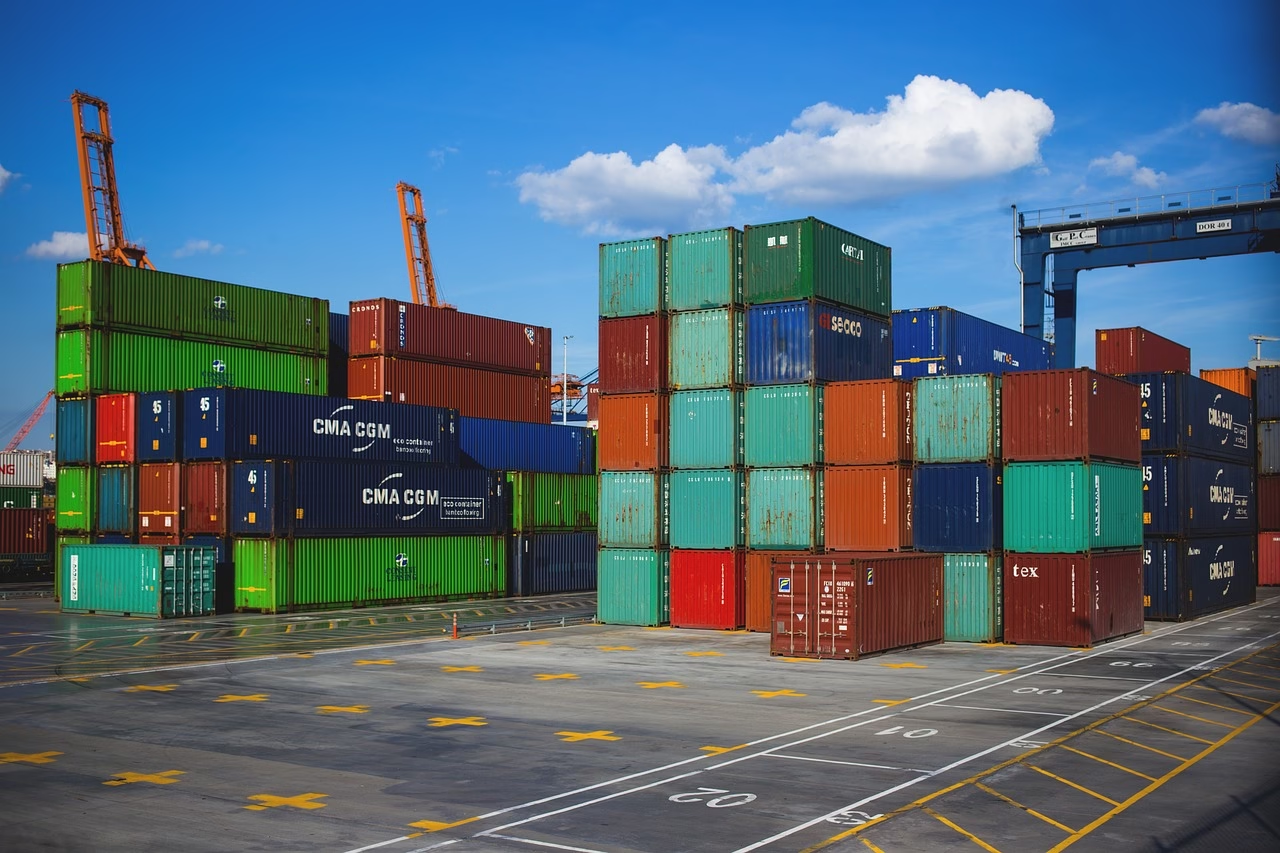
This leaves the Middle Corridor—stretching from China through Kazakhstan, across the Caspian Sea to Azerbaijan, Georgia, and into Turkey/EU—as the only viable mid-speed land bridge. However, this route is currently facing massive ‘success-driven’ bottlenecks at the ports of Aktau and Baku.
The Strategic Risk Tool: Xeneta
To navigate this volatility, we are no longer looking at static spreadsheets. Professional analysts are using Xeneta, a real-time ocean and air freight rate benchmarking platform.
How to use it: Don’t just look at the rates. Monitor the spread between Short-Term Spot Rates and Long-Term Contract Rates on the Far East to Mediterranean lanes. In 2026, if the spot rate jumps 20% above the contract rate, it is a leading indicator that the Middle Corridor rail capacity is about to hit a 14-day backlog, allowing you to pivot to air-sea hybrids before the market reacts.
Actionable Strategy for Business Owners and Investors
- For Logistics Managers: Diversify 20% of your EU-bound inventory to the Middle Corridor rail link. The transit time is currently 18–25 days—faster than the Cape of Good Hope sea route (35–45 days) and safer than the Red Sea.
- For International Freelancers: Watch the Kazakhstani Tenge (KZT) and Georgian Lari (GEL). These currencies are becoming ‘logistics proxies.’ When transit volumes through the Middle Corridor spike, these currencies often strengthen, affecting your local purchasing power and tax liabilities.
- For Global Investors: The ‘bottleneck infrastructure’ is the play. Focus on private equity or infrastructure bonds tied to dry-port expansions in Kazakhstan and the expansion of the Baku-Tbilisi-Kars (BTK) railway.
The Bottom Line
Geopolitics in 2026 isn’t about ideology; it’s about geography and throughput. The Middle Corridor is no longer an ‘alternative’—it is a primary artery. If your supply chain relies on a single maritime route, you aren’t just taking a risk; you are ignoring the map.

























Leave a Reply