


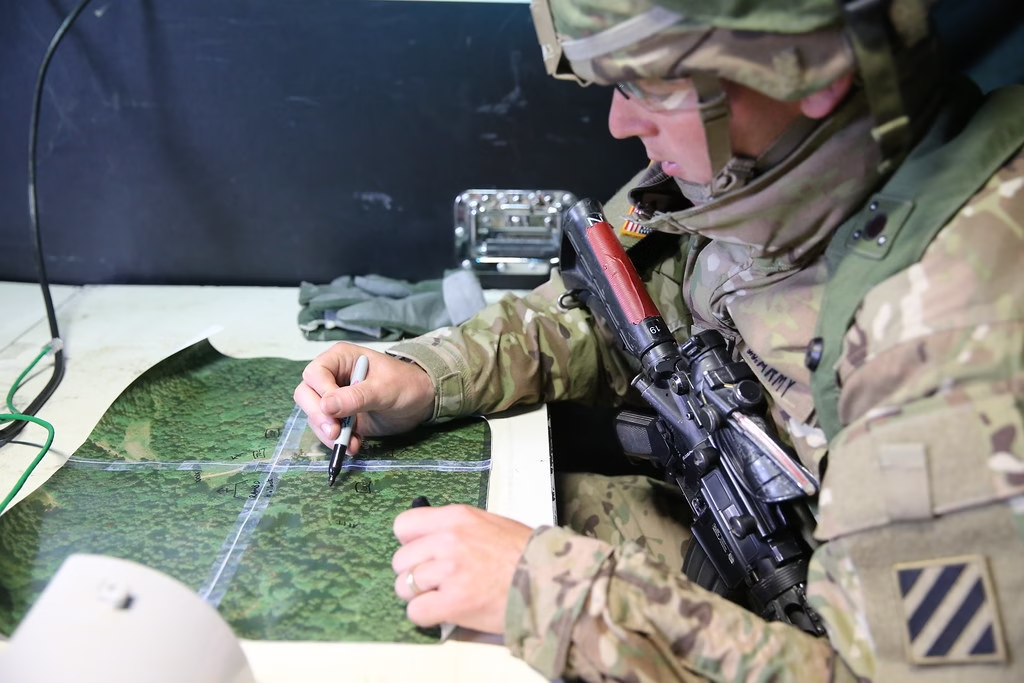
The United States military launched a coordinated wave of airstrikes against Iranian-linked targets on Tuesday, acting on direct orders from President Donald Trump following a drone strike in Jordan that killed three American service members. The fallen soldiers, hailing from Texas, Hawaii, and New York, died when an enemy drone struck their outpost near the Syrian border, marking the first U.S. military fatalities from hostile fire in the region since the escalation of regional tensions.
Background of the Border Outpost Attack
The fatal attack targeted Tower 22, a critical logistical support base located in northeastern Jordan near the borders of Syria and Iraq. Approximately 350 U.S. Army and Air Force personnel are stationed at the outpost, conducting support and coalition operations aimed at the lasting defeat of ISIS.
Defense officials identified the deceased soldiers as Army Reserve specialists and sergeants assigned to an engineering company. The strike also injured more than 40 other service members, several of whom required medical evacuation to regional trauma centers for severe brain injuries and shrapnel wounds.
The three fallen soldiers represent diverse corners of the United States, bringing the human cost of the conflict home to communities in Texas, Hawaii, and New York. Governors from all three states issued statements of condolence and ordered state flags to fly at half-staff in honor of their sacrifice. Their units were primarily tasked with infrastructure support, making them vulnerable targets in the remote desert outpost.
Jordanian authorities initially downplayed the location of the strike, but Pentagon officials quickly confirmed the attack occurred on Jordanian soil. This geographic detail has heightened diplomatic sensitivities, as Jordan remains a key Western ally and a cornerstone of regional security cooperation.
U.S. Retaliation and Military Response
In immediate response to the casualties, President Trump authorized decisive military action against sites linked to Iran’s Islamic Revolutionary Guard Corps (IRGC) and affiliated militias. Pentagon sources confirm that precision-guided munitions struck command-and-control centers, intelligence facilities, and munitions storage depots across multiple locations.
B-1B Lancer heavy bombers, flown from bases in the United States, participated in the multi-hour operation, demonstrating the global reach of the U.S. Air Force. The operation utilized over 125 precision munitions aimed at facilities used by the IRGC Quds Force and affiliated militia groups. Military planners selected these targets specifically to disrupt the logistics chain that supplies unmanned aerial vehicles to proxy forces.
“The United States does not seek conflict in the Middle East, but we will not tolerate attacks on our forces,” President Trump stated during a press briefing from the White House. Military analysts report that the scale of the counter-strikes represents a significant escalation in the ongoing shadow war between Washington and Tehran.
Central Command (CENTCOM) reports that early battle damage assessments indicate high success rates in neutralizing the targeted infrastructure. However, defense analysts warn that targeting IRGC-backed groups inside sovereign territories carries substantial geopolitical risks.
Geopolitical Friction and Expert Analysis
Foreign policy experts suggest that the administration’s robust response aims to establish deterrence without triggering an all-out regional war. “The administration had to thread a very narrow needle,” says Dr. Evelyn Vance, a senior fellow at the Middle East Security Institute. “A weak response would invite further attacks, while an overreaction could ignite a broader conflict involving multiple state actors.”
The attack at Tower 22 exposed critical vulnerabilities in regional air defense networks, particularly regarding low-flying, slow-speed drone detection. Standard radar systems often struggle to distinguish small composite drones from local avian activity or ground clutter. Consequently, the Pentagon is accelerating the deployment of directed-energy weapons and advanced electronic warfare systems to frontline bases.
Intelligence reports indicate that the drone utilized in the Jordan attack was an Iranian-designed Shahed-class one-way attack aerial vehicle. This technological signature directly links the strike to Tehran-backed networks operating in western Iraq and eastern Syria, according to military intelligence analysts.
Iranian officials have denied direct involvement in the strike, claiming that regional resistance groups act independently of Tehran’s command structure. U.S. intelligence agencies reject this narrative, pointing to decades of financial, logistical, and technological support provided by the IRGC to these proxy networks.
Strategic Implications and Future Outlook
The escalation has immediate ramifications for the deployment of U.S. forces across the Middle East, with security postures elevated to maximum alert levels. Air defense systems, including Patriot missile batteries and counter-drone systems, are currently being redeployed to vulnerable outposts throughout Iraq, Syria, and Jordan.
Lawmakers on Capitol Hill remain divided on the long-term strategy, with some demanding harsher direct strikes inside Iran, while others caution against entering another protracted conflict. The economic impact is already visible, as global energy markets reacted to the strikes with a brief surge in crude oil prices amid fears of shipping disruptions in the Strait of Hormuz.
In the coming days, observers will closely monitor the reaction of Iranian-backed militias to determine if the U.S. deterrence strategy has succeeded. The potential for miscalculation remains high, and diplomatic channels through third-party intermediaries like Qatar and Oman are expected to play a critical role in preventing further escalation.























Leave a Reply