


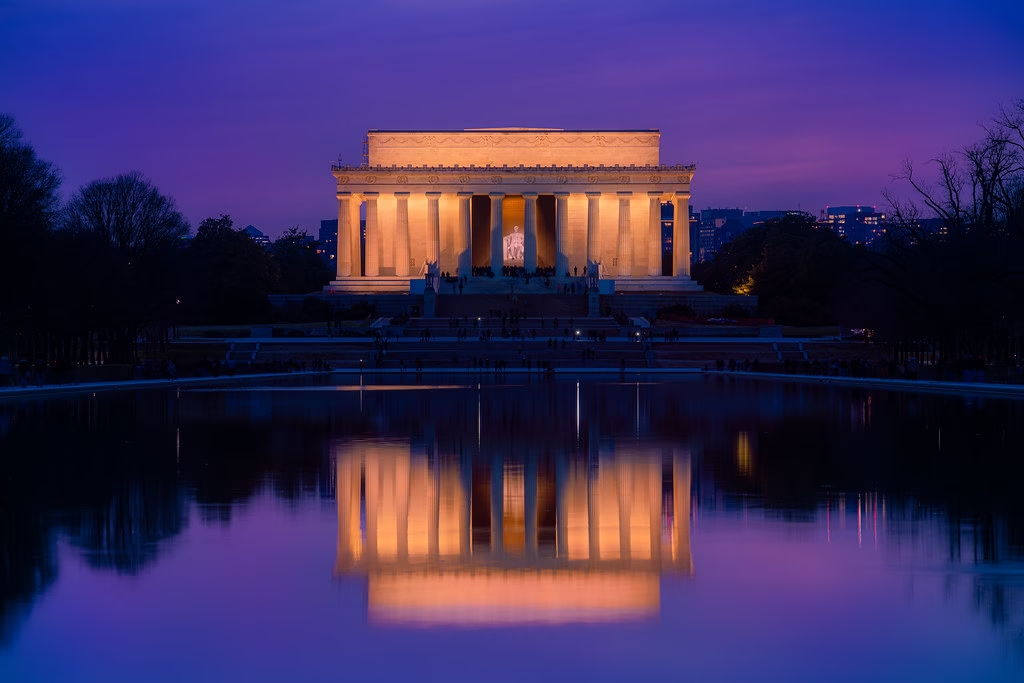
As Washington D.C. prepares for the nation’s 250th anniversary, the Lincoln Memorial Reflecting Pool has emerged as an unlikely epicenter of political tension. On the eve of July Fourth, the iconic landmark—once a symbol of unity—now serves as a physical mirror for a deeply polarized American public.
Contextualizing the National Symbol
The Reflecting Pool, designed to provide a serene vista between the Lincoln Memorial and the Washington Monument, has historically functioned as a site for monumental national gatherings. From the 1963 March on Washington to various bicentennial celebrations, the site has long been treated as neutral ground for democratic expression.
However, recent shifts in public discourse have altered how visitors engage with the space. What was once viewed as a tranquil architectural feature is now frequently interpreted through the lens of partisan identity, with maintenance issues, site accessibility, and even the clarity of the water becoming flashpoints for broader societal grievances.
The Anatomy of Polarization
Observers note that the divide surrounding the pool reflects a broader trend of institutional skepticism. When public infrastructure requires maintenance or becomes the site of security-heavy events, citizens increasingly view these logistical realities as ideological statements rather than administrative necessities.
Sociologists suggest that the physical environment of the National Mall is being repurposed as a canvas for cultural conflict. As the country approaches its semiquincentennial in 2026, the pressure on these physical spaces to represent a cohesive national identity is mounting, often resulting in friction between competing visions of what America should prioritize.
Expert Perspectives and Data
Urban planners argue that the trend of politicizing public space is not unique to Washington, but it is magnified by the city’s role as the seat of government. According to recent survey data from the Pew Research Center, trust in government institutions remains near historic lows, a sentiment that inevitably bleeds into the public’s perception of federally managed landmarks.
Architectural historians point out that the Reflecting Pool was engineered to be a mirror, literally and figuratively. When the water is murky or the site is congested, the public reaction often mirrors their internal frustrations with the state of the union. It is a classic case of projection, where the physical condition of a national monument is conflated with the political health of the nation.
Looking Toward the Semiquincentennial
The implications for the upcoming 250th anniversary are significant. As the National Park Service plans for millions of visitors to descend upon the capital, the challenge will be managing the space as a neutral ground rather than a battlefield.
Industry analysts suggest that the next two years will be a litmus test for how the U.S. manages its public memory. Observers should watch for how upcoming restoration projects and security protocols are communicated to the public, as these will likely serve as the next set of triggers for public debate regarding the ownership and purpose of national monuments.






















Leave a Reply