


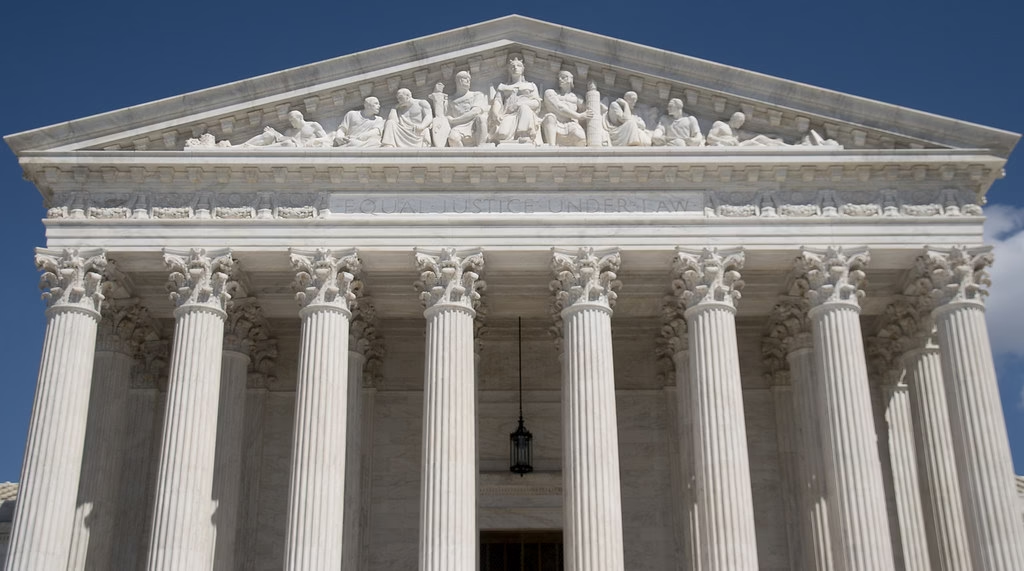
In a landmark decision delivered this week at the U.S. Supreme Court in Washington, D.C., the justices upheld the long-standing constitutional guarantee of birthright citizenship under the 14th Amendment. However, the narrowly tailored ruling has sustained an intense national debate, leaving distinct legal pathways open for conservative opponents to launch future constitutional challenges.
Understanding the 14th Amendment Bedrock
The Citizenship Clause of the 14th Amendment, ratified in 1868, explicitly states that all persons born or naturalized in the United States, and subject to the jurisdiction thereof, are citizens of the United States. Historically, this clause was enacted to ensure that newly freed African Americans were granted full legal citizenship following the Civil War.
The legal precedent governing modern birthright citizenship was firmly established in the 1898 landmark case United States v. Wong Kim Ark. In that decision, the Supreme Court ruled that a child born on U.S. soil to non-citizen parents automatically acquires American citizenship at birth.
Despite this century-old precedent, opponents of automatic birthright citizenship have increasingly argued that the original intent of the phrase “subject to the jurisdiction thereof” was never meant to extend to children of undocumented immigrants or foreign visitors.
A Narrow Verdict That Keeps Opposition Alive
While the Supreme Court’s latest ruling affirmed current birthright citizenship practices, legal experts emphasize that the justices decided the case on specific procedural grounds rather than issuing an absolute, sweeping endorsement of the clause’s modern interpretation.
This technical boundary provides legal scholars and conservative advocacy groups the room they sought to re-litigate the issue under different factual scenarios. Opposition legal teams have already signaled plans to challenge automatic citizenship through targeted state-level legislation designed to trigger higher judicial review.
By reframing the definition of national jurisdiction, opponents hope to present the court with a novel legal question that could force a re-examination of the 1898 Wong Kim Ark precedent.
Expert Perspectives and Demographic Data
Constitutional law experts remain divided on whether a future court would be willing to overturn established precedent regarding automatic citizenship. “The court’s decision maintains the status quo for now, but it signals to litigants that the constitutional interpretation is not entirely immune to re-evaluation,” noted Sarah Lin, a senior legal scholar at the Center for Constitutional Jurisprudence.
Demographic data underscores the vast real-world footprint of the issue. According to estimates from the Pew Research Center, roughly 4.4 million U.S.-born children under the age of 18 live with at least one unauthorized immigrant parent. Policy analysts note that any structural shift in birthright citizenship rules would fundamentally reshape U.S. immigration policy, tax revenue, and social services allocation across multiple states.
Conversely, reform advocates argue that restricting birthright citizenship is essential for protecting national sovereignty and reducing long-term incentives for illegal border crossings.
What to Watch Next in the Courts and Statehouses
The immediate focus now shifts to state legislatures, where conservative lawmakers in several states are drafting model legislation aimed at restricting state-level birth certificates for children of non-citizens. These bills are explicitly structured to generate fresh lawsuits that can travel up the federal appellate ladder.
Legal analysts will also monitor potential executive orders from future presidential administrations designed to alter agency enforcement of the 14th Amendment. As lower federal courts process newly filed challenges, the debate over who automatically qualifies as an American citizen will remain a focal point of legislative battles and presidential campaign platforms in the years ahead.























Leave a Reply