


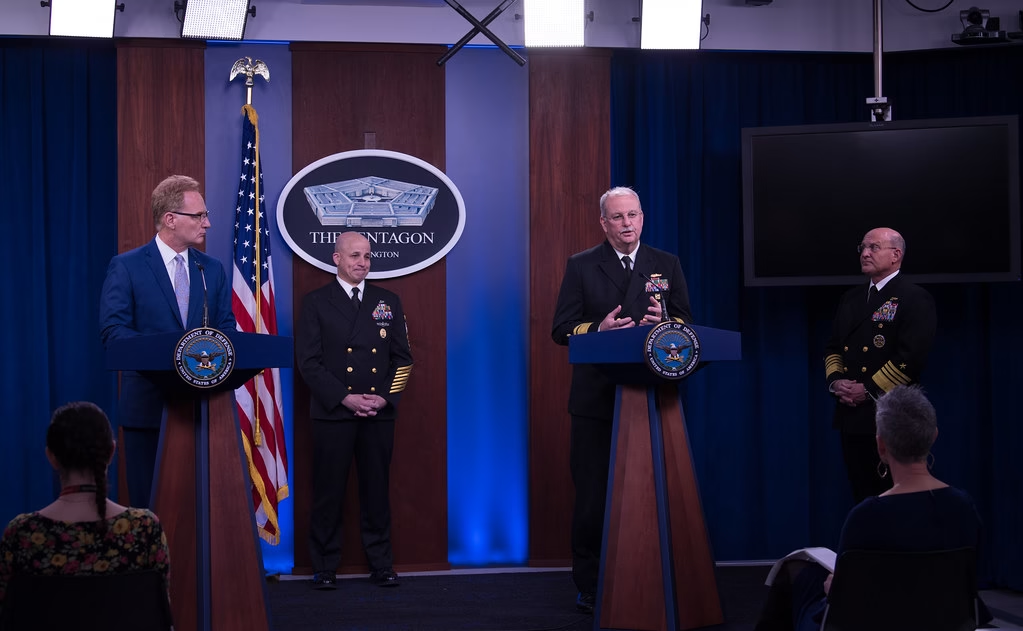
The U.S. Department of Defense revised its official casualty count for military engagements involving Iranian-aligned forces this week, lowering the official death toll from 18 to 14 after quietly removing four service members killed earlier this month. The sudden administrative adjustment, announced quietly in an updated defense log on Tuesday, has raised immediate questions among defense analysts, lawmakers, and veteran advocates regarding military transparency during escalating regional conflicts.
Revising the Ledger of Regional Hostilities
The four omitted service members were initially added to the official tally following a drone strike on an operational outpost in eastern Syria. The Department of Defense had previously attributed the fatalities directly to ongoing escalations with Iranian-backed militias in the region. However, military officials clarified that a secondary administrative review reclassified the incident under a separate, non-combat operational directive.
Under established U.S. military protocol, casualty counts are tied to specific operation designators, such as Operation Inherent Resolve or designated hostile combat zones. When casualties occur outside the precise geographic or tactical boundary of an active operation, they are frequently shifted to general military mortality logs rather than conflict-specific tallies. Defense officials maintain that the adjustment represents a standard auditing procedure rather than an effort to alter the public record.
The revision comes during a period of heightened military readiness across the Middle East, where U.S. forces have faced dozens of attacks by regional proxies over the past six months. Accurate casualty reporting remains a critical component of public accountability and congressional oversight during un-declared operational deployments.
Methodology and the Mechanics of Casualty Tracking
Casualty reporting in the U.S. armed forces is governed by Department of Defense Instruction 1300.18, which sets strict parameters for how personnel losses are categorized. The framework distinguishes sharply between casualties sustained in direct hostile action, non-hostile combat zone deaths, and external administrative losses. While the distinction is vital for internal defense logistics and legal benefit disbursements, it frequently creates confusion for the public and news organizations monitoring regional conflicts.
Military accounting procedures require clear attribution of hostiles before a fatality is permanently linked to a specific state or non-state actor. When intelligence reports suggest mixed causality or administrative overlap, defense auditors often remove names from active battle ledgers pending formal investigation results. This bureaucratic separation often leads to sudden fluctuations in publicly facing military metrics.
Historical precedents show similar accounting adjustments during prolonged foreign engagements. During operations in Iraq and Afghanistan, casualty figures were routinely re-audited as intelligence assessments clarified the exact circumstances of service member deaths. However, adjustments that lower official totals remain relatively rare and draw intense scrutiny from military watchdogs.
Expert Perspectives and Public Reaction
Defense analysts point out that precise accounting is crucial when assessing the true strategic cost of military commitments abroad. Dr. Marcus Vance, a senior fellow at the Center for Security Studies, noted that casualty figures directly influence public perception and legislative authorization. “When the Department of Defense alters combat death totals, it impacts how Congress evaluates the intensity of a conflict,” Vance said. “Methodological consistency is essential for maintaining trust between the military leadership and the public.”
Veteran advocacy organizations have also expressed concern over the timing and communication of the revision. Representatives from national military family networks emphasized that administrative classifications must not obscure the personal sacrifices made by service members deployed in volatile regions. They called for greater public explanation whenever official registries are altered.
Congressional oversight committees have already requested formal briefings from Pentagon officials to review the criteria used in the reclassification. Staffers familiar with the matter indicated that lawmakers seek clarification on whether the four service members will remain eligible for combat-related honours and specialized survivor benefits despite their removal from the primary combat ledger.
Implications and Strategic Outlook
The decision to adjust the casualty registry highlights the growing complexity of modern, asymmetrical warfare, where defining the exact boundaries of a combat zone is increasingly difficult. As U.S. operations rely heavily on decentralized outposts and targeted counter-drone operations, the lines separating direct warfare from regional containment continue to blur. This ambiguity presents persistent challenges for military record-keepers tasked with maintaining clear operational records.
In the coming weeks, Congress is expected to hold closed-door hearings on Middle Eastern operational readiness, where casualty accounting protocols will likely be addressed. The House Armed Services Committee has signaled interest in establishing standardized public notification procedures whenever casualty ledgers are adjusted downward. Watchdogs and defense scholars will be monitoring these legislative efforts to see if updated reporting mandates are introduced in the upcoming National Defense Authorization Act.























Leave a Reply