


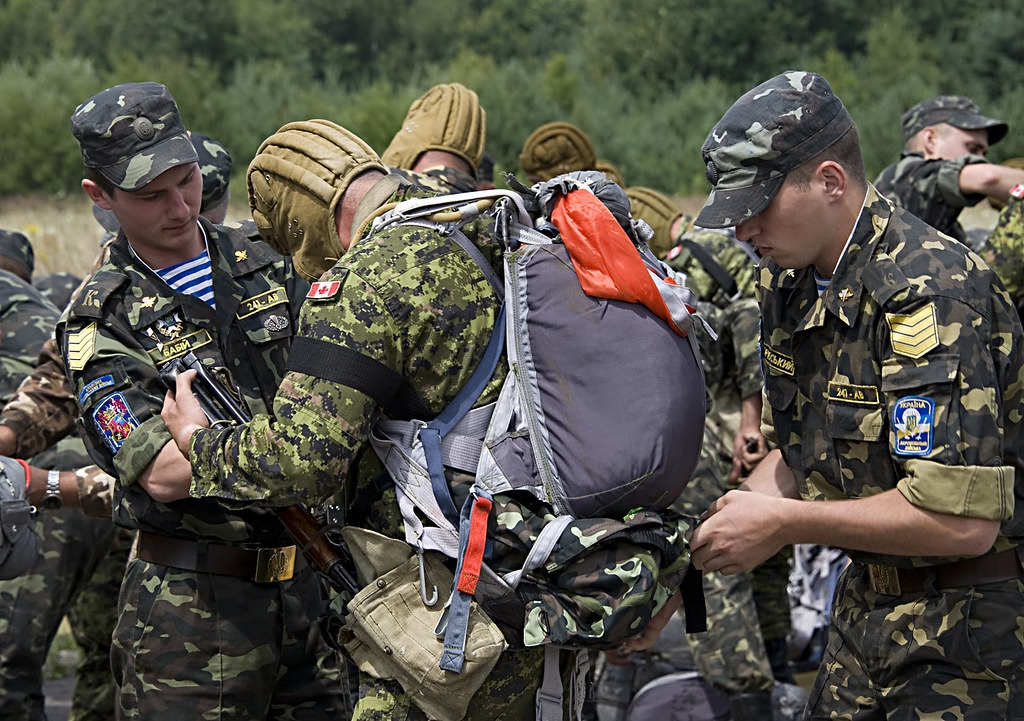
NATO Secretary General Mark Rutte announced on Thursday a massive defense spending surge totaling hundreds of billions of dollars, coinciding with a pledge by US President Donald Trump to deploy an additional 5,000 American troops to Poland. The dual announcements, delivered from Brussels and Washington, signal a dramatic acceleration of military readiness along NATO’s eastern flank. This strategic pivot aims to reinforce deterrence against regional threats while directly rewarding European nations that meet or exceed alliance spending targets.
Rewarding NATO’s Top Spenders
For years, the transatlantic alliance has faced intense pressure to reform its defense spending model. Poland has emerged as a leader in this effort, allocating over 4 percent of its Gross Domestic Product (GDP) to defense, surpassing even the United States in percentage terms. Under Mark Rutte’s leadership, NATO is shifting toward a highly transactional framework that aligns closely with Washington’s demands for equitable burden-sharing.
Trump announced the troop deployment on the social media platform Truth Social on Thursday, stating, “I am pleased to announce that the United States will be sending an additional 5,000 Troops to Poland.” The decision directly links American military commitments to the financial contributions of host nations. This move effectively cements Warsaw as the primary hub for American military power in Central and Eastern Europe.
A Historic Financial Commitment
The deployment of 5,000 additional US troops represents a substantial boost to the existing American military footprint in Poland, which currently stands at approximately 10,000 personnel. These forces will integrate into existing command structures, enhancing rapid-response capabilities. The deployment represents a major logistical undertaking that will require significant infrastructural support from the Polish government.
Simultaneously, Rutte confirmed that NATO allies are prepared to inject hundreds of billions of dollars into collective defense. This capital injection will target critical shortages in ammunition stockpiles, advanced air defense systems, and next-generation electronic warfare capabilities. The commitment represents the largest collective modernization effort since the end of the Cold War, reflecting a heightened sense of urgency among member states.
Strategic Implications and Expert Perspectives
Security analysts argue that the troop deployment serves a dual political and tactical purpose. By rewarding Poland’s high spending, the US administration is sending a clear message to other European allies. Military planners note that the shift of US forces further east reflects the changing realities of European security geography.
“Deterrence is no longer just about historic alliances; it is now explicitly tied to financial contribution,” says Dr. Elena Rostova, a senior fellow at the European Security Institute. This financial transactionalism could pressure lagging Western European nations to accelerate their own defense acquisitions. Countries like Germany and Italy, which have struggled to consistently meet the 2 percent GDP threshold, may face renewed political pressure from both Washington and Brussels.
Poland’s defense ministry welcomed the announcement, noting that the additional troops will be stationed at key strategic locations. Warsaw has spent billions of dollars on American military hardware, including F-35 fighter jets, Patriot missile defense systems, and Abrams tanks. This procurement strategy has made Poland one of the most interoperable allies with US forces in the world.
Defense Industry Boom and Future Outlook
The massive influx of capital is expected to trigger a prolonged boom for the global defense industry, particularly for major aerospace and defense contractors in the US and Europe. Stock prices for major defense firms rose following the announcement, reflecting investor confidence in long-term procurement contracts. The focus will now turn to how quickly defense manufacturers can scale up production to meet the sudden surge in demand.
In the coming months, observers will closely watch the formal deployment timelines for the 5,000 US troops and how they will be distributed across Polish bases. Attention will also turn to the upcoming NATO defense ministerial meeting, where member states must detail how they plan to allocate the promised hundreds of billions of dollars. Additionally, geopolitical analysts will monitor Moscow’s reaction, as the Kremlin has historically viewed any increase in NATO forces near its borders as a direct provocation.




















Leave a Reply