


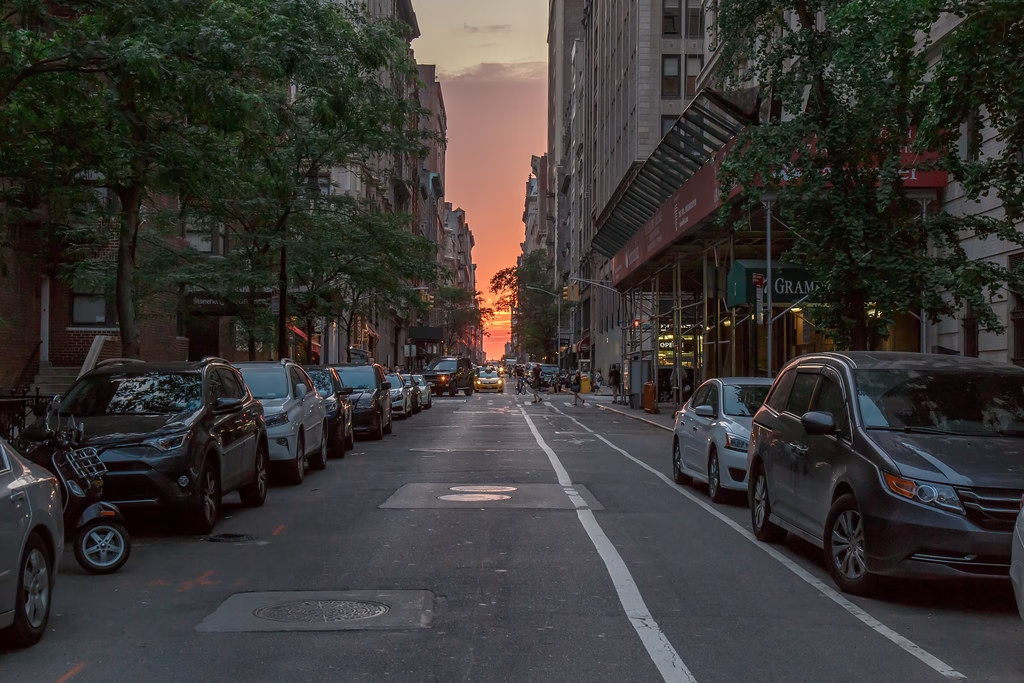
Twice a year, New York City transforms into an open-air observatory as the setting sun aligns perfectly with the Manhattan street grid, a phenomenon colloquially known as Manhattanhenge. This celestial event occurs in late May and mid-July, drawing thousands of spectators to major cross-streets to witness the sun sink directly between the city’s towering skyscrapers.
The Mechanics of the Phenomenon
The term Manhattanhenge was coined by astrophysicist Neil deGrasse Tyson, who drew a comparison between the New York grid and the prehistoric monument Stonehenge. While Stonehenge was designed to frame the sun during solstices, Manhattan’s layout is a result of the 1811 Commissioners’ Plan.
Because the city’s grid is rotated approximately 29 degrees east of true north, the sun does not align with the streets every day. The specific alignment happens only when the sun’s azimuth at sunset matches the orientation of the Manhattan street system.
A Geometric Coincidence
The phenomenon is possible because of the unique intersection of urban planning and planetary motion. Most of Manhattan’s streets run in a precise grid, creating a natural framing effect for the solar disk.
Spectators typically gather on major cross-streets such as 14th, 23rd, 34th, 42nd, and 57th Streets. The most popular viewing spots often include areas near the Chrysler Building or the Empire State Building, which add architectural drama to the golden light.
Expert Insights and Observations
According to data from the American Museum of Natural History, the event occurs on two separate dates for the “half-sun” alignment and two dates for the “full-sun” alignment. The full-sun effect is widely considered the most visually striking, as the entire solar disk rests squarely on the horizon.
Photography experts suggest that the best results occur when viewers position themselves as far east as possible while still looking west toward New Jersey. This vantage point allows the buildings to act as a funnel, concentrating the light and creating a high-contrast silhouette of the city skyline.
Broader Implications for Urban Tourism
For the tourism industry, Manhattanhenge has evolved from a local curiosity into a significant cultural event. City officials and local businesses now anticipate the influx of photographers and sightseers, with many restaurants and hotels offering rooftop viewing packages.
The event also highlights the enduring relationship between urban design and the natural environment. As cities continue to expand, the interest in Manhattanhenge underscores a growing public desire to engage with the natural world even within dense, man-made environments.
Future Trends and Viewing Prospects
Looking ahead, the predictability of these dates allows for long-term urban planning regarding crowd control and traffic management in key viewing corridors. As social media continues to amplify the event, observers should expect even larger crowds in the coming seasons, potentially shifting viewing habits toward lesser-known side streets to avoid congestion.
Future spectators should monitor official forecasts from astronomical institutions, as weather conditions—specifically cloud cover—can significantly impact the visibility of the alignment. As the city evolves, the enduring nature of this solar event serves as a reminder of the fixed, immutable geometry of Manhattan’s historic grid.





















Leave a Reply