



President Donald Trump recently announced that the United States and Iran have reached a preliminary agreement aimed at de-escalating regional tensions and placing verifiable limits on Iran’s nuclear program. The announcement, delivered in Washington this week, marks a significant shift in the administration’s ‘maximum pressure’ strategy, though the framework has immediately drawn comparisons to the 2015 Joint Comprehensive Plan of Action (JCPOA) that the White House withdrew from in 2018.
The Shadow of the 2015 Accord
To understand the current diplomatic landscape, one must look back to the 2015 nuclear deal negotiated under the Obama administration. That agreement provided Iran with sanctions relief in exchange for strict, time-bound limitations on its uranium enrichment capabilities and intrusive inspections by the International Atomic Energy Agency (IAEA).
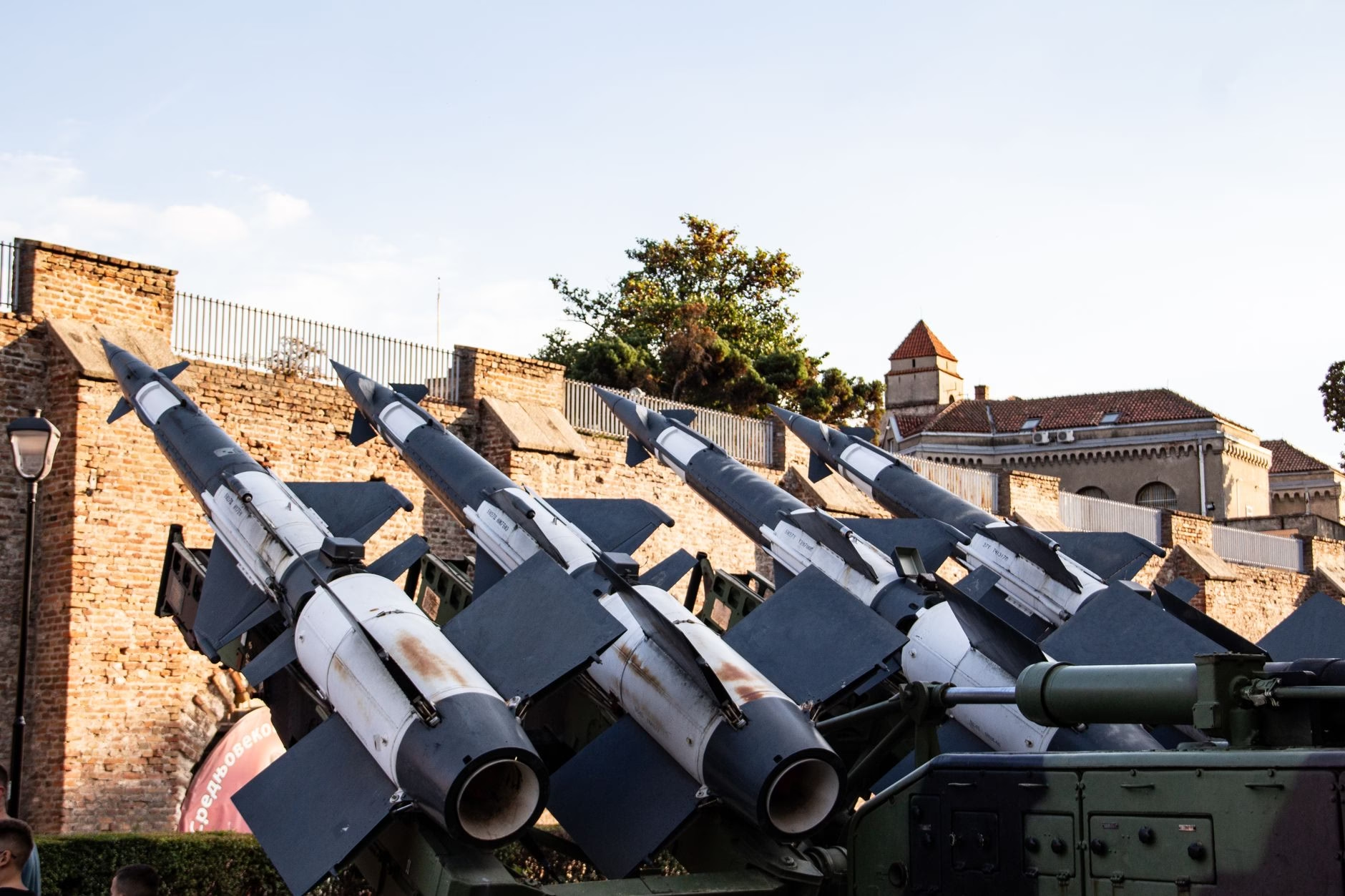
When the Trump administration exited the JCPOA in 2018, officials argued that the deal failed to address Iran’s ballistic missile program and its regional influence. The subsequent campaign of economic sanctions was designed to force Tehran back to the negotiating table on more favorable terms for the United States.
Analyzing the New Proposal
The proposed framework currently under discussion appears to mirror several structural elements of the original 2015 deal, including provisions for monitoring nuclear facilities and caps on enrichment levels. White House officials maintain that this iteration includes ‘stronger enforcement mechanisms’ and addresses the long-range missile concerns that were absent from the previous accord.
However, geopolitical analysts note that the core tension remains: the trade-off between economic revitalization for Iran and the permanent containment of its nuclear ambitions. While the administration frames this as a new path forward, critics argue that the basic architecture of nuclear non-proliferation agreements is inherently limited by the same technical and political constraints that existed a decade ago.
Expert Perspectives and Data
Data from the IAEA has consistently shown that since the U.S. withdrawal from the JCPOA, Iran has significantly increased its stockpile of enriched uranium and deployed advanced centrifuges. According to a recent report by the Institute for Science and International Security, Iran’s ‘breakout time’—the time required to produce enough fissile material for a nuclear weapon—has shrunk to a fraction of what it was under the 2015 deal.
Dr. Elena Rossi, a senior fellow at the Center for International Security, notes that any successful agreement requires trust, which remains in short supply. ‘The challenge is not just the technical language of the treaty, but the political reality of verification and the ability of both nations to sell a compromise to their respective domestic hardliners,’ Rossi stated.
Industry and Global Implications
For the global energy markets and international investors, the potential for a thaw in U.S.-Iran relations represents a significant variable. A lifting of energy sanctions could theoretically return Iranian oil to the global market, potentially easing price pressures, though such an outcome depends entirely on the durability of a signed agreement.
Regional allies, particularly in the Middle East, are closely monitoring the negotiations for signs of how the U.S. intends to balance its security commitments. The shift suggests a pivot toward a more transactional approach to diplomacy, prioritizing immediate stabilization over broad, multi-nation consensus.
Moving forward, observers should watch for the announcement of a formal signing ceremony or the establishment of a joint commission to oversee compliance. The primary indicator of success will be whether the administration can secure bipartisan support in Congress and whether Tehran can navigate its own internal political divisions regarding the perceived concessions required to achieve sanctions relief.



















Leave a Reply