


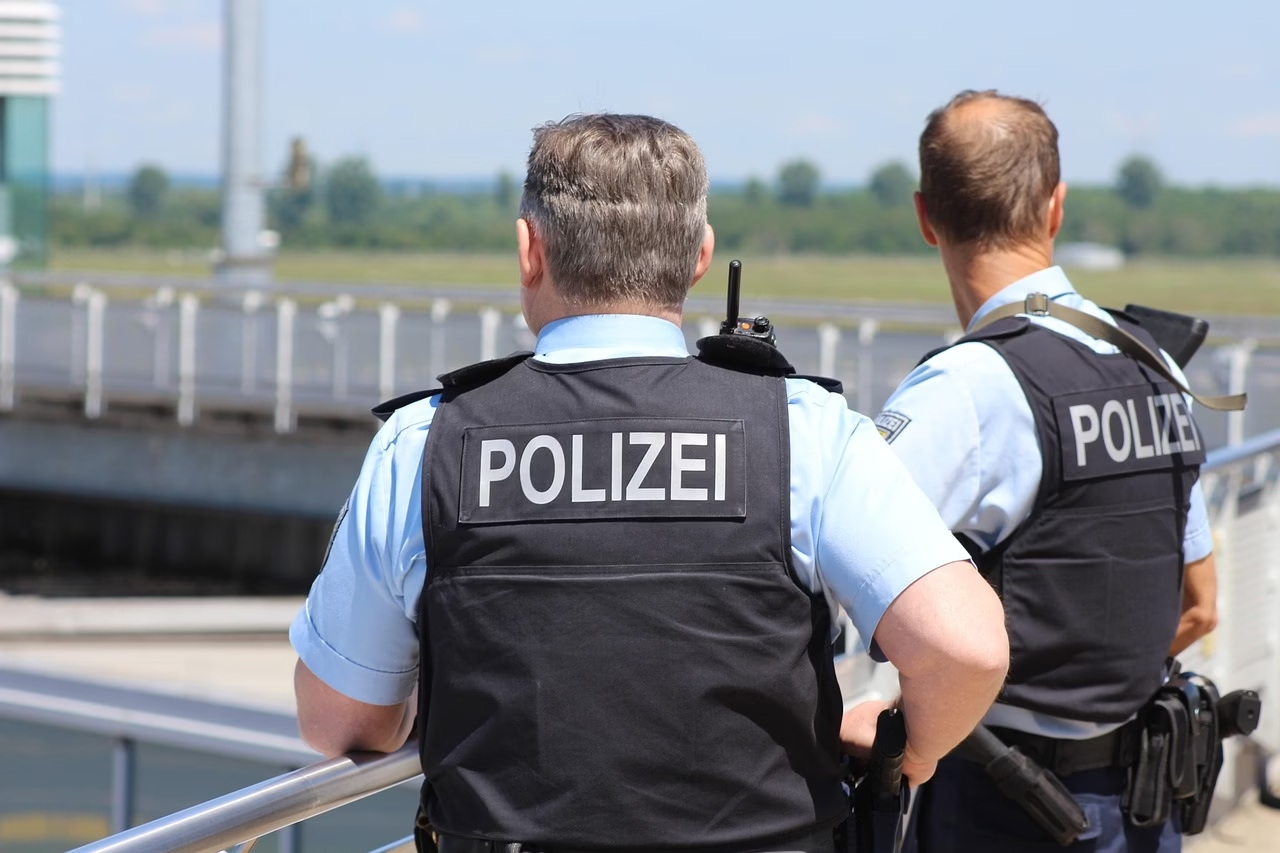
Federal law enforcement officers apprehended an individual outside 26 Federal Plaza in Lower Manhattan on Tuesday after the suspect detonated an incendiary device near a prominent federal immigration court complex. The Federal Bureau of Investigation confirmed to news outlets that the suspect carried airsoft rifles designed to resemble authentic military weapons and set off high-grade commercial fireworks, causing a localized explosion outside the building housing U.S. Immigration and Customs Enforcement field offices.
Immediate Law Enforcement Response and Incident Details
The incident triggered an emergency multi-agency response, mobilizing the FBI Joint Terrorism Task Force, the New York City Police Department, and Federal Protective Service officers. Eyewitnesses reported a loud blast and smoke billowing near the plaza entrance along Foley Square shortly before law enforcement personnel subdued the suspect without active gunshots fired. Authorities immediately cordoned off surrounding streets, halting public access to one of the nation’s busiest federal administrative hubs.
Initial physical assessments indicated that while the airsoft rifles lacked lethal ballistic capabilities, the pyrotechnic explosion presented a direct physical threat to bystanders and court visitors. Law enforcement officials isolated the device fragments and swept the immediate perimeter with bomb-sniffing K-9 units to rule out secondary explosive threats. The suspect was taken into federal custody for detailed interrogation regarding motive and preparation.
Background and Context of Federal Plaza Security
The Jacob K. Javits Federal Building at 26 Federal Plaza serves as a primary hub for government administration in the northeastern United States. Beyond housing ICE leadership and deportation officers, the facility contains bustling immigration courts that handle thousands of asylum, deportation, and status adjustment hearings annually. Consequently, the plaza experiences heavy daily foot traffic, comprising legal representatives, federal employees, and visa petitioners.
Government facilities across major American urban centers have faced heightened security postures in recent years amid escalating political tensions surrounding federal law enforcement and immigration policy. According to data published by the U.S. Marshals Service, reported threats and inappropriate communications directed at federal judicial officials and court facilities reached over 4,000 incidents in fiscal year 2023, reflecting a sustained rise in security risks targeting government administrative sites.
Expert Security Perspectives and Threat Analyses
Physical security experts emphasize that simulated weaponry combined with functional pyrotechnics presents severe tactical challenges for security forces guarding civic spaces. Retired federal security analyst Marcus Vance noted that open-air public plazas surrounding government skyscrapers represent ‘soft targets within hard perimeters.’ He explained that distinguishing real firearms from realistic airsoft replicas during a rapid pyrotechnic event forces officers to make split-second decisions under extreme stress.
Data from the Department of Homeland Security indicates that non-lethal pyrotechnic disruptions near government infrastructure have increasingly been utilized to provoke panic or test security perimeter response times. Forensic teams at the scene are evaluating the exact composition of the incendiary device to determine whether federal arson or explosive charges apply under Title 18 of the United States Code.
Broader Implications for Federal Facilities and Legal Operations
This security breach highlights ongoing operational vulnerabilities at high-density administrative complexes operating in major metropolitan areas. In response to the breach, regional federal agencies are expected to conduct immediate reviews of access control protocols and perimeter surveillance capabilities around public plazas across Manhattan and nationwide.
Legal proceedings inside 26 Federal Plaza faced temporary disruptions following the evacuation and perimeter lockdown, illustrating how physical security incidents directly impact judicial operations and scheduled hearings. Federal court administrators may implement stricter standoff distances and enhanced mobile patrol units to deter future attempts at disrupting government functions.
Future Security Outlook and Key Factors to Watch
Looking ahead, federal prosecutors are expected to file formal charges detailing whether the suspect acted independently or in coordination with broader activist groups. Observers will monitor how the Department of Homeland Security and the General Services Administration adjust physical barrier architecture surrounding 26 Federal Plaza and similar urban government centers.
Additionally, lawmakers may revisit federal regulations regarding the public open-carry of realistic airsoft weaponry near sensitive government infrastructure. Security updates and court scheduling adjustments stemming from this incident will serve as a critical test case for federal facility protection protocols in dense urban environments nationwide.


















Leave a Reply