


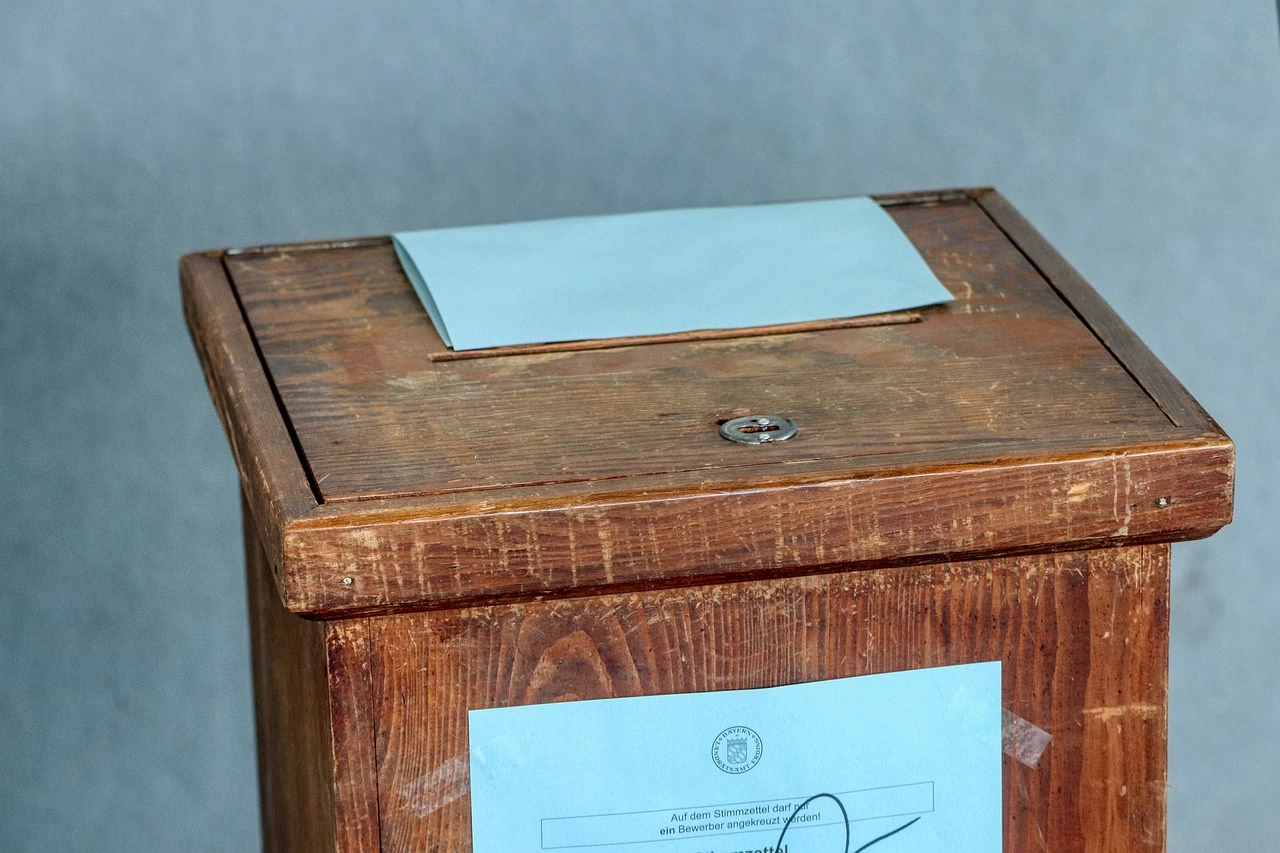
WASHINGTON — Former President Donald Trump is renewing calls for an expanded federal role in overseeing national voting procedures ahead of the 2026 midterm elections, sparking intense debate among lawmakers and election officials over constitutional boundaries and ballot integrity. The push comes as state election directors nationwide maintain that local voting systems are more secure than ever following years of state-funded upgrades.
State Upgrades and Constitutional Boundaries
Under Article I, Section 4 of the U.S. Constitution, individual states hold primary responsibility for administering elections and setting voting regulations. In the years following the 2020 election, state legislatures across the country enacted sweeping updates to modernize voting infrastructure and tighten security protocols.
Data from the National Conference of State Legislatures shows that more than 35 states have passed major election administration legislation since 2021. These state-level statutes focused on enhancing physical security at voting sites, refining chain-of-custody procedures for mail ballots, and introducing mandatory pre- and post-election audits.
State election administrators emphasize that these localized efforts have systematically addressed vulnerabilities. Officials point out that decentralized systems inherently protect national elections from single points of failure or widespread systemic interference.
The Growing Push for Federal Oversight
Despite significant state-level changes, national political figures continue to push for centralized federal standards. Proposed federal initiatives include mandatory national voter identification rules, federal proof-of-citizenship requirements for voter registration, and direct federal monitoring of local polling operations.
Proponents of federal intervention argue that national standards are necessary to ensure uniformity across state lines and bolster voter confidence. They maintain that varying rules between neighboring states create confusion and fuel public skepticism regarding federal election outcomes.
Opponents, including bipartisan groups of Secretaries of State, argue that federal mandates infringe on state sovereignty. They warn that top-down requirements could disrupt functional state systems and impose unfunded operational burdens on municipal clerks.
Expert Perspectives and Hard Data
Federal security agencies and nonpartisan researchers report that current election safeguards are exceptionally robust. According to reports from the Cybersecurity and Infrastructure Security Agency, over 98 percent of all votes cast in recent federal elections had a verifiable paper record, up from roughly 80 percent in 2016.
“Decentralization is actually a key strength of the American voting infrastructure,” said David Becker, executive director of the Center for Election Innovation & Research. “When thousands of independent local jurisdictions run elections using distinct technology and paper trails, compromising a national result becomes mathematically and logistically near impossible.”
Research from the Bipartisan Policy Center shows states have invested hundreds of millions of dollars into cyber-defense upgrades and staff training over the last four years. These investments have established multi-layered defenses, including offline voting machines, strict chain-of-custody logs, and rigorous post-election hand-count audits.
Implications for the 2026 Midterm Battles
The tension between state control and federal oversight promises to be a central legislative topic in Washington and state capitals leading into the 2026 midterm cycle. Federal courts are expected to face new legal challenges questioning the extent to which federal statutes can pre-empt state election laws.
Congress will also face crucial decisions regarding the allocation of federal funding through the Help America Vote Act. Lawmakers must decide whether future technology and security grants will remain flexible or be tied to compliance with federal voting rules.
State legislative sessions in early 2025 will serve as an early indicator of how election administration will evolve. Observers are watching closely to see whether state lawmakers will further fortify local laws or adjust regulations to pre-empt potential federal legislation ahead of the next major voting cycle.




















Leave a Reply