


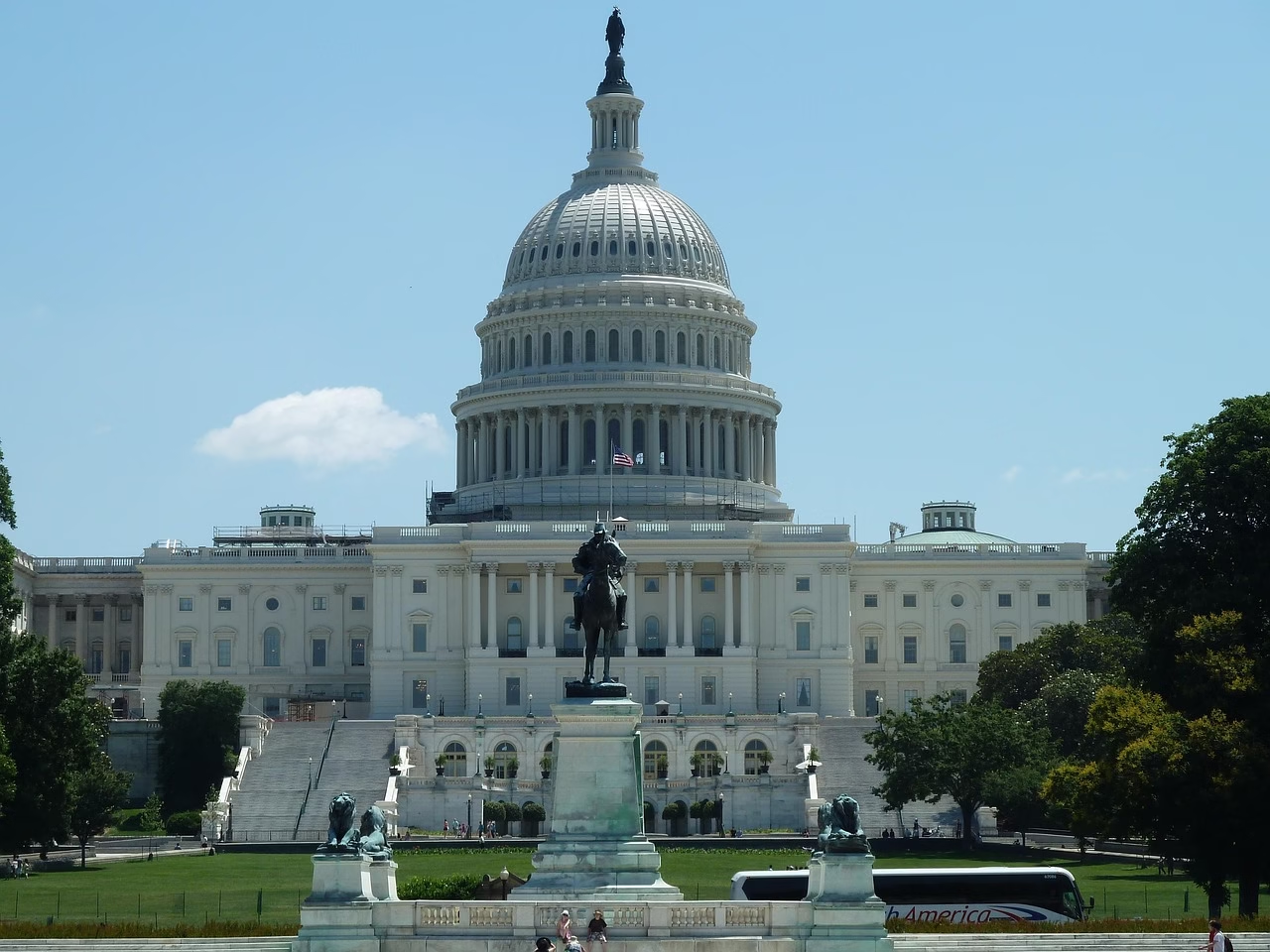
Lawmakers in Washington remain deeply divided this week as the U.S. Congress debates legislative War Powers resolutions intended to restrict President Donald Trump from engaging in unauthorized military operations against Iran. Driven by rapidly escalating tensions in the Middle East, the legislative push seeks to reassert congressional authority over foreign conflict, though any approved measure faces a near-certain presidential veto at the White House.
Constitutional Tug-of-War Over War Powers
The current legislative standoff sits at the intersection of constitutional law and national security strategy. Under Article I of the U.S. Constitution, Congress holds the sole power to declare war, whereas Article II designates the President as Commander-in-Chief of the armed forces.
This dynamic led to the passage of the War Powers Resolution of 1973, enacted over President Richard Nixon’s veto during the Vietnam War. The statute requires the executive branch to consult Congress before introducing military forces into hostilities and mandates that troops be withdrawn within 60 days unless Congress explicitly authorizes the action.
In recent years, successive presidential administrations have stretched executive authority, citing inherent constitutional rights to defend U.S. personnel and interests abroad. The recent escalation in military posturing between Washington and Tehran has brought this long-standing institutional conflict back into sharp focus.
Partisan Divide and Legislative Mechanics
On Capitol Hill, vote counts reflect a deeply polarized legislature attempting to balance executive deterrence against regional escalation. House and Senate Democrats, alongside a handful of libertarian-leaning Republicans, argue that prolonged military engagement without congressional consent risks dragging the nation into an unplanned foreign war.
Conversely, the majority of congressional Republicans contend that constraining presidential authority undermines deterrence against Iran and signals weakness to foreign adversaries. Administration officials maintain that executive actions remain fully justified under existing self-defense frameworks and past Authorizations for Use of Military Force.
The proposed resolutions explicitly direct the President to terminate the use of U.S. Armed Forces for hostilities against Iran unless authorized by a formal declaration of war or specific statutory authorization. However, political realities dictate that even if both chambers pass the measure, supporters lack the two-thirds supermajority required to override an inevitable presidential veto.
Expert Perspectives and Historical Context
Constitutional scholars note that the War Powers Resolution has rarely functioned as a strict hard stop against executive action since its inception. Data from the Congressional Research Service indicates that U.S. presidents have submitted over 180 reports under the War Powers Resolution since 1973, often framing operations as limited tactical actions rather than formal hostilities.
“Congress has historically struggled to reclaim its constitutional mandate once military operations are already underway,” said Dr. Elena Rostova, a senior fellow in defense studies at the Center for Strategic Policy. “The political cost of appearing to undermine a sitting president during an active foreign crisis often prevents legislative consensus.”
Military analysts also emphasize the operational risks tied to legislative ambiguity. According to foreign policy experts at the Brookings Institution, clear signaling is critical in Middle Eastern geopolitics, where miscalculations by either Washington or Tehran could trigger a broader regional conflict.
Implications for Executive Power and Regional Stability
The outcome of this legislative battle carries significant implications for the future balance of power between the White House and Capitol Hill. A failed override vote demonstrates the extreme difficulty Congress faces in checking executive military discretion, potentially setting a precedent for future foreign interventions.
For regional allies and adversaries in the Middle East, the political friction in Washington signals internal division over long-term strategic commitment. Tehran continues to monitor legislative proceedings closely, assessing how congressional action might influence U.S. sanction enforcement and military deployments in the Persian Gulf.
Attention now shifts to the upcoming floor votes in both chambers and the subsequent White House response. Observers will be watching closely to see whether moderate lawmakers cross party lines, how the administration adjusts its public rhetoric on Iran, and whether alternative foreign policy funding bills are introduced to impose indirect statutory limits on executive military action.





















Leave a Reply