


Search Efforts Intensify
A cargo plane carrying five crew members vanished from radar screens early Tuesday morning while operating over the Arabian Sea, prompting an urgent, multi-agency search and rescue operation off the coast of Pakistan. Aviation authorities and maritime rescue teams are currently scouring the waters for signs of the aircraft, which lost contact shortly after takeoff from a regional hub.
Local aviation officials confirmed that the flight crew issued no distress signal before the aircraft disappeared from tracking systems. Weather conditions in the region have been reported as stable, leading investigators to prioritize mechanical failure or an unforeseen emergency as potential factors in the disappearance.
Context of the Incident
The Arabian Sea serves as a critical corridor for international cargo transit, linking major Middle Eastern ports with South Asian markets. Aviation safety in the region is governed by strict international protocols, yet the vast expanse of the ocean remains a challenge for rapid response operations.
Maritime surveillance data indicates that the flight path was routine, traversing a heavily monitored corridor. The sudden loss of communication has triggered international cooperation protocols, involving both Pakistani naval assets and regional aviation authorities to coordinate the search grid.
Current Search Operations
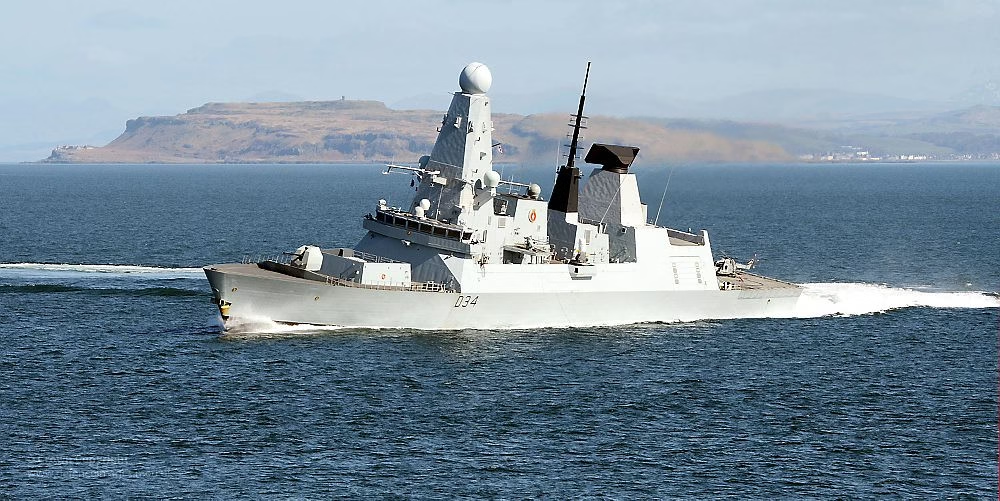
The Pakistan Navy has deployed several vessels and long-range maritime patrol aircraft to the last known coordinates of the flight. Search teams are currently contending with strong currents, which may have dispersed potential debris from the initial impact site.
“Our primary objective remains the location of the crew and the recovery of flight data recorders,” a spokesperson for the aviation authority stated during a press briefing. Divers and underwater sonar equipment are being mobilized to survey the seabed in areas where the water depth reaches significant levels.
Data points from flight tracking services suggest the aircraft experienced a rapid loss of altitude prior to the signal cutoff. Experts in aviation safety, such as those from the International Civil Aviation Organization, emphasize that the absence of a distress call often suggests a high-energy event or a total loss of electrical systems.
Industry Implications
This incident underscores the ongoing vulnerabilities of cargo aviation in remote maritime regions. As global supply chains rely increasingly on air freight, the pressure on operators to maintain aging fleets and adhere to rigorous maintenance schedules has come under renewed scrutiny.
For the logistics industry, the disappearance serves as a somber reminder of the limitations of satellite tracking in deep-sea environments. Stakeholders are expected to push for enhanced real-time telemetry requirements, which could provide more granular data during mid-flight emergencies.
Observers should watch for the release of the preliminary investigation report from the national aviation board, which will likely focus on maintenance logs and air traffic control transcripts. The international aviation community will also be monitoring the recovery of the aircraft’s black box, as that data remains essential to preventing similar tragedies in the future.

























Leave a Reply