


SoftBank Group CEO Masayoshi Son, speaking at a recent industry forum, identified Artificial Super Intelligence (ASI) as the singular, most significant investment opportunity of the next decade. As the head of one of the world’s largest technology investment firms, Son’s pivot toward ASI marks a strategic shift for the Tokyo-based conglomerate, signaling a massive reallocation of capital toward the next evolution of machine learning capabilities.
The Evolution of SoftBank’s Investment Strategy
SoftBank has historically maintained a reputation for aggressive, high-stakes bets on transformative technologies. From early investments in Alibaba to the creation of the Vision Fund, the firm has consistently prioritized companies that sit at the intersection of infrastructure and digital disruption.
Son’s latest focus on ASI represents a shift from general-purpose venture capital to a concentrated effort in building the foundational architecture for intelligence that exceeds human capability. This transition follows a period of portfolio restructuring for SoftBank, which has sought to recover from volatility in the late-stage startup market.
The Mechanics of Artificial Super Intelligence
Unlike current Generative AI, which primarily assists in content creation and data synthesis, ASI refers to a hypothetical form of intelligence that surpasses human cognitive performance across all domains. Experts suggest that achieving this milestone requires a fundamental breakthrough in compute power and energy efficiency.
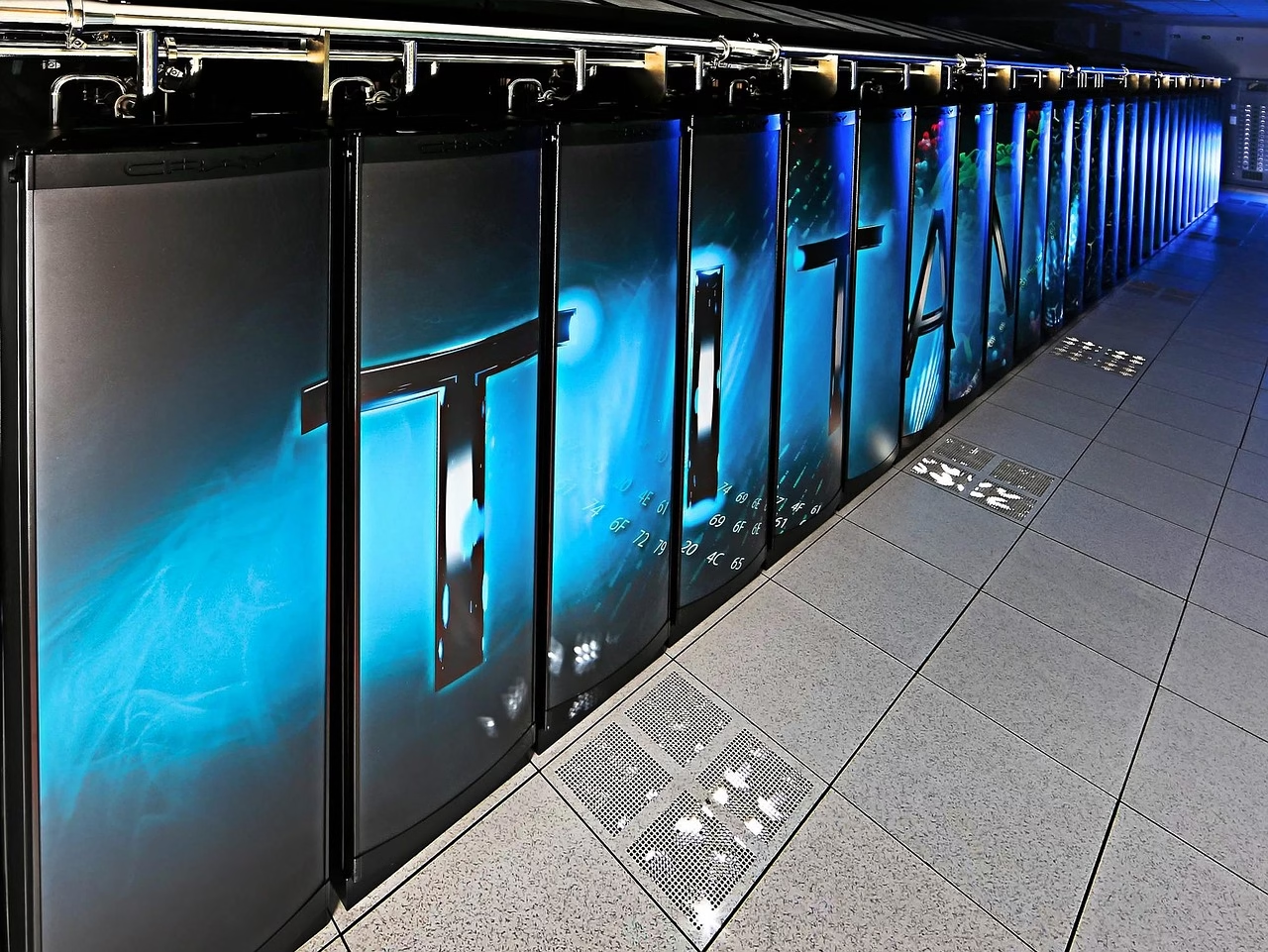
Son emphasized that the path to ASI is intrinsically linked to the semiconductor industry. By securing supply chains for specialized AI chips and high-capacity data centers, SoftBank aims to position itself as the primary architect of the hardware ecosystem required to train these next-generation models.
Industry Perspectives and Economic Impact
Market analysts note that the race to ASI is currently driving record-breaking capital expenditure among global tech giants. According to recent data from Goldman Sachs, global AI infrastructure spending is projected to exceed $200 billion annually by 2025 as firms compete to secure the hardware necessary for advanced model development.
However, the transition to ASI brings significant regulatory and ethical scrutiny. Industry experts warn that as models become more autonomous, the reliance on proprietary infrastructure could create new monopolies in the global tech landscape, potentially sparking antitrust concerns in both the United States and the European Union.
Implications for the Global Market
For investors and industry stakeholders, Son’s focus underscores that the AI boom is entering a capital-intensive phase. The era of low-cost software experimentation is giving way to a period of massive physical infrastructure development, including specialized cooling systems, energy-dense data centers, and advanced chip fabrication facilities.
Looking ahead, observers should monitor SoftBank’s upcoming partnerships with semiconductor manufacturers and energy providers. The ability to guarantee a sustainable and scalable energy supply for supercomputing clusters will likely determine which firms dominate the ASI landscape by the end of the decade.






















Leave a Reply