


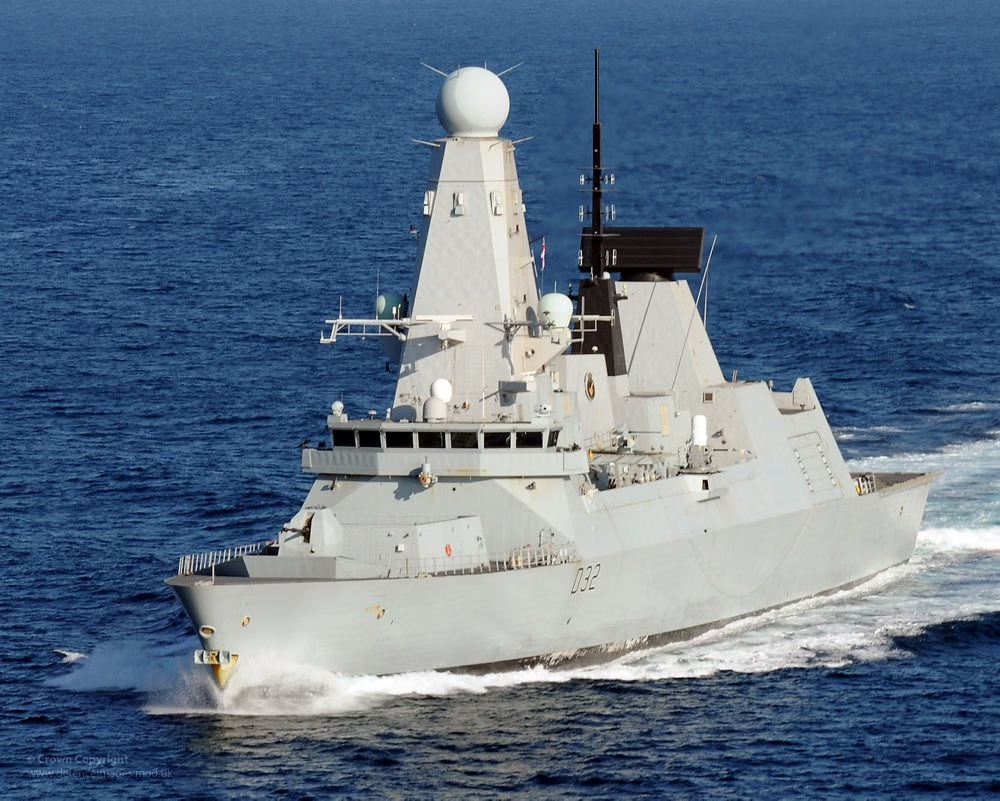
Pentagon officials and national security experts expressed heightened concern this week over the rapid depletion of critical U.S. weapons stockpiles as American forces expand their operational presence in the Middle East following escalating military exchanges with Iran. The accelerating consumption of high-end air defense interceptors and precision-guided munitions, driven by directives from Washington to counter Iranian regional strikes, has forced defense planners to re-evaluate military readiness across multiple global theaters.
Escalating Tensions and Industrial Strain
The recent surge in regional deployments follows months of targeted strikes and counter-strikes between U.S. forces and Iranian-aligned networks. As President Donald Trump signals potential further escalations, military assets stationed in the Persian Gulf and Red Sea are consuming advanced munitions at an unprecedented rate.
Naval destroyers and shore-based air defense batteries have fired hundreds of sophisticated missiles to neutralize incoming ballistic targets and attack drones. Operations in the region have consumed significant portions of the U.S. Navy’s inventory of Standard Missile variants, including the SM-2 and SM-6 platforms.
The current operational tempo has highlighted a stark cost and volume asymmetry. U.S. forces regularly employ multi-million-dollar interceptors to intercept low-cost unmanned aerial vehicles, draining high-end reserves far faster than defense contractors can replace them.
Stockpile Vulnerabilities and Production Constraints
The sustained engagement in the Middle East comes on top of years of heavy munitions transfers to allies in Europe and Asia. Defense analysts warn that the simultaneous demand across multiple regions has stretched the U.S. defense industrial base to its limits.
Production lines for critical platforms like Patriot PAC-3 interceptors and Tomahawk cruise missiles are already operating at or near maximum capacity. According to defense manufacturing data, replacing specialized surface-to-air missiles can take anywhere from 18 to 36 months due to complex supply chain requirements and specialized component shortages.
Military logistics experts note that while the U.S. maintains strategic war reserves, prolonged engagements without immediate manufacturing surges risk leaving front-line units with depleted magazines in high-threat environments.
Expert Perspectives and Strategic Trade-Offs
Defense analysts emphasize that the depletion issue is not merely a financial challenge, but a profound strategic vulnerability. CSIS defense scholars have noted that intense air defense operations in the Middle East directly reduce the inventory available for potential deterrence scenarios in the Indo-Pacific region.
Retired naval commanders have raised concerns that shipboard Vertical Launch System (VLS) cells cannot be reloaded at sea under current operational doctrine. Destroyers must transit out of active combat zones to friendly ports to replenish their missile tubes, temporarily reducing naval firepower in the region.
Industry experts caution that political rhetoric demanding higher readiness must be matched by structural reforms in military procurement. Without long-term multi-year procurement contracts, defense contractors remain hesitant to make the capital investments required to expand factory floors and train specialized workers.
Strategic Implications and What to Watch Next
The mounting strain on U.S. munitions reserves will likely force difficult operational decisions in the coming weeks. Military commanders may be compelled to adjust engagement protocols, relying more heavily on electronic warfare, directed energy testing, and lower-cost point-defense systems to preserve high-end interceptors for high-tier ballistic threats.
Capitol Hill lawmakers are expected to debate emergency defense supplemental funding aimed at expanding domestic manufacturing lines and incentivizing supply chain resilience. Congressional committees will scrutinize Pentagon inventory levels to assess whether current operational posture compromises broader global deterrence objectives.
In the Middle East theater, observers will monitor whether the U.S. shifts toward a more diplomatic posture or continues military exchanges despite inventory pressures. Key indicators to watch include changes in U.S. naval ship rotations, announcements of expedited defense production contracts, and potential adjustments to the force posture around critical maritime corridors.























Leave a Reply