



Former Cuban President Raúl Castro is expected to face indictment by the United States, with an official announcement anticipated Wednesday in Miami. Two federal sources familiar with the ongoing investigation disclosed this development to NBC News, signaling a significant escalation in U.S.-Cuba relations and potentially targeting high-level figures within the Cuban government for charges likely related to drug trafficking or other illicit activities.
A History of Strain: U.S.-Cuba Relations
The anticipated indictment unfolds against a backdrop of historically complex and often hostile relations between the United States and Cuba. For over six decades, following the 1959 Cuban Revolution, the two nations have been locked in a geopolitical struggle marked by economic embargoes, political rhetoric, and proxy conflicts. Raúl Castro, brother of revolutionary leader Fidel Castro, played a pivotal role in this history, first as Minister of the Revolutionary Armed Forces and later as President from 2008 to 2018, and then as First Secretary of the Communist Party until 2021.
During his presidency, Raúl Castro oversaw a brief thaw in relations, culminating in the restoration of diplomatic ties with the Obama administration in 2015. However, these advancements largely unraveled under subsequent U.S. administrations, which reimposed and tightened sanctions, citing Cuba’s human rights record and its support for Venezuela’s socialist government. The U.S. has also consistently accused Havana of harboring fugitives and engaging in malign activities detrimental to U.S. national security interests.
The Legal Framework and Potential Charges
While the specific charges against Raúl Castro remain officially sealed, federal indictments against high-ranking foreign officials often involve serious offenses such as drug trafficking, money laundering, or terrorism-related activities. U.S. federal law grants broad jurisdiction to prosecute individuals who engage in such crimes, even if the acts occur outside U.S. territory, provided there is a nexus to American interests or citizens.
The process typically begins with a grand jury investigation, which, if it finds sufficient evidence, issues a sealed indictment. This indictment is then unsealed, often accompanied by a public announcement from the Department of Justice. For former heads of state, such indictments are largely symbolic without an extradition treaty or the individual being present on U.S. soil or in a country willing to extradite. However, they carry significant weight, imposing travel restrictions and financial penalties, and signaling a clear intent by the U.S. government to hold individuals accountable.
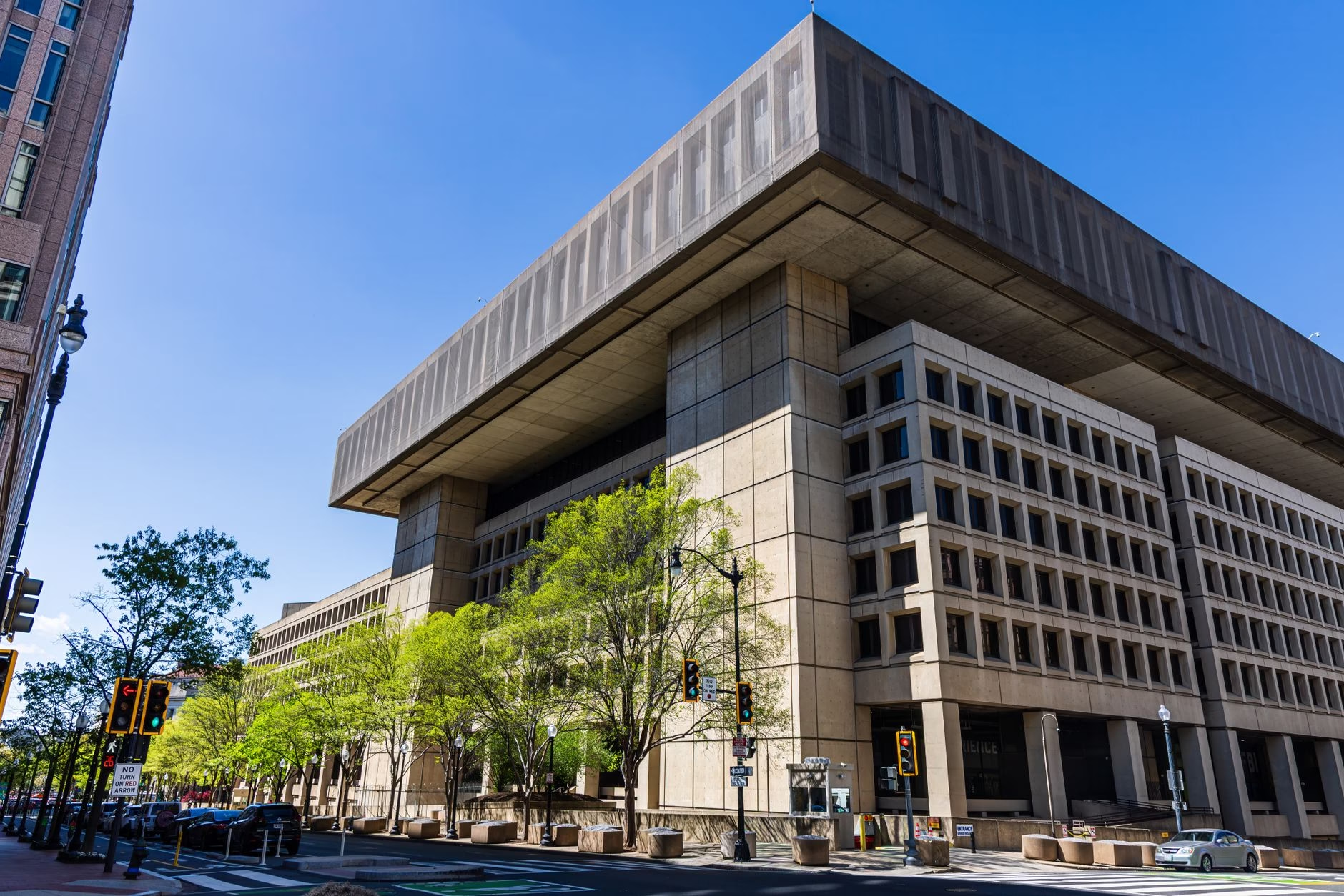
Legal analysts suggest that an indictment of this magnitude would likely be the culmination of years of intelligence gathering and investigation by multiple U.S. agencies, including the Drug Enforcement Administration (DEA), the Federal Bureau of Investigation (FBI), and the Department of Justice (DOJ). These agencies frequently collaborate on international criminal investigations targeting state-sponsored illicit networks.
Expert Perspectives and Precedents
“An indictment against someone of Raúl Castro’s stature is not undertaken lightly,” stated Dr. Elena Rodriguez, a professor of international law at Georgetown University. “It indicates the U.S. government believes it possesses compelling evidence and is prepared to pursue legal action, even if the immediate prospect of arrest seems remote. It sends a powerful message to other foreign leaders that they are not beyond the reach of U.S. law for certain transnational crimes.”
Historically, the U.S. has pursued indictments against other high-profile foreign figures, most notably Panamanian dictator Manuel Noriega in 1988 on drug trafficking charges. Noriega was eventually apprehended following a U.S. invasion of Panama and served time in a U.S. prison. While the circumstances differ significantly, the Noriega case established a precedent for the U.S. to seek prosecution of foreign leaders for crimes against U.S. law.
Data from the U.S. Department of Justice consistently highlights its commitment to combating international drug trafficking, often identifying state actors or state-affiliated entities as facilitators or beneficiaries of such illicit trade. The anticipated indictment would align with this long-standing policy, reinforcing Washington’s stance against what it perceives as state-sponsored criminal enterprises.
Implications for U.S.-Cuba Relations and Beyond
The expected indictment of Raúl Castro is poised to further exacerbate already strained U.S.-Cuba relations. It will likely be met with strong condemnation from Havana, which typically views such actions as politically motivated aggressions and violations of its sovereignty. Cuba’s foreign ministry has historically dismissed U.S. charges against its officials as baseless and part of a broader campaign to destabilize the island nation.
For the Biden administration, this move could be seen as an attempt to project strength and consistency in its foreign policy, particularly concerning human rights and combating international crime, while also appealing to a domestic constituency that advocates for a hardline stance against Cuba. However, it also risks closing off any remaining avenues for diplomatic engagement, making future cooperation on issues like migration or regional stability even more challenging.
Internally, within Cuba, the indictment may serve to rally support for the current government against perceived external threats, despite Raúl Castro having stepped down from his formal leadership roles. It could also complicate the positions of other Cuban officials who might face similar scrutiny or travel restrictions. The international community will be closely watching for reactions from Latin American nations and European allies, many of whom maintain different approaches to engaging with Cuba.
Looking ahead, the immediate focus will be on the official announcement and the specific charges unsealed. This will determine the legal basis and the U.S. government’s narrative surrounding the indictment. Observers will also monitor Cuba’s official response and any retaliatory measures, as well as potential shifts in U.S. policy toward the island. The development signals a continued period of high tension and legal confrontation rather than reconciliation in U.S.-Cuba affairs.















Leave a Reply