


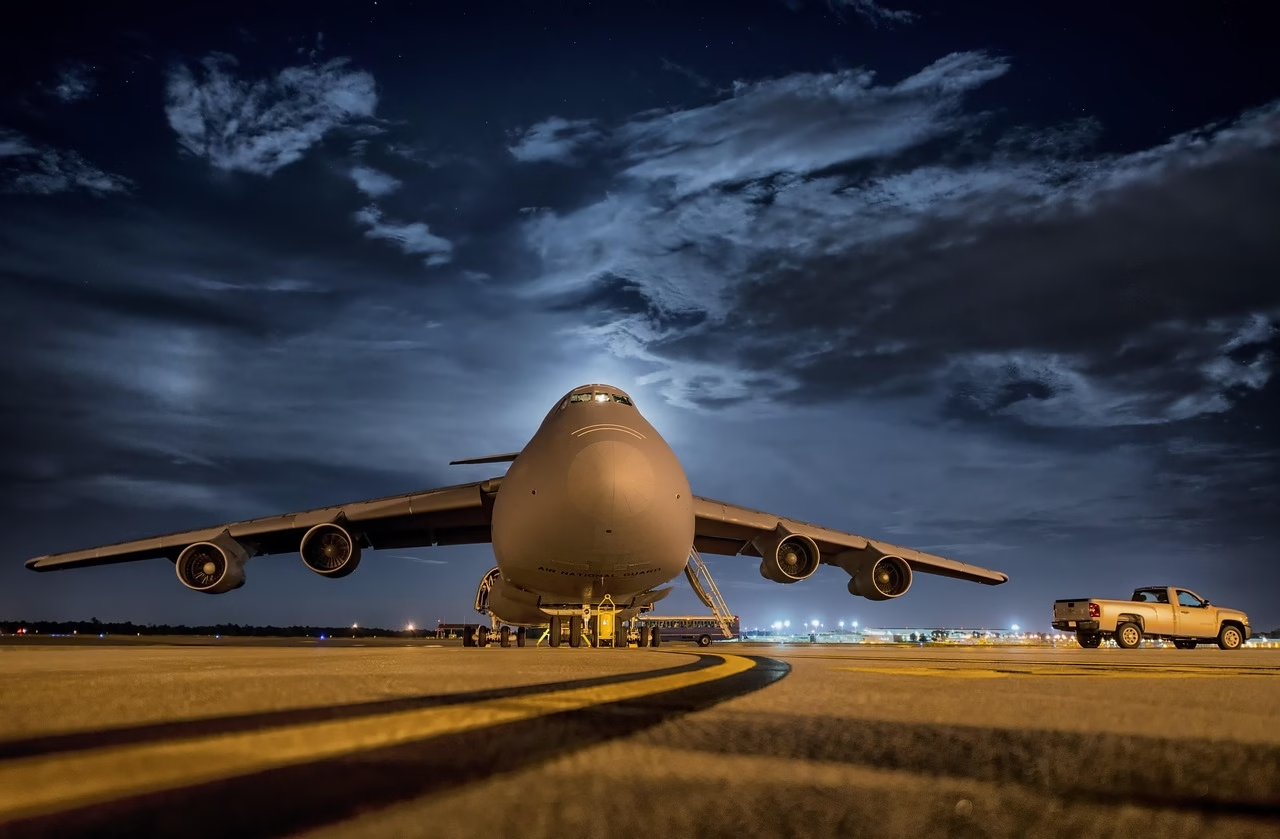
The United States Department of Defense significantly reinforced its military footprint across the Middle East this week, deploying strategic heavy bombers and a fleet of aerial refueling tankers to counter heightening security risks associated with ongoing military hostilities involving Iran and regional proxy forces.
Geopolitical Context and Rising Regional Tensions
The latest force posture adjustments follow months of intensifying friction across multiple operational fronts in the Middle East. Continued missile and drone engagements targeting commercial shipping lanes and international coalition bases have prompted Washington to expand its defensive posture within the U.S. Central Command (CENTCOM) area of responsibility.
Military planners have systematically scaled up response capabilities to safeguard critical maritime corridors, including the Bab-el-Mandeb Strait and the Persian Gulf, while bolstering defensive coverage for key regional allies. The rapid influx of long-range strike capabilities signals a firm commitment to regional deterrence amid sustained escalation.
Strategic Asset Deployments and Flight Tracking Operations
Commercial flight tracking platforms and open-source intelligence networks documented significant air assets departing European installations toward operational zones in the Eastern Mediterranean and the Gulf region. Data logs confirmed multiple U.S. Air Force B-1B Lancer strategic bombers departing Royal Air Force Base Fairford in the United Kingdom, navigating established military corridors toward the Middle East.
Simultaneously, specialized aerial refuelers, including Boeing KC-135 Stratotankers and advanced KC-46A Pegasus platforms, landed at forward operating locations in Israel and partner Gulf nations. These refueler assets provide critical endurance extension, enabling tactical aircraft and long-range heavy bombers to conduct persistent air patrols without returning to home bases.
Expert Analysis and Capability Assessment
Defense analysts emphasize that the strategic integration of long-range heavy bombers with forward-stationed tanker fleets represents a major operational posture shift in the theater. The presence of aerial refueling support directly within regional airbases dramatically expands continuous combat air patrol capacity and shortens response timelines.
“Deploying high-capacity aerial refueling assets directly into Israeli and Gulf airfields drastically alters the tactical landscape,” stated Dr. Marcus Vance, senior defense analyst at the Institute for Strategic Security Studies. “It provides coalition forces with the operational flexibility required for sustained, long-range interdiction and rapid deterrent response.”
The B-1B Lancer serves as a primary heavy conventional strike asset for the U.S. military, capable of carrying up to 75,000 pounds of precision-guided munitions. Paired with local refueling support, these bombers can launch standoff strikes against fortified targets across deep operational depth while remaining stationed at secure standoff distances.
Pentagon officials maintain that these strategic asset movements serve a primary goal of active deterrence, aimed at deterring further state and non-state aggression while reassuring regional coalition partners of U.S. defense commitments.
Economic Impacts and Security Implications
The escalation in military deployments has prompted immediate reactions across global energy markets and international trade sectors. Crude oil benchmark prices experienced heightened intraday volatility as energy traders evaluated potential supply chain disruptions near key choke points like the Strait of Hormuz.
Maritime logistics firms continue to divert commercial transport around Africa’s Cape of Good Hope to avoid high-risk operational zones, leading to longer shipping timelines and elevated insurance premiums for international freight.
Regional armed forces have elevated operational readiness standards in tandem with the U.S. arrivals, establishing real-time communication protocols to maintain air defense integration and prevent potential miscalculations in congested airspace.
What to Watch Next
Military observers are closely monitoring whether the U.S. Department of Defense will order secondary deployments, such as additional aircraft carrier strike groups or land-based air defense systems like THAAD and Patriot missile batteries, to reinforce force protection capabilities.
Diplomatic efforts led by international mediators remain active in attempt to establish formal de-escalation channels and mitigate risks of broader regional warfare. Key indicators to track in the coming days include regional response exercises, additional forward staging announcements, and changes to commercial airspace advisories across the Middle East.






















Leave a Reply