


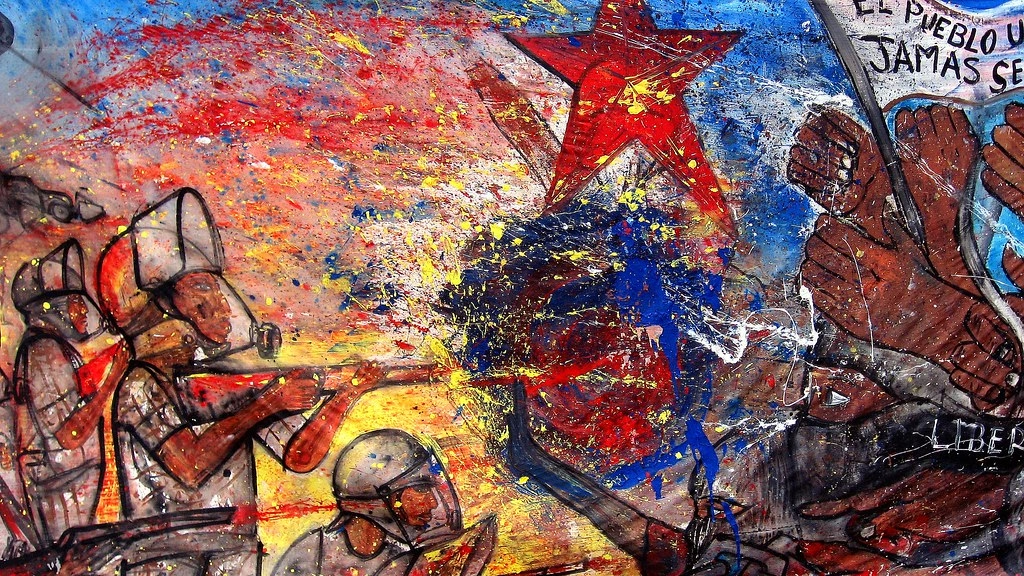
Swiss police forces surrounded and contained a group of violent rioters in Geneva on Thursday as anti-G7 demonstrations escalated into localized street battles. The unrest, which began as a protest against the upcoming G7 summit, prompted a heavy security response in the city center as law enforcement moved to prevent further property damage and ensure public safety.
The Context of Global Summits
The Group of Seven (G7) summits have historically served as focal points for international protest movements. Activists often congregate at these sites to voice grievances regarding global economic policies, environmental regulations, and geopolitical stances.
Geneva, a hub for international diplomacy, frequently hosts high-stakes meetings. The city’s proximity to various international organizations makes it a recurring venue for both official summits and the counter-protests that accompany them.
Escalation and Security Response
The situation in Geneva deteriorated rapidly when a segment of the crowd began targeting local businesses and public infrastructure. Witnesses reported that agitators utilized makeshift barricades and projectiles against security cordons.
Police deployed specialized units to isolate the violent factions from peaceful demonstrators. Officers utilized containment tactics to restrict movement and prevent the spread of the unrest to surrounding neighborhoods.
Authorities confirmed that the operation was focused on de-escalation while maintaining the security of the city’s international quarter. Law enforcement officials stated that while the right to assemble is protected, the resort to violence necessitates an immediate and firm response to maintain civil order.
Expert Perspectives on Protest Dynamics
Security analysts note that modern protests are increasingly bifurcated between organized, peaceful groups and decentralized, militant actors. This shift presents significant challenges for municipal police forces tasked with protecting both the demonstrators’ rights and public property.
Data from recent international summits suggests that the presence of ‘black bloc’ tactics—which involve the use of nondescript, dark clothing to evade identification—has become more frequent. These groups often operate independently of larger, registered protest organizations, making crowd control significantly more complex for authorities.
According to urban security experts, the integration of real-time surveillance and rapid-response tactical teams is now a standard requirement for cities hosting major geopolitical events. The goal is to minimize the duration of disruptions and prevent the total shutdown of urban transit networks.
Implications for Future Diplomacy
The events in Geneva underscore the increasing difficulty of hosting global summits in densely populated urban centers. As security perimeters expand, the friction between protestors and authorities is likely to intensify, potentially prompting organizers to consider more remote or fortified locations for future meetings.
For local businesses and residents, the volatility poses a significant operational risk. Insurance premiums and security costs for hosting cities are expected to climb as the threat of property damage remains a constant factor during high-profile diplomatic gatherings.
Observers will be monitoring the upcoming official summit to see if these protests influence the policy discussions occurring behind closed doors. Future security planning will likely emphasize earlier detection of fringe groups to prevent the types of confrontations observed on the streets of Geneva today.
















Leave a Reply