


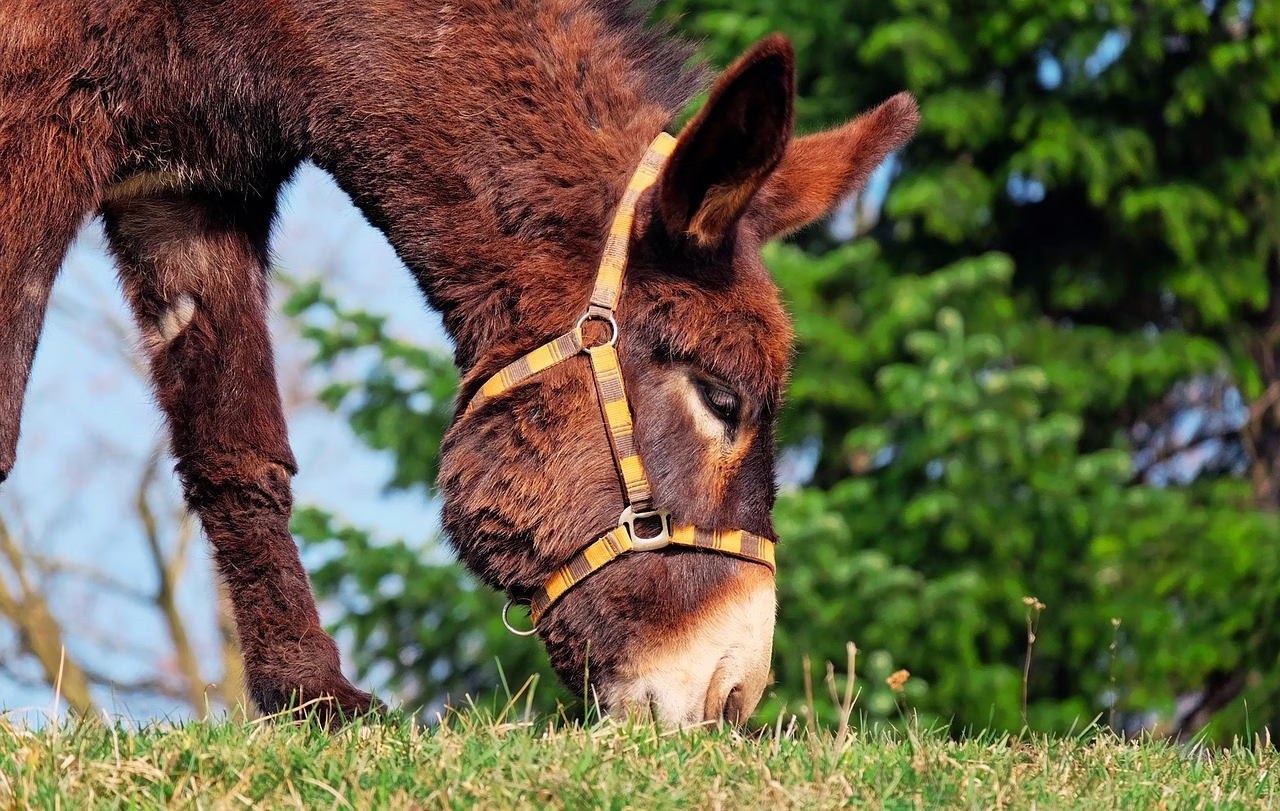
Rural communities and forestry agencies across Spain have deployed specialized herds of donkeys—dubbed “donkey brigades”—to mitigate the escalating risk of devastating summer wildfires by clearing dense, highly flammable brush. Operating in high-risk zones across Andalusia and Catalonia ahead of peak summer temperatures, these livestock herds serve as a biological defense system designed to suppress fire intensity and safeguard regional biodiversity.
Rising Wildfire Risks and Rural Transformation
Southern Europe faces increasingly severe wildfire seasons driven by rising global temperatures, prolonged droughts, and historic land management shifts. In Spain, decades of rural depopulation—often referred to as España vaciada or “Empty Spain”—have left vast tracts of agricultural land abandoned, allowing aggressive undergrowth to accumulate unchecked.
When dry summer winds sweep across these overgrown landscapes, thick scrubland transforms into fuel for uncontrollable crown fires. Traditional fire suppression methods, such as mechanical clearance and controlled burns, often prove logistically difficult and expensive in rugged, mountainous terrains.
Furthermore, heavy machinery can accelerate soil erosion, consume fossil fuels, and disrupt delicate local ecosystems. In response, environmental managers are turning toward silvopastoral systems—integrating livestock into forestry management—as a sustainable, low-impact solution to landscape management.
The Science of Biological Firebreaks
The strategic deployment of grazing animals, known as prescribed or targeted grazing, fundamentally alters how wildfires behave on the landscape. By systematically consuming dry grasses, low-hanging branches, and dense underbrush, the donkeys reduce the total biomass available to fuel a fire.
Donkeys are particularly effective for this task due to their robust digestive systems and versatile diets. Unlike sheep or cattle, which prefer soft grasses, donkeys readily consume coarse vegetation, thorny shrubs, and woody biomass that constitute the primary ladder fuel for forest fires.
When a wildfire encounters an area cleared by grazing animals, its intensity drops significantly. The lower fuel load reduces flame height and slows the rate of spread, giving ground crews crucial time to establish containment lines and extinguish the flames safely.
Data-Backed Defense and Expert Insights
Research published by Mediterranean forestry institutes indicates that targeted grazing can reduce surface fuel loads by up to 70 percent in high-risk woodland ecosystems. This substantial reduction lowers the rate of fire spread by more than half, converting potential megafires into manageable ground fires.
Dr. Elena Morales, a landscape ecology researcher based in Madrid, emphasizes the structural efficiency of animal-led land management. “Mechanical clearing often leaves behind shredded plant matter that quickly dries out and remains highly flammable on the forest floor,” Morales noted in a recent forestry report. “Grazing animals entirely remove that biomass from the ecosystem while naturally fertilizing the soil.”
Data from regional trial programs in southern Spain demonstrates that maintaining traditional firebreaks with livestock costs roughly one-third of the price of operating motorized brush-cutters. Additionally, donkeys can navigate steep, rocky ravines that are entirely inaccessible to heavy tractors and mechanical crews.
Economic Benefits and Regional Scaling
Beyond fire prevention, the donkey brigade initiative provides vital economic support to struggling rural regions. Local shepherds receive municipal contracts and agricultural subsidies to manage the herds, creating sustainable green jobs in areas long impacted by economic decline and youth emigration.
The program also contributes to biological conservation efforts by revitalizing native donkey breeds whose populations had plummeted due to agricultural modernization. By reintegrating these animals into active land stewardship, conservationists are securing the survival of traditional working livestock species.
As climate projections indicate longer, hotter, and more intense fire seasons across Southern Europe, international interest in bio-prevention models is growing rapidly. Neighboring nations, including Portugal, France, and Greece, are currently evaluating Spain’s grazing framework for potential adaptation in their own high-risk Mediterranean forest zones.
Forestry officials are now working to integrate real-time satellite imagery and thermal risk mapping with herd management strategies. By predicting high-risk ignition zones weeks in advance, authorities plan to deploy donkey brigades with pinpoint precision, establishing dynamic, living barriers ahead of future fire seasons.

























Leave a Reply