


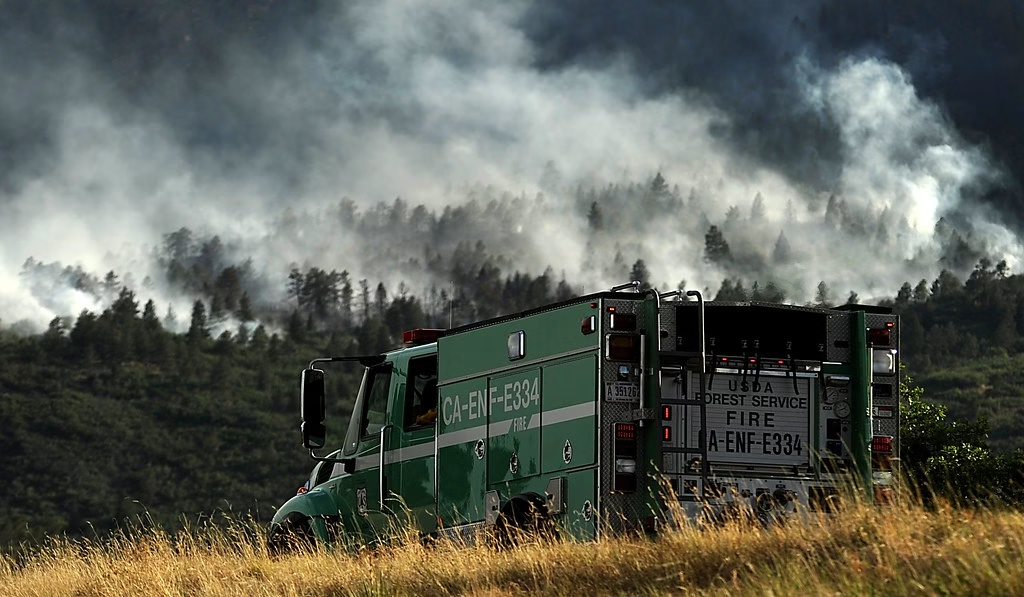
Thousands of residents across southern Colorado have evacuated their homes this week as a rapidly growing wildfire consumes thousands of acres of dry forestland, triggering urgent emergency responses from state and local authorities. Driven by high winds and arid conditions, the blaze has forced families to seek refuge in temporary shelters while livestock owners scramble to transport animals to safety, marking one of the most significant fire events in the region this season.
Context of the Escalating Crisis
The southern Colorado region has faced an exceptionally dry winter, leaving the landscape primed for rapid fire propagation. According to the National Interagency Fire Center, the combination of low humidity and unseasonably high temperatures has created a volatile environment where even minor sparks can ignite massive infernos.
Local officials have issued mandatory evacuation orders for several counties, as the fire’s path threatens rural homesteads and critical infrastructure. The rapid expansion of the fire perimeter has stretched local firefighting resources to their limit, prompting the deployment of state-level air support to drop retardant on the most active fronts.
The Logistics of Mass Displacement
Evacuation centers have emerged as the primary lifeline for displaced families, providing food, medical aid, and temporary housing. Community centers and fairgrounds have pivoted their operations to accommodate not only people but also the surge of livestock being relocated from threatened pastures.
Agricultural organizations are currently coordinating with local ranchers to move cattle and horses to higher ground or secure facilities further from the fire zone. The psychological and financial toll on these families is significant, as many face the uncertainty of whether their primary residences or livelihoods will remain standing once the smoke clears.
Expert Insights and Environmental Factors
Fire ecologists note that the increased frequency of these large-scale events is consistent with broader climate trends affecting the American West. Dr. Elena Vance, a wildfire management researcher, stated that the current fire behavior is characterized by extreme spotting, where embers travel ahead of the main fire front to start new blazes, making containment efforts incredibly difficult.
Data from the Colorado Department of Public Health and Environment indicates that air quality in surrounding areas has plummeted, with particulate matter reaching hazardous levels. Authorities are urging residents to remain indoors and follow official evacuation routes strictly, as visibility on roadways remains dangerously low.
Future Implications for Regional Safety
The immediate focus remains on containment, but the long-term implications for southern Colorado are substantial. Insurance premiums in fire-prone regions are expected to rise, and local governments may need to revisit land-use policies to better mitigate the risk of future residential damage.
Observers should watch for upcoming state legislative sessions, where funding for enhanced forest management and improved early-warning alert systems will likely take center stage. As the fire season progresses, the ability of local communities to maintain these ad-hoc support networks will be tested, highlighting a growing need for regional cooperation in disaster resilience.




















Leave a Reply