


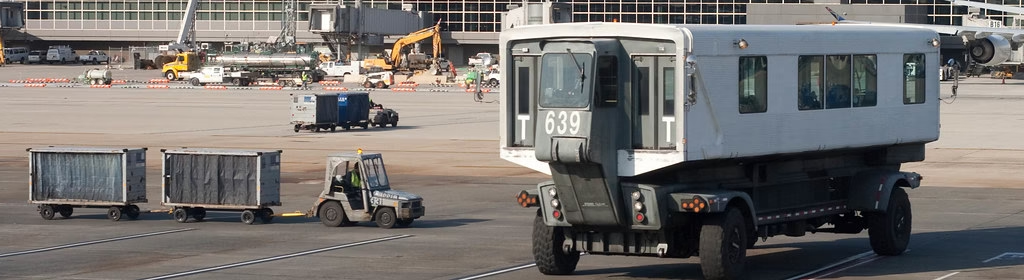
The Incident at George Bush Intercontinental
A Texas man was taken into federal custody this week after allegedly bypassing security protocols at Houston’s George Bush Intercontinental Airport (IAH) using a fraudulent boarding pass. The incident, which occurred on a United Airlines flight destined for Los Angeles, forced the aircraft to return to the gate shortly before departure, causing significant delays for fellow passengers and triggering a comprehensive security review.
Context and Security Protocols
Modern airport security relies on a multi-layered verification process managed by the Transportation Security Administration (TSA) and individual airline systems. Passengers are typically required to present a valid government-issued identification alongside a legitimate boarding pass, which is scanned to verify booking status and seat assignment. This system is designed to create a sterile environment where every individual onboard is accounted for in the airline’s manifest.
The Mechanics of the Breach
According to initial reports, the individual managed to board the aircraft without a valid ticket, raising immediate concerns regarding the efficacy of gate-level screening. Law enforcement officials confirmed that the flight crew identified the discrepancy after the aircraft had already pulled away from the gate. Once the unauthorized passenger was discovered, standard operating procedure dictated that the plane return to the terminal to ensure the safety and security of the remaining passengers.
Expert Perspectives on Aviation Security
Aviation security experts suggest that while boarding technology has advanced, human factors remain a critical variable in airport safety. Dr. Marcus Thorne, an aviation security consultant, notes that incidents involving fraudulent boarding documents are rare but highlight the necessity of constant vigilance. “Airlines and airport authorities continuously refine their digital verification tools to prevent unauthorized access, but the integration between gate agents and security systems must be seamless to catch sophisticated attempts at deception,” Thorne stated.
Data from the Department of Homeland Security indicates that while physical security checkpoints like TSA PreCheck and traditional metal detectors are highly effective, the final check at the boarding gate acts as the last line of defense. The fact that the crew identified the passenger suggests that onboard verification protocols are functioning as intended, even if the initial gate screening was bypassed.
Industry Implications
For the aviation industry, this breach serves as a stark reminder of the evolving challenges in passenger verification. As airports move toward biometric boarding—where facial recognition replaces traditional paper or digital passes—the industry hopes to reduce the risk of manual error or fraudulent documents. However, this transition also introduces new concerns regarding data privacy and system vulnerabilities that must be addressed.
For the average traveler, this incident likely signals a period of heightened scrutiny at boarding gates. Passengers should anticipate more rigorous manual checks of boarding passes until officials complete their investigation and determine if current protocols require a systemic overhaul. Observers should monitor upcoming statements from the TSA and United Airlines for updates on potential policy shifts, as federal authorities continue their investigation into how the passenger gained unauthorized access to the restricted area.






















Leave a Reply