


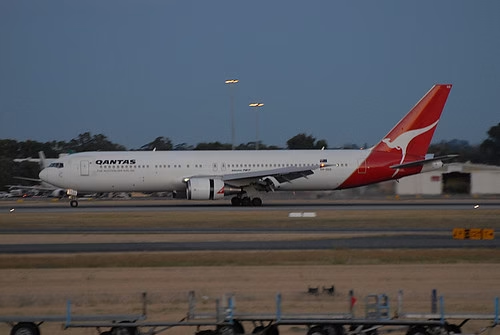
Qantas Airways has successfully completed a historic 19-hour non-stop test flight from Toulouse, France, landing in Australia as part of its ongoing preparation for ultra-long-haul commercial service. The monumental flight marks a critical technical milestone for the carrier’s long-awaited “Project Sunrise” initiative, which aims to permanently connect Australia directly with Europe and North America without layovers. Qantas Chief Executive Officer Vanessa Hudson confirmed that the airline plans to officially begin ticket sales for these non-stop ultra-long-range flights in February, signaling an unprecedented shift in global travel routes.
The Long Road to Project Sunrise
The concept of Project Sunrise originated in 2017, named as a tribute to the airline’s historic World War II covert flights across the Indian Ocean that remained airborne long enough to see two sunrises. For decades, direct flights between the east coast of Australia and Western Europe were deemed technically impossible due to aircraft range limitations and payload restrictions.
To overcome these physical boundaries, Qantas challenged major aircraft manufacturers to design an airliner capable of flying fully loaded routes such as Sydney to London and Sydney to New York. Airbus ultimately won the contract with a customized version of its A350-1000 jetliner. The specialized aircraft features an additional center fuel tank and a reduced passenger capacity designed specifically for extreme endurance operations.
Previous research flights conducted under Project Sunrise included test runs from London and New York to Sydney using Boeing 787 Dreamliners. However, this recent delivery flight from Airbus headquarters in Toulouse represents a major leap forward using the actual fleet hardware intended for commercial service.
Inside the 19-Hour Non-Stop Test Run
The 19-hour journey across the globe served as an intensive test environment for aircraft performance, pilot workload management, and in-cabin environmental monitoring. Flight crews monitored fuel burn efficiency, navigational accuracy over polar and desert airspace, and real-time atmospheric conditions across multiple air traffic control jurisdictions.
Beyond aircraft mechanics, human physiology remains the central hurdle for flights exceeding the 16-hour mark. During the test, researchers tracked pilot fatigue levels, circadian rhythm shifts, and cabin pressurization metrics to optimize flight deck rotation schedules and cabin environmental conditions.
In the commercial configuration, Qantas plans to configure these A350 aircraft with only 238 seats—significantly fewer than the standard 300 to 350 seats found on typical international A350 operations. More than 40 percent of the aircraft space will be dedicated to premium cabins, including a dedicated passenger “Wellbeing Zone” located between Economy and Premium Economy, allowing travelers to stretch, hydrate, and complete guided movement exercises.
Industry Data and Aviation Economics
According to aviation data firm Cirium, demand for direct, point-to-point long-haul travel has surged by over 20 percent post-pandemic as travelers increasingly prioritize reduced transit times and fewer airport connections. Passengers are routinely demonstrating a willingness to pay a premium of 15 to 25 percent for non-stop routes over traditional multi-leg itineraries.
Industry analysts point out that while fuel costs represent a major risk factor for non-stop long-haul operations—since aircraft must burn fuel simply to carry heavy fuel loads—the high proportion of premium seating on these flights is calculated to offset operational overhead.
Data from the International Air Transport Association (IATA) indicates that direct connectivity often generates new business traffic between regional hubs, potentially boosting trade and tourism links between Australia and key European economic centers. The elimination of stopovers in traditional hub cities like Singapore, Dubai, or Doha reshapes long-standing international flight corridors.
Strategic Implications for Global Aviation
The successful completion of the Toulouse-to-Australia flight signals a broader disruption in international air travel networks. Traditional global aviation hubs that rely heavily on transit passenger traffic may face increased competition as ultra-long-range jet technology expands globally.
Competing international airlines are closely monitoring Qantas’s progress. If Project Sunrise proves commercially lucrative, other global carriers are expected to explore similar extreme long-range routes, connecting historically isolated city pairs across South America, Southeast Asia, and North America.
Environmental groups, however, continue to scrutinize ultra-long-haul travel due to higher carbon emissions per passenger kilometer resulting from heavy takeoff weights. Qantas has addressed these concerns by committing to use sustainable aviation fuel (SAF) blends where available and offsetting remaining emissions through verified carbon credit schemes.
What to Watch Next
Industry observers and travelers should look to February, when Qantas is scheduled to open ticket sales and reveal final seat pricing and schedules for its first commercial Project Sunrise routes. Regulatory authorities, including Australia’s Civil Aviation Safety Authority (CASA), are expected to issue final approvals for extended crew operation guidelines in late 2025 ahead of the official commercial launch planned for 2026. Attention will also turn to the physical delivery of the remaining Airbus A350-1000 fleet as assembly lines in Toulouse scale production to meet the carrier’s order book.


























Leave a Reply