


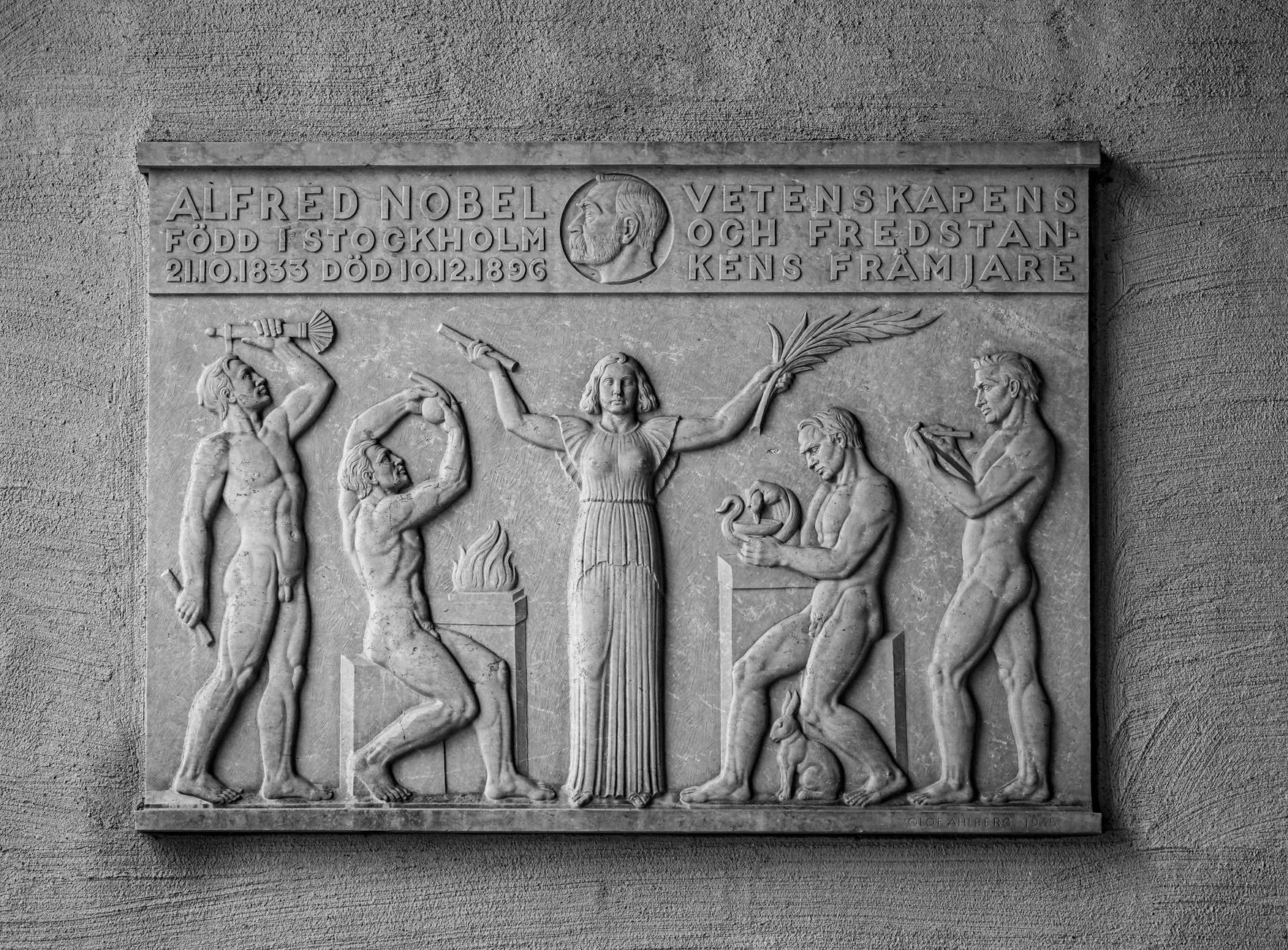
The Nobel Committee for Physics has recognized Francis Halzen for his monumental contributions to the study of elusive subatomic particles often referred to as ghost particles. His groundbreaking scientific investigations paved the way for profound discoveries in modern astrophysics.
Understanding Neutrino Research
Neutrinos are extremely tiny subatomic particles that rarely interact with ordinary matter. Because they pass through planets, stars, and living beings without leaving a trace, detecting them has presented one of the greatest challenges in modern physics.
Halzen dedicated decades of his academic career to understanding these mysterious entities. His theoretical and practical frameworks transformed how researchers approach particle detection and cosmic observation.
The IceCube Neutrino Observatory
A central pillar of the Nobel Committee recognition involves Halzen playing a critical role in the development and construction of the IceCube Neutrino Observatory. Located deep beneath the Antarctic ice sheet, this massive facility serves as a unique telescope designed to capture signals from the most distant corners of the universe.
By utilizing a cubic kilometer of pristine ice as a particle detector, the observatory allows scientists to trace high-energy neutrinos back to their cosmic origins. This technological marvel expanded the boundaries of human knowledge regarding black holes, supernovae, and other violent astrophysical phenomena.
Impact on Modern Physics
The recognition from the Nobel Committee highlights the increasing importance of neutrino astronomy in the scientific community. Traditional telescopes rely on light, but neutrino detectors open an entirely new window to observe the universe.
Halzen legacy now stands alongside the giants of modern physics. His persistence in studying particles that refuse to interact with the physical world has fundamentally altered our comprehension of the cosmos.
























Leave a Reply