


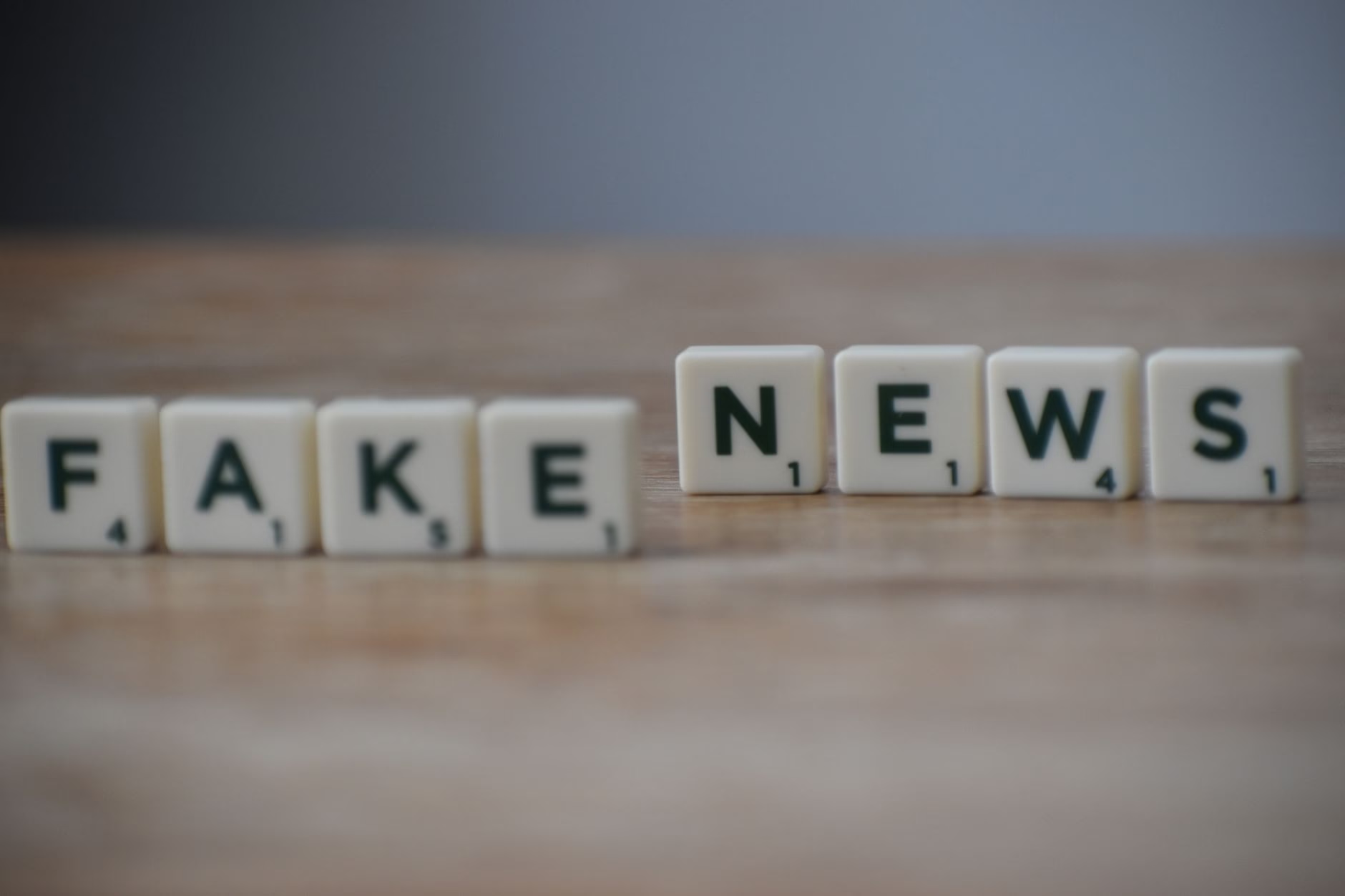
In the contemporary digital landscape, the rapid dissemination of information presents both unprecedented opportunities and significant challenges. Among these challenges is the pervasive issue of digital misinformation, where altered images and satirical content are frequently misconstrued as factual reports. A recurring pattern involves the modification of authentic visual evidence, such as photographs depicting genuine events, which are then circulated with misleading narratives. For instance, scenarios have emerged where an image originally capturing a legitimate incident, perhaps from several years prior, is digitally manipulated and subsequently shared to fabricate a new, often sensationalized, story. Such occurrences can involve various subjects, including public institutions or law enforcement agencies, leading to widespread confusion and erosion of public trust. This phenomenon underscores the critical need for heightened media literacy and a discerning approach to online content.
The Blurring Lines of Digital Content
The sheer volume and velocity of content shared across digital platforms have created an environment where the lines between factual reporting, opinion, satire, and outright fabrication are increasingly blurred. Social media, in particular, acts as a powerful amplifier, enabling content to reach vast audiences within moments. In this ecosystem, a single image or a cleverly worded satirical post can quickly escape its original context, morphing into a seemingly credible piece of news. This rapid transformation often occurs without the critical scrutiny that traditional media channels typically afford, leaving many users vulnerable to deception. The ease with which digital tools allow for image manipulation further complicates this landscape, making it challenging for the average user to distinguish between genuine and altered visuals.
Anatomy of an Online Hoax
Understanding the lifecycle of an online hoax is crucial for recognizing and mitigating its impact. Typically, such a hoax might begin with a genuine event, captured photographically, providing an authentic visual foundation. This image then becomes the raw material for manipulation. Digital editing software allows for subtle or overt alterations, changing elements within the photograph to fit a new, fabricated narrative. Concurrently, a satirical commentary or a fictional story might be crafted, often with an intent to provoke thought or humor. The critical juncture occurs when this altered image, paired with its new, misleading context or satirical caption, is shared on platforms where its original intent or authenticity is not immediately apparent. When users share this content without verifying its provenance or understanding its satirical nature, it rapidly propagates as a factual incident, often gaining traction through emotional appeal or confirmation bias.
The Challenge of Visual Verification
Visual content possesses an inherent power to convey information and evoke emotion far more effectively than text alone. An image can instantly communicate a narrative, making it a potent tool for both legitimate reporting and deceptive practices. However, this power also makes images particularly susceptible to misuse in the context of digital misinformation. Verifying the authenticity of an image in the digital age presents a significant challenge. Sophisticated editing techniques can produce highly convincing fakes that are difficult to detect without specialized tools or expert analysis. Furthermore, the sheer volume of images shared daily makes individual verification a daunting task for most users. Consequently, many individuals tend to accept visual information at face value, making them prime targets for hoaxes that leverage altered photographs to lend credibility to false stories.
Satire’s Double-Edged Sword
Satire, a venerable form of social and political commentary, relies on irony, exaggeration, and humor to critique contemporary issues. Its effectiveness lies in its ability to provoke thought and expose absurdities. However, in the fast-paced, context-stripped environment of online sharing, satire often becomes a double-edged sword. A satirical post, intended by its creator to be a clear parody, can be easily misinterpreted as a factual report by audiences unfamiliar with the original context, the creator’s intent, or the nuances of satirical expression. When a satirical image or caption is stripped of its humorous or critical framing and shared as a literal truth, its original purpose is lost, and it instead contributes directly to the spread of misinformation. This phenomenon highlights a growing challenge: ensuring that the critical function of satire is preserved without inadvertently fueling the very misinformation it often seeks to lampoon.
Real-World Implications
The proliferation of digital misinformation, particularly through altered images and miscontextualized satire, carries profound real-world implications. One of the most significant consequences is the erosion of public trust in credible news sources, institutions, and even governmental bodies. When fabricated stories, especially those involving law enforcement or public officials, gain traction, they can undermine the authority and legitimacy of these entities. Such hoaxes can incite public outrage, foster division, and even lead to tangible harm if individuals act upon false information. The constant exposure to manipulated content can also cultivate a general sense of cynicism, making it harder for individuals to distinguish truth from falsehood, even when presented with verified facts. This environment poses a serious threat to informed public discourse and democratic processes.
Strategies for Critical Engagement
Combating the tide of digital misinformation requires a collective effort, beginning with individual media literacy. Several strategies can help individuals critically engage with online content. Firstly, always question the source: Is it a reputable news organization, or an unknown social media account? Secondly, scrutinize images: Look for inconsistencies, unnatural lighting, or signs of digital manipulation. Reverse image searches can reveal if an image has been used before in a different context. Thirdly, read beyond the headline: Often, the full article provides necessary context or reveals the satirical nature of a piece. Fourthly, cross-reference information with multiple, trusted sources. If a story seems too sensational or emotionally charged, it warrants extra scrutiny. Finally, be wary of content that confirms existing biases, as this can make one more susceptible to believing false narratives.
Conclusion
The digital age, while connecting us globally, also demands an unprecedented level of vigilance and critical thinking. The ease with which altered images and satirical posts can transform into widespread digital misinformation poses a continuous threat to factual accuracy and public understanding. As content creators and consumers, we share a collective responsibility to foster an environment of truth and transparency. By adopting robust media literacy practices, questioning dubious content, and actively seeking verification, individuals can play a crucial role in stemming the flow of online hoaxes. Upholding the integrity of information is not merely an academic exercise; it is fundamental to maintaining an informed society and safeguarding democratic values in an increasingly complex digital world.






















Leave a Reply